
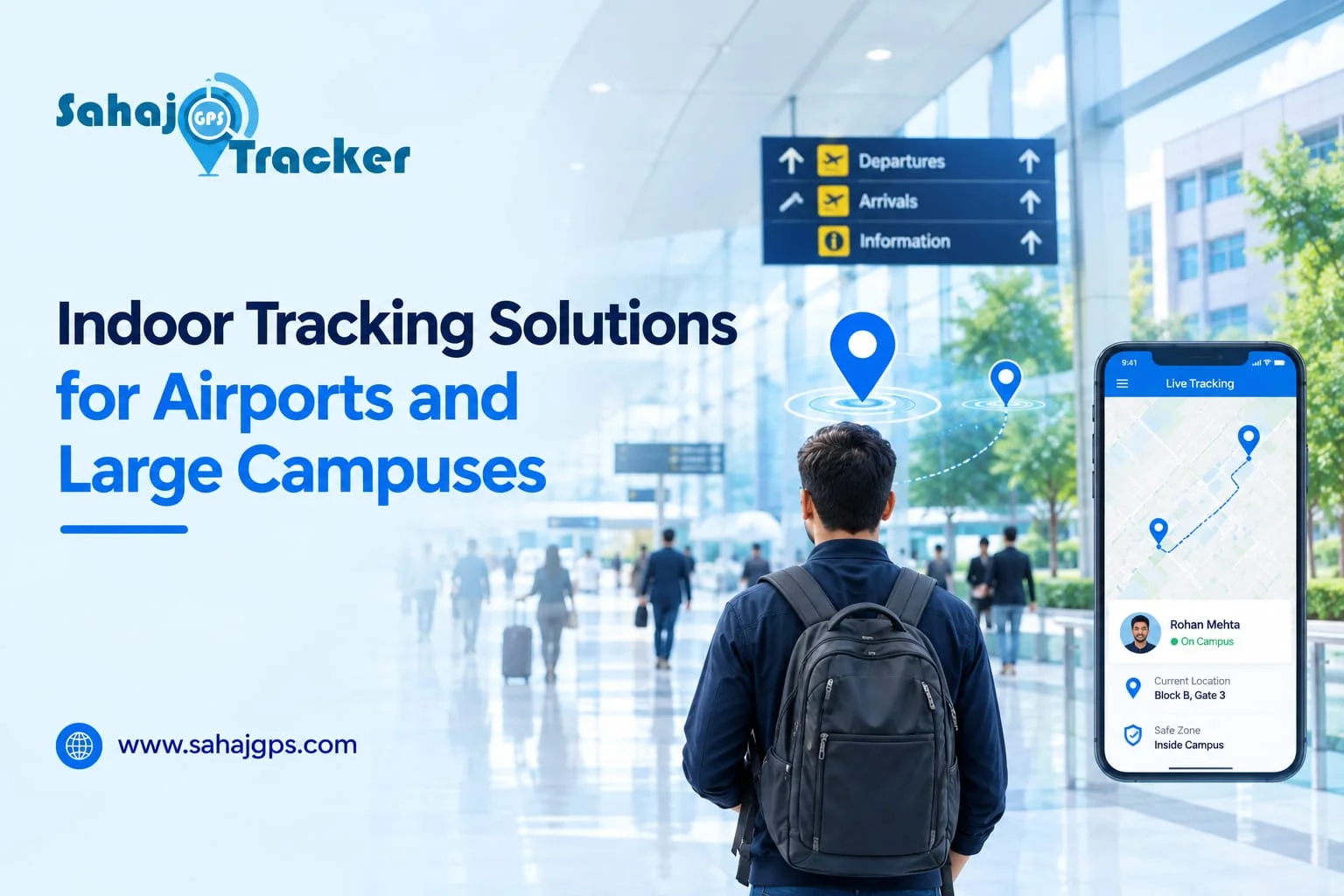
Large facilities are difficult to manage when people, equipment, vehicles, and valuable assets are constantly moving between different areas. Airports, hospitals, universities, manufacturing campuses, warehouses, and other large facilities can cover hundreds of thousands of square metres, making traditional monitoring methods difficult to scale.
This is where indoor tracking technology can provide better visibility. Unlike conventional outdoor GPS tracking, indoor systems are designed to help organisations understand the location and movement of assets or people inside buildings and enclosed spaces.
Modern airport asset tracking, campus indoor tracking, and other large-facility applications can use location data to improve operational coordination, asset utilisation, safety, and response times.
What Is Indoor Tracking?
Indoor tracking refers to technologies that determine the approximate location of an asset, person, or equipment inside a building or defined indoor environment. Since satellite signals may not work reliably inside large buildings, indoor systems use technologies such as Bluetooth Low Energy, Wi-Fi, ultra-wideband, RFID, sensors, or other positioning methods depending on the application.
The collected location information can be displayed through software, allowing authorised teams to understand where tracked resources are located.
Why Indoor Location Visibility Matters
In a small office, finding equipment may not be difficult. In a large airport or multi-building campus, however, a single asset could be several floors or hundreds of metres away from the person searching for it.
Indoor tracking can reduce this uncertainty by providing location information through a central interface. This can save time and help operational teams coordinate activities more efficiently.
Airport Asset Tracking for Better Operations
Airports contain a complex combination of assets, equipment, vehicles, service areas, terminals, baggage facilities, maintenance zones, and restricted spaces. Many assets need to move between different locations throughout the day.
Airport asset tracking can help authorised teams monitor the location and movement of selected equipment and resources.
Tracking Ground Support Equipment
Ground support equipment can include service vehicles, baggage-handling equipment, maintenance tools, carts, and other operational assets. When equipment is distributed across a large airport, locating a particular item manually can consume valuable time.
An indoor tracking system can provide location visibility and help teams understand whether equipment is available, in use, or positioned in another area.
Reducing Time Spent Searching for Assets
Operational delays can occur when employees spend too much time looking for equipment. A location-based system can provide a more structured way to identify the last known or current location of a tracked asset.
This can improve asset availability and help teams make better use of equipment already present within the facility.
Campus Indoor Tracking for Large Facilities
Universities, technology campuses, hospitals, research centres, and corporate facilities may contain multiple buildings, floors, corridors, laboratories, storage rooms, and service areas.
Campus indoor tracking can help organisations maintain better visibility across these environments.
Managing Shared Equipment
Large campuses often have equipment that is shared between departments or locations. Without a proper tracking system, teams may rely on spreadsheets, phone calls, or manual records to locate equipment.
Indoor tracking can provide a more dynamic view of where selected assets are located. This can help teams identify underused equipment and reduce unnecessary purchases when existing resources are simply difficult to locate.
Indoor Positioning Tracking Explained
Indoor positioning tracking determines the location of a device, tag, person, or asset within a defined indoor area. The exact accuracy depends on the technology, infrastructure, building layout, and system configuration.
Different environments may require different positioning technologies. For example, an application that only needs room-level location may have different requirements from one that needs highly precise positioning within a few metres.
Choosing the Right Positioning Technology
The right technology depends on the use case. Factors such as required accuracy, facility size, infrastructure, signal conditions, number of assets, battery requirements, and budget should be considered before implementation.
A successful indoor tracking project should begin with the operational problem rather than simply selecting a technology first.
Real-Time Location System for Large Facilities
A Real Time Location System (RTLS) provides location information about tracked assets or resources as they move through a facility.
For large organisations, this can create a centralised view of asset movement and help teams respond more quickly to operational requirements.
How RTLS Can Improve Visibility
Suppose a maintenance team needs a particular piece of equipment urgently. Instead of contacting multiple departments, authorised staff can use the tracking platform to identify where the asset is located.
Similarly, facility managers can review movement patterns and understand how frequently certain resources are being used. This information can support more efficient resource allocation and operational planning.
Indoor Tracking Software and Centralised Monitoring
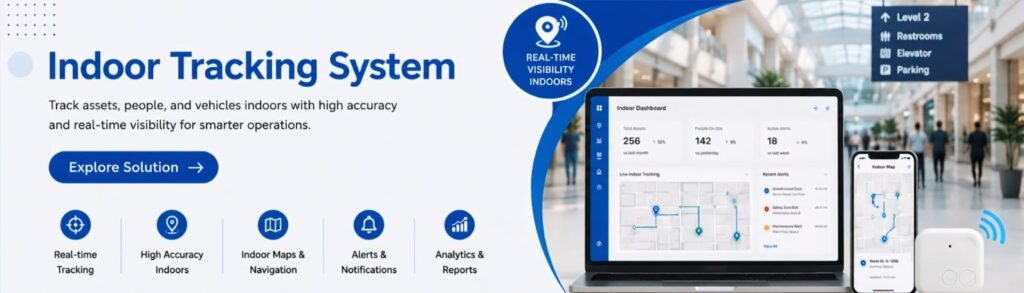
Hardware alone does not provide much value unless the location information can be interpreted and used effectively. Indoor tracking software acts as the interface through which authorised users can view location information, monitor assets, configure alerts, and analyse movement data.
A well-designed software platform should make complex location information easy to understand.
Maps, Alerts and Historical Data
Depending on the system, indoor tracking software may provide digital maps, location dashboards, movement history, geofenced zones, and configurable alerts.
Historical location data can also be useful. It can help organisations understand how assets move through a facility and identify operational patterns that may not be obvious from manual observation.
Large Facility Tracking Beyond Airports
The applications of large facility tracking extend well beyond airports. Any organisation managing a large physical environment with valuable or frequently moving resources can potentially benefit from indoor location technology.
Manufacturing plants can use tracking to improve equipment visibility. Hospitals can monitor selected medical assets. Universities can manage shared equipment across departments. Warehouses can improve visibility of mobile resources.
The exact implementation should depend on the facility’s workflow and the type of assets being monitored.
Improving Safety and Operational Response
Location information can also support safety and emergency response processes. In large facilities, knowing where certain resources are located can help authorised teams coordinate their response more efficiently.
For example, maintenance teams may need to locate equipment quickly, while facility managers may need to know whether assets have moved into restricted areas.
Indoor tracking should not be treated as a replacement for established safety procedures. Instead, it can provide additional location intelligence that supports existing operational processes.
How Sahaj GPS Can Support Indoor Tracking Requirements
Sahaj GPS provides tracking solutions designed around different operational requirements. For organisations considering indoor location technology, the focus should be on understanding the facility layout, assets being tracked, required accuracy, monitoring workflow, and expected outcomes before selecting the appropriate solution.
A structured implementation can help businesses avoid unnecessary complexity and ensure that location data supports real operational decisions.
Planning an Indoor Tracking System
Before implementing an indoor tracking solution, organisations should clearly define what they want to track and why. Tracking every possible asset may not always be necessary.
Start by identifying high-value equipment, frequently moved resources, critical operational assets, or areas where locating resources currently takes significant time.
From Tracking Data to Better Decisions
Once an indoor tracking system is operational, the collected information can become useful beyond simple location monitoring. Historical data can reveal movement patterns, asset utilisation, bottlenecks, and areas where operational processes could be improved.
This makes indoor tracking more than a technology project. It becomes a way of creating better visibility across complex physical environments.
Conclusion
Airports and large campuses require a high level of coordination because thousands of assets, resources, and operational activities can exist within the same physical environment. Traditional methods may not always provide the visibility required to manage these environments efficiently.
Airport asset tracking, campus indoor tracking, indoor positioning tracking, and real time location system technology can provide organisations with a clearer understanding of where important resources are located and how they move.
With suitable indoor tracking software, businesses can turn location information into practical operational insights. Sahaj GPS can help organisations explore tracking requirements based on their facility, assets, and operational objectives.
FAQs
What is airport asset tracking?
Airport asset tracking is the use of location technology to monitor selected equipment, vehicles, tools, or other operational assets within airport environments. It can help authorised teams locate resources and improve asset utilisation.
How does campus indoor tracking work?
Campus indoor tracking uses technologies such as Bluetooth, Wi-Fi, RFID, ultra-wideband, or other positioning methods to determine the location of tagged assets or devices within buildings and defined areas.
What is a Real Time Location System?
A Real Time Location System, or RTLS, is a technology solution designed to provide location information about tracked assets, equipment, or resources as they move within a defined environment.
What is indoor tracking software used for?
Indoor tracking software can provide location dashboards, digital maps, alerts, movement history, and asset information. It helps authorised users interpret and manage location data from a central platform.
Can indoor tracking be used outside airports?
Yes. Large facility tracking can be useful in hospitals, universities, warehouses, manufacturing facilities, corporate campuses, research centres, and other large environments where locating mobile assets is important.