
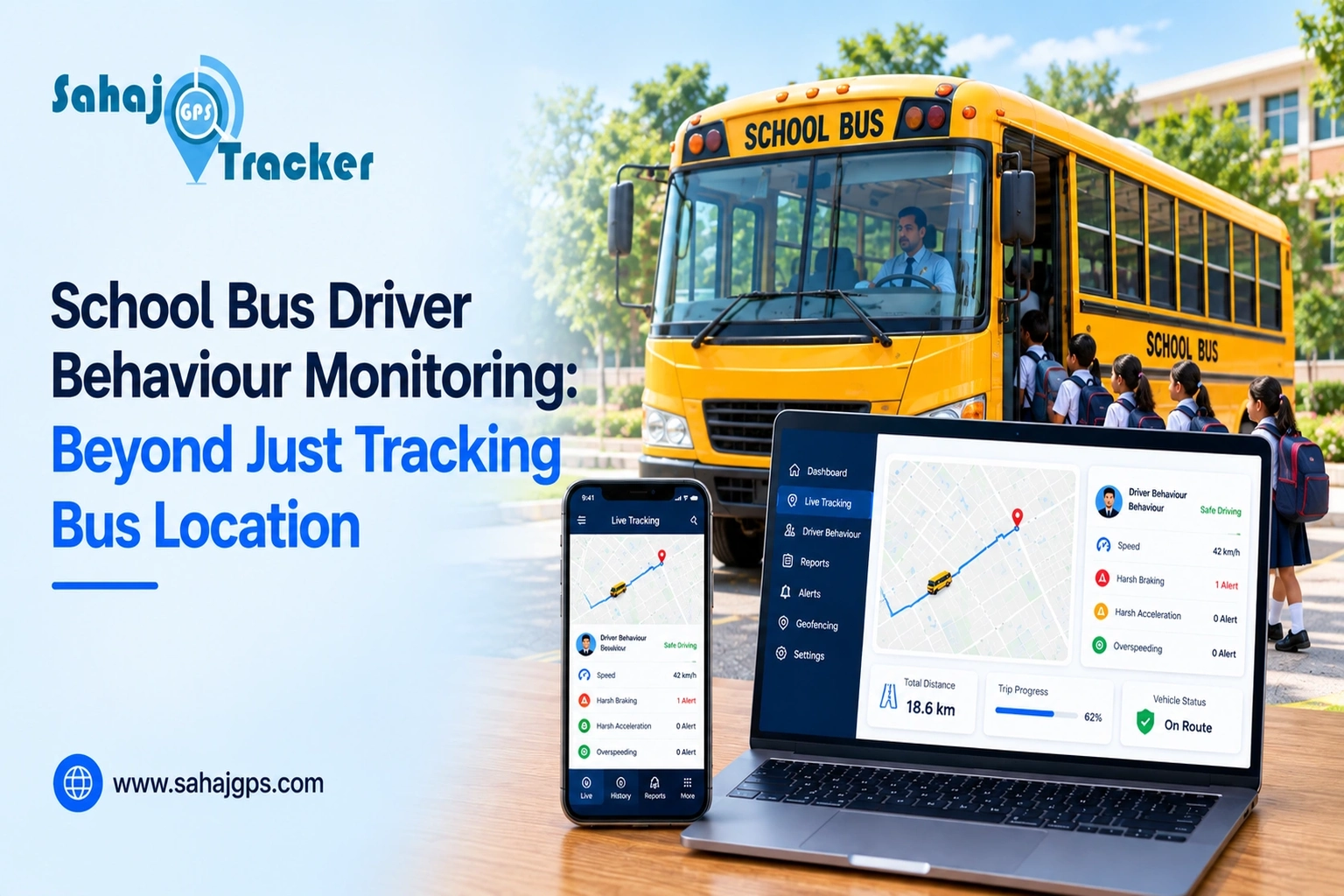
When schools invest in technology for student transportation, the first priority is usually knowing where every bus is at a given moment. While location tracking is important, modern school transportation requires much more than simply watching a vehicle move across a map.
The way a school bus is driven directly affects student safety, punctuality, vehicle condition, and the overall reliability of transportation services. This is where driver behaviour monitoring becomes an important part of a complete transportation management strategy. A school bus tracking system can provide real-time information about the location of buses, but its real value increases when tracking is combined with driver behaviour insights.
With the right technology, schools can understand driving patterns, identify risky behaviour, improve accountability, and create a safer transportation environment for students. Sahaj GPS provides technology that helps schools move beyond basic vehicle tracking and focus on the complete picture of school bus safety.
Why Driver Behaviour Matters in School Transportation
Driving a school bus is a responsibility that goes far beyond reaching a destination on time. Drivers operate large vehicles while carrying students, often through busy roads, intersections, residential areas, and changing traffic conditions.
Sudden braking, rapid acceleration, speeding, harsh cornering, unnecessary idling, or other unsafe driving patterns can increase risks for passengers and put additional stress on the vehicle. Traditional transportation management often depends on manual observation or complaints to identify such behaviour.
This approach can leave schools with limited information about what happens during a journey. A technology-enabled approach creates a more consistent way to understand driving patterns and address concerns before they become serious problems.
Driver behaviour monitoring gives school administrators useful information that can support better training and supervision. Instead of relying entirely on assumptions, schools can use transportation data to identify areas where drivers may need additional guidance.
From Location Tracking to Complete Bus Monitoring
A School Bus Tracking System primarily answers one important question: where is the bus? However, schools increasingly need answers to additional questions. Is the bus being driven responsibly? Is the driver following expected routes and schedules? Are there repeated instances of sudden braking or speeding? Is the vehicle spending unnecessary time idling? Is the bus reaching designated stops within the expected timeframe?
This broader approach makes school transportation management more proactive. A School Bus GPS Tracking System can provide location information while additional monitoring capabilities can help administrators understand how the vehicle is being operated.
The objective is not simply to monitor drivers for the sake of surveillance. Instead, the information can be used to establish safer driving standards, provide constructive feedback, and improve transportation operations.
Using Data to Identify Driving Patterns
One of the biggest advantages of technology-based monitoring is the ability to identify patterns over time. A single instance of hard braking may not indicate a serious problem because traffic conditions can change unexpectedly. However, repeated incidents across multiple journeys may indicate that a driver needs additional training or that a particular route presents recurring challenges.
This distinction is important. Schools can use collected data to look at overall behaviour rather than reacting to isolated events. Over time, transportation administrators can identify improvements, compare driving patterns across routes, and create more consistent safety practices.
How School Bus Monitoring Solutions Improve Accountability
School Bus monitoring Solutions can create greater visibility into transportation operations. When drivers know that driving patterns are being monitored through a structured system, there is an additional layer of accountability. This can encourage adherence to speed limits, safer acceleration and braking, and more responsible vehicle handling.
Accountability also benefits drivers. Monitoring data can help distinguish between genuine driving concerns and situations caused by external circumstances. If a driver receives a complaint about a particular incident, available transportation data can provide additional context.
This creates a more balanced management process. Schools can use objective information when discussing performance instead of depending only on verbal reports or assumptions.
Supporting Driver Training and Safety Improvements
The purpose of monitoring should ultimately be improvement. If data shows that a driver frequently brakes harshly, the school can provide specific training related to speed management, following distance, and anticipation of traffic conditions. If speeding occurs repeatedly on certain sections of a route, administrators can review the circumstances and reinforce appropriate driving practices.
A School Bus Fleet Management System can help bring these transportation insights together, making it easier for schools to manage multiple buses and drivers. Rather than treating every vehicle as a separate operation, administrators can develop a broader view of fleet performance.
This approach can also support regular driver reviews. Schools can establish internal safety standards and use transportation data as one part of performance discussions. The result is a continuous improvement cycle where monitoring leads to feedback, feedback leads to training, and training contributes to safer driving.
Improving Student Safety Through Smarter Transportation Management
Student safety should remain at the center of every school transportation decision. Real-time bus visibility can help administrators respond when a bus is delayed or deviates from an expected route, while driver behaviour information adds another layer of operational awareness.
For parents and school administrators, knowing that transportation is being actively managed can provide greater confidence. For drivers, clear expectations and constructive feedback can make safety standards easier to understand and follow.
Sahaj GPS helps bring these capabilities into a more connected transportation environment. By combining tracking and monitoring, schools can move toward transportation management that focuses not only on where buses are, but also on how they are being operated.
The Role of Technology in Modern School Transportation
Technology is changing how schools approach transportation. Earlier systems were largely focused on basic vehicle location, while modern solutions can provide a broader understanding of fleet operations and driver activity.
A school bus GPS tracking system can serve as the foundation for visibility, while a School Bus fleet management system can support broader operational management. Together, these capabilities can help schools make better-informed decisions about routes, vehicles, schedules, and driver performance.
The real benefit comes from using information intelligently. Data should not simply be collected and forgotten. It should help administrators recognize problems, improve processes, and establish safer standards throughout the transportation network.
Building a Culture of Safer Driving
The strongest school transportation programs do not depend entirely on technology. They combine responsible drivers, clear safety policies, regular training, effective supervision, and reliable monitoring tools.
When these elements work together, driver monitoring becomes more than a technical feature. It becomes part of a larger safety culture. Drivers understand that responsible behaviour matters, administrators have better visibility, and schools can continuously improve their transportation practices.
Sahaj GPS supports this shift by helping schools look beyond simple bus location tracking. The focus can move toward safer journeys, stronger accountability, and more informed fleet management.
Conclusion
Tracking a school bus location is essential, but it represents only one part of transportation safety. Driver behaviour can have a direct impact on student comfort, vehicle safety, operational efficiency, and the reliability of school transportation services.
With a School Bus Tracking System supported by driver behaviour monitoring, schools can gain a more complete understanding of their transportation operations. School bus monitoring software can further help administrators analyze driver activity, identify repeated risky driving patterns, and support targeted driver training.
With features such as geofencing, schools can also monitor whether buses enter or leave designated areas, helping improve route compliance and transportation visibility. Sahaj GPS can help bring these capabilities together for more effective school bus management.
The future of school transportation is not simply about knowing where a bus is. It is about understanding what happens throughout the journey and using that information to create safer, more accountable, and better-managed transportation systems.
Frequently Asked Questions
What is school bus driver behaviour monitoring?
School bus driver behaviour monitoring uses technology to observe and analyze driving patterns during bus journeys. Depending on the system, schools may be able to identify behaviours such as speeding, harsh braking, rapid acceleration, or other driving events that require attention.
How is a School Bus Tracking System different from driver behaviour monitoring?
A School Bus Tracking System primarily provides information about the vehicle’s location and movement. Driver behaviour monitoring focuses on how the vehicle is being driven. When both capabilities are used together, schools can gain a more complete view of transportation safety and operations.
Can driver monitoring help improve student safety?
Yes. Monitoring can help schools identify recurring unsafe driving patterns and use that information to provide targeted training and feedback. It can also improve accountability and help transportation administrators establish more consistent driving standards.
Why is a School Bus GPS Tracking System useful for schools?
A School Bus GPS Tracking System provides real-time visibility into bus movements, helping administrators understand where vehicles are and identify route or schedule issues. When combined with broader monitoring capabilities, it can become part of a comprehensive transportation management strategy.
What is the benefit of using a School Bus Fleet Management System?
A School Bus Fleet Management System can help schools manage multiple vehicles and transportation activities from a centralized system. It can improve operational visibility, support better decision-making, and provide useful information for managing routes, vehicles, schedules, and driver performance.