
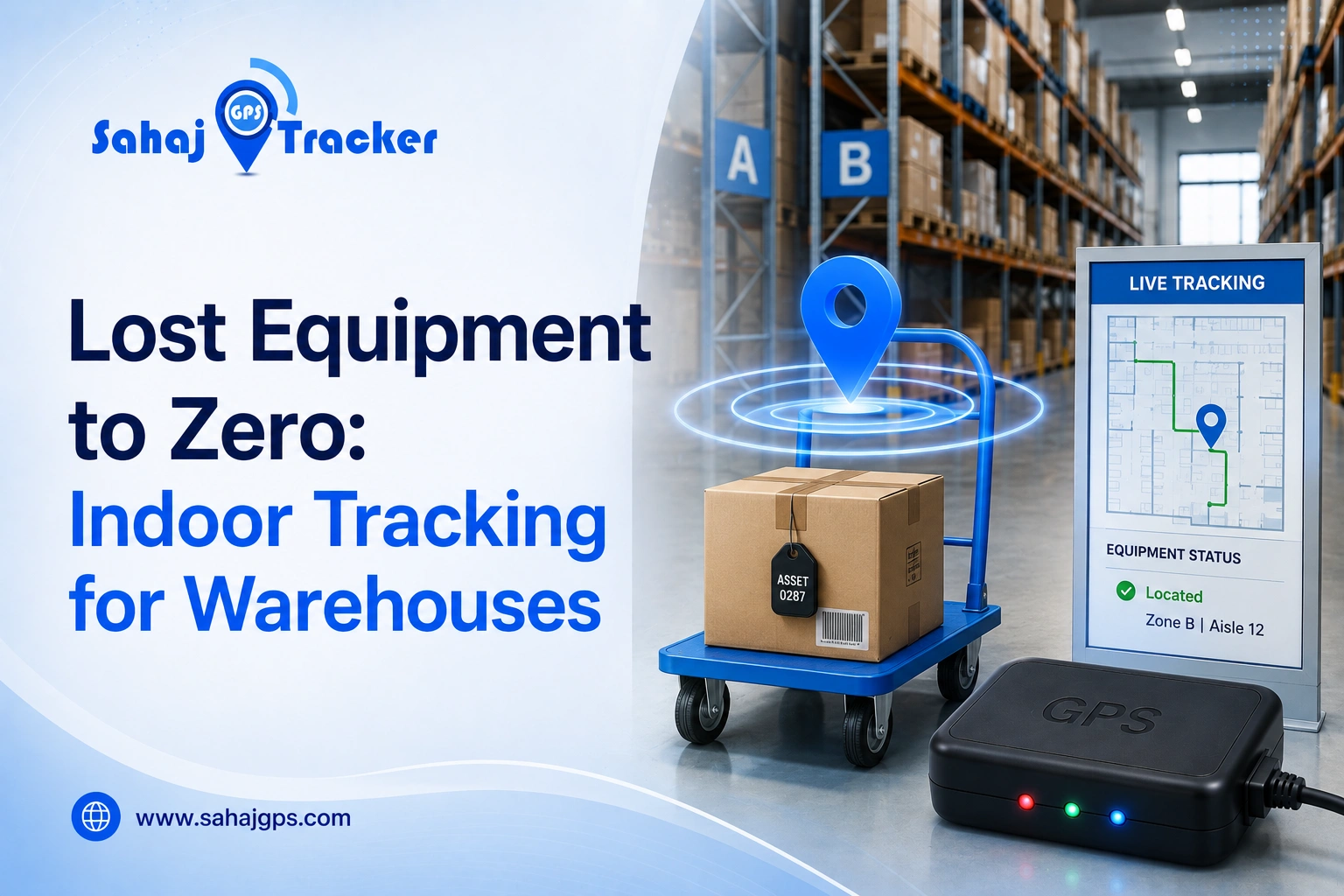
Warehouses are fast-moving environments where equipment, tools, scanners, forklifts, pallets, and other assets are constantly moved from one area to another. As the size of a warehouse increases, keeping track of every asset manually becomes increasingly difficult.
Equipment may be left in the wrong aisle, moved to another department, or temporarily used by a different team without its location being recorded. These situations can result in wasted time, operational delays, unnecessary replacement costs, and reduced productivity.
Modern warehouses need better visibility into the location and movement of their assets. Instead of depending entirely on manual registers or verbal communication, businesses can use indoor tracking technology to monitor equipment within the facility. indoor tracking solutions make it possible to understand where an asset is located, when it moved, and whether it has entered an unauthorized area.
With the right system, businesses can significantly reduce the chances of equipment becoming misplaced and create a more organized warehouse environment.
Why Lost Equipment Is a Warehouse Problem
Equipment that cannot be located quickly can affect several parts of warehouse operations. When an employee needs a scanner, trolley, tool, or other equipment and cannot find it, time is spent searching instead of completing the assigned task. In larger facilities, employees may need to contact multiple departments or physically check several storage areas before locating the required asset.
Why GPS Is Not Enough for Indoor Warehouses
GPS is highly useful for tracking vehicles and assets in outdoor environments, but it is not designed to provide precise positioning inside large buildings. Warehouse roofs, walls, metal racks, machinery, and other structures can weaken or interfere with satellite signals. This is why warehouses require technologies specifically designed for indoor environments.
Indoor positioning tracking uses signals from technologies such as Bluetooth Low Energy, Ultra-Wideband, RFID, or Wi-Fi to determine the location of an asset inside a facility. The level of accuracy depends on the technology being used and the infrastructure installed in the warehouse. Some systems can identify the general zone where an asset is located, while advanced solutions can provide much more precise positioning.
What Is Indoor Tracking Software?
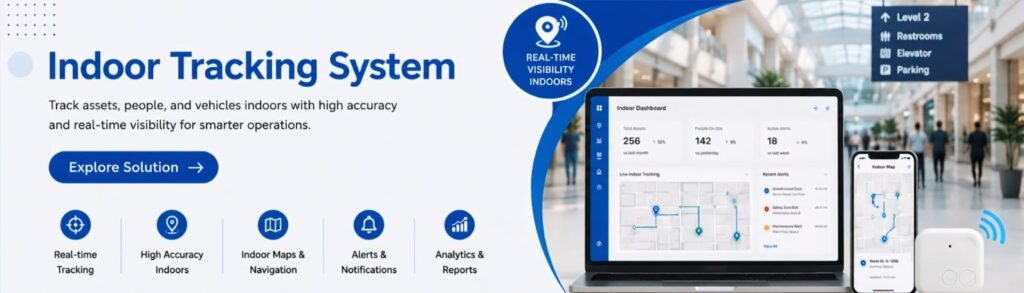
Indoor tracking software is a digital platform that collects location information from tags, sensors, gateways, and other tracking infrastructure and presents that information through a centralized interface. Instead of depending on manual records, warehouse managers can use the software to monitor assets and understand their movement within the facility.
An indoor tracking software system can provide information about the current location of equipment as well as its previous movement history. This allows managers to understand where assets are being used, identify frequently moved equipment, and recognize unusual movement patterns.
Technologies Used for Indoor Tracking
Different indoor tracking technologies offer different levels of accuracy, range, cost, and power consumption. The most suitable option depends on the type of warehouse, the assets being tracked, and the level of location precision required.
Bluetooth Low Energy Tracking
Bluetooth Low Energy is commonly used for indoor asset tracking because BLE tags can be compact and energy efficient. Tags attached to equipment communicate with receivers or gateways positioned throughout the warehouse. BLE can be useful when a business needs zone-level or room-level visibility without requiring extremely precise positioning.
It can work well for assets such as carts, pallets, containers, handheld devices, and general warehouse equipment. Because BLE tags can consume relatively little power, they can also be suitable for long-term asset tracking applications.
Ultra-Wideband Tracking
Ultra-Wideband technology is designed for applications where highly precise positioning is important. Compared with basic zone-level tracking, UWB can provide much more accurate information about an asset’s location.
This makes it particularly useful for high-value equipment, specialized tools, automated equipment, and other assets where knowing the exact position can improve safety and operational efficiency.
RFID-Based Tracking
RFID can also support warehouse asset management. Passive RFID can be useful for identification and scanning at specific locations such as warehouse entrances, exits, storage points, or loading areas. Active RFID can provide broader tracking capabilities by continuously transmitting signals.
The right RFID approach depends on whether the warehouse primarily needs identification at specific checkpoints or continuous visibility of moving assets.
Wi-Fi-Based Tracking
Wi-Fi-based tracking can use existing wireless infrastructure to estimate the location of connected devices or tracking tags. This can be useful for warehouses that already have extensive Wi-Fi coverage. However, factors such as battery consumption, network infrastructure, and required accuracy should be considered when selecting this approach.
How Indoor Location Tracking Works
Indoor location tracking generally involves three main elements: a tracking tag attached to an asset, receivers or gateways installed around the facility, and software that processes the collected information. Sahaj GPS helps businesses leverage location-based tracking technology to improve visibility and manage assets more efficiently within indoor environments.
When a tagged asset moves through the warehouse, nearby receivers detect the signal from the tag. The system processes this information to estimate the asset’s location. Depending on the technology, the location can be displayed as a warehouse zone, aisle, room, or more precise position.
For example, a warehouse can be divided into receiving, storage, picking, packing, and dispatch areas. When an asset moves from one area to another, its location information can be updated through the tracking platform, giving warehouse teams better visibility and control over equipment movement.
Using Geofencing to Prevent Equipment Loss
geofencing is another important capability that can improve warehouse asset control. Sahaj GPS can help businesses use location-based tracking to create virtual boundaries around specific areas, such as restricted storage rooms, maintenance zones, or loading areas.
When a tracked asset enters or leaves a defined boundary, the system can generate an alert. This can be especially useful for expensive or critical equipment that should not be moved outside a particular operational area.
For example, if a high-value device is moved toward an unauthorized exit, the system can notify the responsible team. Early notification allows the business to investigate the movement before the asset becomes difficult to locate, helping improve warehouse security and asset visibility.
Integrating Indoor Tracking With Warehouse Operations
Location information becomes more useful when it is connected with existing warehouse processes. Businesses can combine tracking information with their warehouse management workflows to gain a clearer understanding of both asset availability and asset location.
When equipment location is visible alongside operational information, managers can make better decisions about equipment allocation and utilization. They can identify assets that remain unused for long periods, understand where equipment is frequently required, and determine whether certain areas need additional resources.
Sahaj GPS focuses on location-based tracking solutions that can help businesses improve visibility over their assets and operational environments. By bringing location information into a centralized system, warehouse teams can reduce dependence on manual searches and improve day-to-day asset management.
Best Practices for Reducing Lost Equipment
Technology is most effective when it is supported by consistent warehouse procedures. Businesses should first determine which assets need to be tracked and decide the level of location accuracy required for each category. General warehouse equipment may only require zone-level tracking, while high-value or critical equipment may require more precise positioning.
Warehouse zones should also be clearly defined so that asset movement can be understood more easily. When an asset moves between receiving, storage, picking, and dispatch areas, the tracking system can provide a clearer record of its movement.
Benefits of Indoor Tracking for Warehouses
Indoor Tracking Solutions can provide significant operational advantages for businesses managing large numbers of movable assets. The most immediate benefit is improved visibility. Employees can spend less time searching for equipment because location information can be accessed digitally.
Better visibility can also improve asset utilization. Managers can identify equipment that is underused, frequently moved, or regularly unavailable. This information can support better allocation decisions and reduce unnecessary purchases.
Indoor tracking can also improve security by identifying unexpected movement. When combined with geofencing and automated alerts, the system can help warehouse teams respond quickly to unusual asset activity.
Moving From Lost Equipment to Better Warehouse Visibility
The goal of indoor tracking is not simply to find an asset after it has been misplaced. A well-designed system can provide continuous visibility that helps businesses understand how equipment moves throughout the warehouse and how efficiently it is being used.
As warehouses become larger and operations become more complex, manual asset tracking becomes increasingly difficult to maintain. Indoor positioning tracking provides a technology-driven approach that can bring real-time location intelligence into enclosed environments where conventional GPS cannot deliver the required accuracy. For more on indoor positioning, read our guide on BLE, Wi-Fi & GPS.
Frequently Asked Questions
What is indoor tracking in a warehouse?
Indoor tracking is a technology-based method of monitoring the location and movement of assets inside a building. It uses technologies such as BLE, UWB, RFID, or Wi-Fi to provide location information within an indoor environment where traditional GPS may not provide sufficient accuracy.
Why is GPS not suitable for precise warehouse tracking?
GPS relies on satellite signals, which can become weak or unreliable inside buildings. Warehouse roofs, walls, metal structures, and other obstacles can affect signal availability and accuracy. Indoor tracking technologies are specifically designed to work within enclosed environments.
What types of warehouse equipment can be tracked?
A wide range of assets can be tracked, including forklifts, scanners, carts, pallets, containers, tools, handheld devices, and specialized equipment. The appropriate tracking technology depends on the asset’s value, movement pattern, and required location accuracy.
How can indoor tracking help prevent equipment from being lost?
Indoor tracking provides visibility into the location and movement of assets. Businesses can also use geofences and alerts to identify unexpected movement. This allows warehouse teams to respond earlier instead of discovering that equipment is missing after a long period.
How should a warehouse choose an indoor tracking solution?
The right solution depends on warehouse size, asset types, required accuracy, infrastructure, tracking frequency, and budget. BLE can be suitable for general zone-level visibility, while UWB may be more appropriate when highly precise positioning is required. A warehouse assessment can help determine the most suitable technology and implementation approach.