
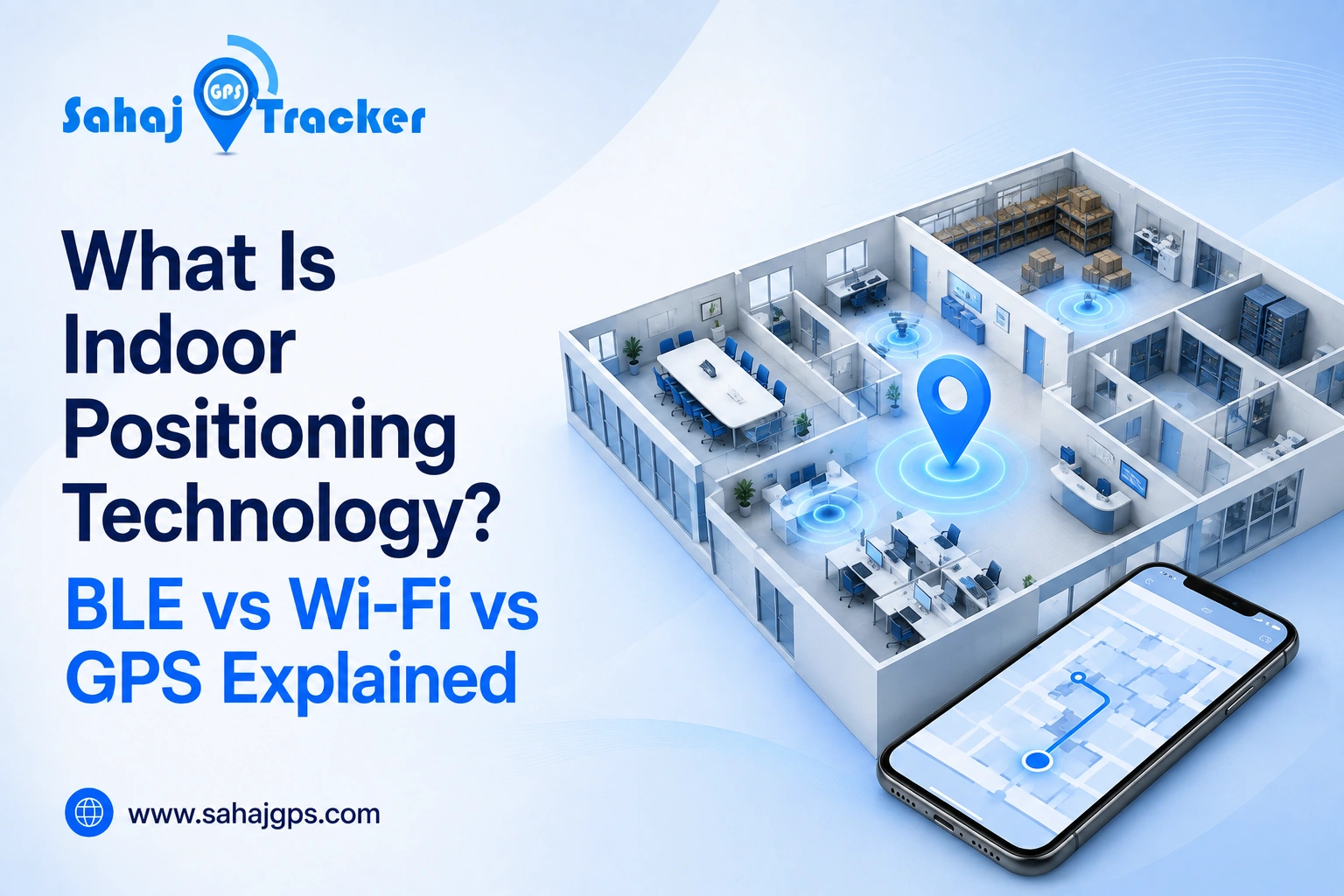
Finding a person or asset outdoors is usually straightforward with GPS. Indoors, things get a little more complicated. Thick walls, floors, machinery, and weak satellite signals can make traditional tracking unreliable. This is where Indoor positioning technology becomes useful. It supports indoor location tracking by using technologies such as Bluetooth Low Energy (BLE), Wi-Fi, and, in some cases, GPS to estimate where a person, device, or asset is located inside a building.
Hospitals, warehouses, factories, offices, airports, and large commercial facilities are already dealing with this problem in practical ways. Where is that medical trolley? Which room is the technician in? Did that equipment actually reach the storage area? These sound like small questions until staff spend ten minutes searching for something that should have taken thirty seconds to find.
What Is Indoor Positioning Technology?
Indoor Positioning Technology refers to systems that determine the approximate location of people, equipment, vehicles, or other tracked objects inside buildings or enclosed areas. Instead of relying only on satellites, indoor systems can use nearby wireless signals, sensors, beacons, access points, and other positioning methods.
The exact accuracy depends on the technology, building layout, hardware placement, and environmental conditions. There isn’t one technology that is automatically best for every building.
For example, a warehouse may prioritise coverage and asset visibility, while a hospital may need room-level tracking for mobile equipment. An office might care more about employee movement and workspace utilisation. That’s why choosing the right positioning method starts with understanding the environment.
Why GPS Is Not Always Enough Indoors
GPS works extremely well in many outdoor environments because devices communicate with satellites. Once you move inside a large concrete building, underground facility, or enclosed structure, things change.
Walls, ceilings, metal structures, and other obstacles can weaken satellite signals. A device may show a general location, but it may not provide the room-level accuracy a business actually needs.
GPS Indoor tracking can still have a role in solutions that combine indoor and outdoor positioning, particularly when an asset moves between a building and outdoor areas. But for detailed indoor positioning, other technologies are often more practical. This is where BLE and Wi-Fi become interesting.
BLE Indoor Positioning: Small Beacons, Practical Tracking
Bluetooth Low Energy, usually called BLE, is widely used for indoor positioning because BLE devices can operate with relatively low power consumption. A typical BLE setup may use small beacon devices installed at known locations.
A tracked tag or compatible device detects nearby signals, and the positioning software estimates where it is based on those signals. For indoor location tracking, BLE can be useful in hospitals, warehouses, offices, and manufacturing facilities where businesses want to locate mobile assets or people.
Where BLE Works Well
BLE can be particularly useful for asset tracking software because small tags can be attached to equipment without adding much physical weight or complexity.
Imagine a hospital with hundreds of wheelchairs, infusion pumps, medical carts, and other mobile equipment. Staff don’t necessarily need to know the exact centimetre-level position of every item. They need to know which area it is in and find it quickly. That is where BLE-based tracking can be quite practical.
Wi-Fi Indoor Positioning: Using Existing Infrastructure
Wi-Fi positioning uses wireless networks and access points to estimate the location of a connected device. Since many businesses already have Wi-Fi infrastructure, this approach can sometimes be convenient.
A Wi-Fi-based system can estimate a device’s location by analysing signals from nearby access points. Accuracy varies depending on access point placement, building structure, device capabilities, and the positioning method being used.
For organisations that already have strong Wi-Fi coverage, this can reduce the need to install a completely separate positioning infrastructure.
When Wi-Fi Tracking Makes Sense
Wi-Fi positioning can work well in offices, hospitals, campuses, warehouses, and other facilities where Wi-Fi networks are already widely deployed.
However, relying on Wi-Fi doesn’t automatically mean highly precise positioning. The actual accuracy depends heavily on the environment and system configuration.So, “Wi-Fi is already installed” shouldn’t be the only reason to choose it.
BLE vs Wi-Fi vs GPS: What Is the Difference?
The easiest way to understand these technologies is to look at what each one is designed to do.
BLE is often a practical option for close-range indoor positioning and asset tracking. Wi-Fi can use existing network infrastructure and may be useful for tracking connected devices across larger indoor areas. GPS is generally stronger outdoors and can complement indoor technologies when assets move between indoor and outdoor locations.
There are also hybrid solutions that combine multiple positioning technologies. These can be useful when a business wants continuous visibility as an asset moves from a warehouse to an outdoor yard, for example.The “best” option depends on the building, required accuracy, number of tracked assets, battery requirements, and budget.
How Indoor Tracking Software Makes the Data Useful
Tracking hardware alone doesn’t solve much. The information needs to be presented in a way that people can actually use.
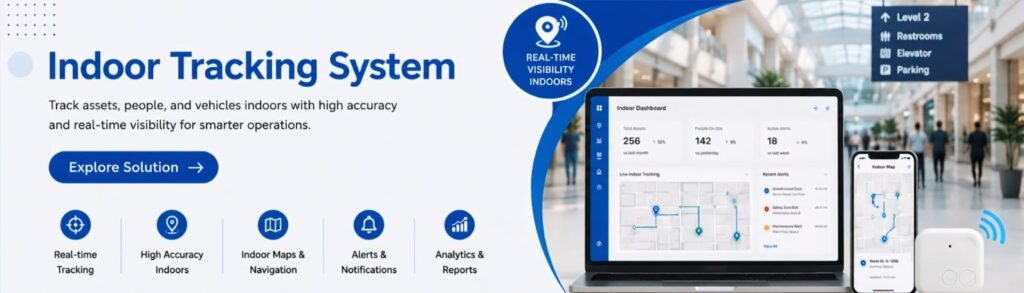
Indoor tracking software receives positioning information and turns it into a visual interface. Depending on the platform, users may see floor plans, asset locations, zones, movement history, alerts, and other information.A good system should answer practical questions quickly.
Where is the asset now? Where was it earlier? Has it entered the correct zone? Has it remained stationary for too long?The point is to reduce searching and manual checking, not create another complicated dashboard.
Indoor Asset Tracking for Hospitals and Warehouses
One of the strongest applications for indoor positioning is asset tracking. Hospitals have expensive equipment moving between wards, treatment rooms, storage areas, and service departments. Warehouses have tools, pallets, machines, and other assets spread across large spaces.Asset tracking software can help businesses maintain better visibility of these items.
In a warehouse, a manager may be able to identify whether equipment is sitting in the wrong zone. In a hospital, staff can search for available equipment digitally rather than walking around multiple floors.That time saving can be surprisingly valuable.
Can Real-Time GPS Tracking Work With Indoor Positioning?
Yes, but it depends on how the complete system is designed.Real-time GPS tracking is generally most effective outdoors. Indoor positioning technologies such as BLE or Wi-Fi can complement GPS when an asset moves inside a building.
For example, a company vehicle may be tracked through GPS while travelling between sites. Once equipment is moved into a warehouse, an indoor positioning layer can provide more detailed information about its location.
This combination can create a more continuous tracking experience. Sahaj GPS provides tracking solutions that can help businesses manage location visibility across different operational environments, depending on the tracking technology and deployment requirements.
What About the Best GPS Tracker?
People often search for the best GPS tracker, but the question needs a little more context.A tracker designed for outdoor vehicles may not be suitable for room-level indoor positioning. Similarly, a small BLE tag designed for indoor assets isn’t intended to replace a vehicle GPS device.The right device depends on what you are tracking and where it operates.
If the asset spends most of its time outdoors, GPS may be the obvious choice. If it spends its day inside a hospital or warehouse, BLE or Wi-Fi may be more appropriate. If it moves between both environments, a hybrid solution may make more sense.
How Businesses Choose the Right Indoor Positioning System
Before investing in an indoor positioning solution, businesses should consider the building layout, required accuracy, tracking range, number of assets, battery life, installation requirements, network availability, and software capabilities.It is also worth testing the technology in the actual environment.
A positioning system may perform differently in an open warehouse compared with a building full of metal racks, concrete walls, and machinery. Real-world testing can reveal problems that aren’t obvious from a product brochure. Sahaj GPS can be considered by organisations looking for tracking and location-monitoring solutions that support their specific operational requirements.
Where Indoor Positioning Technology Is Heading
Indoor positioning is becoming more useful as businesses try to understand not only where assets are, but how spaces and resources are being used.
Hospitals can improve equipment availability. Warehouses can reduce search time. Offices can understand workspace movement. Manufacturing facilities can monitor important assets.
The technology itself isn’t magic. BLE, Wi-Fi, GPS, and other positioning methods all have limitations.What matters is matching the technology to the actual environment.Sahaj GPS offers tracking technology that can help businesses improve visibility across vehicle, employee, and asset-monitoring operations where appropriate.
If your team spends too much time asking, “Where is that equipment?” or “Who has that device right now?”, indoor positioning may be worth looking into. Sometimes the simplest operational improvement starts with knowing where things actually are.
FAQs
1. What is Indoor Positioning Technology?
Indoor Positioning Technology helps determine the approximate location of people, assets, or devices inside buildings. It can use BLE, Wi-Fi, sensors, beacons, or hybrid technologies depending on the required accuracy and environment.
2. Is GPS suitable for indoor tracking?
GPS is generally more effective outdoors because indoor structures can weaken satellite signals. For detailed indoor positioning, technologies such as BLE and Wi-Fi are often more suitable, while GPS can complement indoor tracking outdoors.
3. Which is better for indoor tracking, BLE or Wi-Fi?
Neither is universally better. BLE can be useful for asset-level indoor tracking and low-power tags, while Wi-Fi can be convenient where strong wireless infrastructure already exists. Building conditions and accuracy requirements matter.
4. What is indoor asset tracking used for?
Indoor asset tracking helps businesses locate equipment, tools, medical devices, and other valuable items inside buildings. It can reduce search time, improve asset utilisation, and provide better visibility of equipment movement.
5. Can indoor positioning provide real-time location?
Yes. Depending on the technology, hardware, network, and software configuration, indoor positioning systems can provide near-real-time or real-time location information for tracked people, devices, and assets.