
A school bus tracking system enables schools to monitor buses in real time, improve student safety, optimise transport routes, automate attendance, and keep parents informed throughout every journey. It provides complete visibility into school transportation while making daily operations safer, smarter, and more efficient.
School transportation plays a vital role in every student’s daily routine. Parents expect their children to travel safely, schools need better control over transport operations, and administrators must ensure every bus follows its assigned route without delays. Managing these responsibilities manually becomes increasingly difficult as student strength and fleet size continue to grow.
A school bus tracking system addresses these challenges by combining GPS technology, real-time monitoring, automated alerts, and digital reporting into one platform. Instead of depending on manual coordination and constant phone calls, schools can manage transportation with greater accuracy while keeping parents informed at every stage of the journey.
Why Traditional School Transport Management Creates Challenges
Many educational institutions still rely on manual attendance registers, phone calls, and transport coordinators to manage school buses. Although these methods have been followed for years, they often create communication gaps and make it difficult to respond quickly when unexpected situations arise.
Without real-time visibility, administrators cannot easily verify whether buses are following planned routes or arriving on schedule. Parents also have limited information once the bus leaves the pickup point, leading to frequent enquiries and unnecessary concern.
A GPS-enabled school bus tracking solution eliminates these limitations by providing live location updates, automated notifications, and complete transport visibility for schools and parents alike.
What Is a School Bus Tracking System?
A school bus tracking system is a GPS-based transport management solution that monitors the real-time location of school buses, records trip activity, manages student attendance digitally, and improves communication between schools, parents, and transport staff.
Instead of relying on manual records, schools receive accurate information about every vehicle operating within their transport network. Parents can monitor bus movement through a mobile application, while administrators gain complete control through a central dashboard.
The system helps schools improve:
- Student transportation safety
- Route management
- Driver accountability
- Parent communication
- Transport efficiency
How the System Works During Daily School Operations
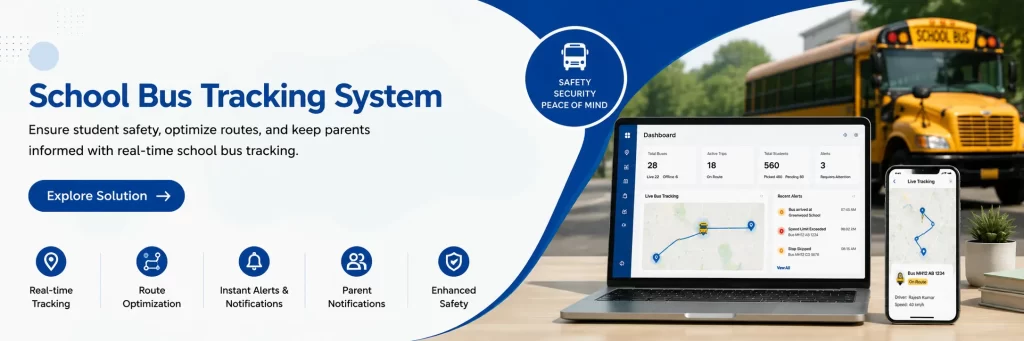
Every school bus is equipped with a GPS tracking device that continuously sends location data to a secure cloud platform. Administrators can monitor every vehicle through a web dashboard, while parents receive live updates through a mobile application.
As buses begin their routes, the platform records movement, estimated arrival times, attendance, and trip history automatically. If a bus encounters traffic, deviates from its assigned route, or experiences delays, authorised users receive instant notifications.
Instead of depending on assumptions, schools make decisions using real-time transportation data.
Better Visibility for Parents
One of the biggest advantages of a GPS school bus tracking system is the confidence it provides to parents throughout the school day.
Rather than waiting without any updates, parents can check the live location of the school bus and receive automatic notifications as the journey progresses. This creates greater transparency while reducing unnecessary phone calls to school staff.
Parents can receive alerts when:
- The bus approaches the pickup location
- Their child boards the bus
- The bus reaches school
- The return journey begins
- Their child reaches the drop-off point
With accurate information available at every stage, parents feel more confident about their child’s daily commute.
Smarter Transport Management for Schools
Managing several buses manually can become challenging, especially during busy school hours. Administrators must coordinate drivers, monitor routes, answer parent enquiries, and ensure every vehicle follows the planned schedule.
A school transportation management system simplifies these responsibilities by providing one central platform for monitoring the complete fleet.
School administrators can:
- View live bus locations
- Monitor completed and active trips
- Review transport history
- Track route performance
- Improve scheduling efficiency
Centralised management helps schools reduce manual effort while improving overall transport operations.
Separate Access for Parents, Drivers, and Administrators
Modern school bus fleet management software is designed for different users, ensuring everyone receives information relevant to their responsibilities.
Parent Mobile Application
Parents receive access to a simple mobile application that displays bus movement in real time, sends automatic notifications, and improves communication with the school whenever transport-related information is required.
Driver Application
Drivers receive digital route information, navigation support, attendance tools, and emergency communication features that simplify daily transport management while helping them follow assigned schedules more efficiently.
Administrator Dashboard
School administrators manage the complete transportation system through a web-based dashboard that provides live vehicle tracking, driver performance reports, attendance records, route optimisation tools, and transport analytics from one location.
This integrated approach improves coordination while reducing communication delays between all stakeholders.
Safety Features That Strengthen Student Protection
A school bus tracking system offers much more than location tracking. Modern solutions combine multiple safety features that help schools monitor transport operations proactively rather than reacting after problems occur.
Important safety capabilities include:
- Live GPS bus tracking
- Route deviation monitoring
- Driver behaviour analysis
- Speed alerts
- Digital attendance management
- Emergency SOS notifications
- Geofencing for authorised routes
These features allow schools to identify potential issues quickly while ensuring safer transportation for students throughout the academic year.
Operational Benefits Beyond Student Safety
While student safety is the primary reason many schools adopt a school bus tracking system, the operational improvements are equally valuable. Managing transportation manually often results in higher fuel expenses, inefficient routes, increased administrative work, and limited visibility into fleet performance.
A digital transport management system helps schools streamline daily operations by automating routine tasks and providing accurate, real-time data. This allows transport coordinators to focus on improving efficiency rather than handling repetitive manual processes.
Schools can benefit from:
- Better fleet utilisation
- Reduced administrative workload
- Faster transport coordination
- Improved scheduling accuracy
- Greater operational transparency
Route Optimisation Improves Daily Bus Operations
Efficient route planning plays a major role in reducing travel time and operating costs. Many schools continue using routes that were created years ago without considering changes in traffic conditions, student locations, or road infrastructure.
A GPS school bus tracking system analyses route performance and helps schools identify more efficient travel paths.
Optimised routes help schools:
- Reduce travel distance
- Minimise traffic delays
- Improve pickup and drop timings
- Lower fuel consumption
- Reduce unnecessary vehicle usage
Shorter, better-planned routes also allow students to spend less time travelling each day.
Driver Monitoring Encourages Safer Driving
Driver behaviour directly influences the safety of every school journey. Monitoring vehicle movement helps schools maintain higher driving standards and quickly identify unsafe practices.
The system can monitor:
- Overspeeding
- Sudden braking
- Harsh acceleration
- Route deviations
- Excessive idling
This information enables administrators to provide timely guidance, improve driver accountability, and maintain safer transport operations throughout the academic year.
Fuel Monitoring Helps Reduce Transport Costs
Fuel is one of the largest recurring expenses in school transportation. Without proper monitoring, unnecessary idling, inefficient routes, and unauthorised vehicle usage can gradually increase operating costs.
An integrated fuel monitoring system provides detailed insights into vehicle usage, fuel consumption, and idle time, allowing schools to identify areas where costs can be reduced.
With better fuel management, schools can:
- Improve fuel efficiency
- Reduce unnecessary trips
- Monitor vehicle utilisation
- Lower operational expenses
- Improve long-term fleet performance
Digital Attendance Improves Accuracy
Manual attendance records require additional paperwork and are prone to errors. A digital attendance system simplifies this process by automatically recording student boarding and drop-off activities.
Schools receive accurate attendance records without additional administrative effort, while parents gain confidence knowing exactly when their child boards and exits the school bus.
Digital attendance also supports faster record retrieval whenever transport-related information is required.
Faster Response During Emergencies
Unexpected situations can occur during any journey, making quick communication essential.
A school bus tracking solution helps administrators respond immediately by providing live vehicle location and emergency alerts whenever assistance is required.
During emergencies, schools can:
- Locate the bus instantly
- Contact the driver quickly
- Inform parents without delay
- Coordinate emergency assistance
- Monitor the situation in real time
Rapid access to accurate information helps schools respond more effectively while improving overall student safety.
Why AIS-140 Compliance Matters
AIS-140 is the government standard for GPS tracking in commercial passenger vehicles across India, including school buses. Compliance ensures that transport vehicles meet regulatory requirements while providing accurate tracking and emergency response capabilities.
Using an AIS-140 compliant GPS tracking system helps schools:
- Meet government transport regulations
- Improve transport monitoring
- Maintain accurate trip records
- Strengthen student safety
- Support regulatory inspections
Selecting a compliant solution ensures schools remain prepared for current and future transportation standards.
How Sahaj GPS Supports School Transportation
Managing school transportation becomes much easier when administrators have complete visibility into every vehicle from a single platform. Sahaj GPS provides advanced school bus tracking software that combines live GPS tracking, route monitoring, driver behaviour analysis, digital attendance, fuel monitoring, emergency alerts, and transport reporting into one integrated solution.
The platform helps schools improve student safety, optimise transport operations, reduce manual work, and strengthen communication between parents, drivers, and administrators through real-time information and intelligent transport management.
Final Thoughts
School transportation has evolved beyond simply moving students between home and school. Parents expect greater transparency, schools require better operational control, and administrators need reliable data to make informed decisions.
A school bus tracking system helps meet these expectations by improving student safety, simplifying fleet management, optimising routes, and enhancing communication throughout every journey. By implementing an intelligent transport solution like Sahaj GPS, educational institutions can create a safer, more organised, and future-ready transportation system for students, parents, and school staff alike.
Frequently Asked Questions
What is a school bus tracking system?
A school bus tracking system is a GPS-enabled transportation solution that allows schools to monitor buses in real time, manage student transportation, improve driver accountability, and provide live updates to parents.
How does a school bus tracking system improve student safety?
The system improves safety by offering live GPS tracking, route monitoring, speed alerts, digital attendance, driver behaviour monitoring, and emergency notifications, helping schools respond quickly whenever needed.
Can parents track the school bus in real time?
Yes. Parents can use a mobile application to view the live location of the school bus, receive arrival notifications, and stay informed throughout their child’s journey.
Is a school bus tracking system suitable for schools with a small fleet?
Yes. Whether a school operates a few buses or a large transportation fleet, a GPS tracking system improves visibility, simplifies transport management, and enhances communication with parents.
Why choose Sahaj GPS for school bus tracking?
Sahaj GPS offers real-time bus tracking, route optimisation, digital attendance, fuel monitoring, driver behaviour analysis, emergency alerts, and comprehensive transport management tools that help schools improve both safety and operational efficiency.