
Ask any operations manager running a field team without employee activity monitoring software how confident they are that their staff are where they’re supposed to be right now- and watch the pause before they answer. Because the honest truth is that managing a field workforce without live visibility is mostly an exercise in trusting that the system is working as planned, and finding out when it isn’t only after something’s already gone wrong.
That’s the gap Live Employee Tracking software closes. And across logistics, FMCG distribution, and service industries in India, the businesses that have made this shift describe it consistently as one of the better operational decisions they’ve made- not because it revealed that everyone was slacking off, but because it surfaced inefficiencies and system problems that were invisible before the data existed.
The Field Team Visibility Problem Quietly Draining Business Performance
Field operations have a specific information asymmetry problem. Employees are distributed, often across large territories, operating without direct supervision. Managers rely on what employees report- visit logs, expense claims, task completion updates- compiled at the end of a day when memory fades and self-reporting incentives aren’t always perfectly aligned with accuracy.
The result is an operational picture that’s always partially constructed from reported data rather than verified data. And partially constructed pictures have gaps that show up in unexpected ways: client visits that were logged but didn’t happen, expense claims that don’t match actual travel routes, delivery timelines that look fine on paper but generate client complaints in practice.
What Actually Happens Without Real-Time Field Visibility
Here’s the version most operations managers recognize. A logistics coordinator has 25 delivery staff across Mumbai. Three clients call on the same afternoon- package didn’t arrive, no one showed up for the service appointment, delivery was delayed by two hours with no communication.
The coordinator starts making calls. The picture that emerges is different from what the morning’s planned schedule showed. Somewhere between the plan and the execution, three things went off track- and nobody knew until clients called.
With live field staff tracking, that coordinator sees all 25 delivery staff on a map in real time. They know at 11 AM which deliveries are running late, which staff are idle, and where to reallocate resources before clients are affected. Not reactive. Actually proactive.
Live Employee Tracking: What It Actually Looks Like for Field Teams
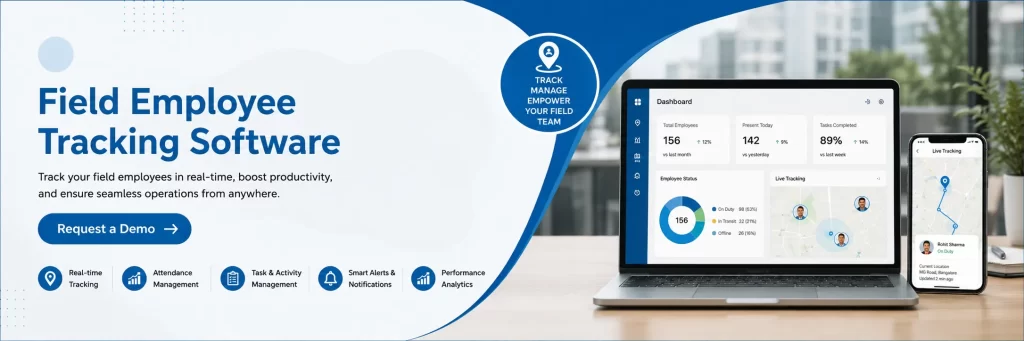
Live Employee Tracking through a field staff software platform is simpler to implement than most managers expect. Field staff download a mobile app. The app shares GPS location continuously during working hours. The manager’s dashboard shows every employee’s current position, movement history, visit logs, and task status- updated in real time, accessible from a phone or computer.
No hardware installation required. No vehicle GPS needed for staff on bikes or on foot. Just a smartphone and an active data connection.
Sahaj GPS provides this through a mobile app paired with a web dashboard that operations managers can access from anywhere. The app interface is intentionally simple for field staff- showing their assigned tasks, navigation to next stops, and check-in prompts- while the backend gives managers detailed activity data, visit verification, and productivity analytics across their entire team simultaneously.
Geo Fencing for Accurate Field Staff Tracking: Visits You Can Verify
Geo fencing for accurate field staff tracking solves one of the most persistent problems in field team management: the self-reported client visit that may or may not have actually happened.
When a geofence is placed around a client location, the system automatically logs when a field employee enters and exits that location- timestamped, GPS-confirmed, and stored without any manual input from the employee. No check-in button to forget. No visit log to fill in retroactively. The system records it because the employee was physically there.
For FMCG sales teams where daily visit targets are tracked as a performance metric, this transforms the conversation from “how many visits did you report?” to “how many verified visits did the system record?”- a shift that most managers find immediately clarifying.
Sahaj GPS allows geofences to be configured around client sites, office locations, or defined territory zones- with entry and exit alerts going to supervisors in real time, not in a daily summary report the next morning.
Why Logistics, FMCG and Service Industries Specifically Need Live Tracking
These three industries share a structural characteristic: their value delivery happens outside the office, in the field, in interactions that managers can’t directly observe. That makes live visibility not a nice-to-have but an operational requirement for consistent performance.
FMCG Field Sales: Visit Frequency, Route Efficiency, and Beat Compliance
FMCG field sales teams in India typically run beat routes- predefined sequences of retail outlets or distributor visits that need to happen at defined frequencies. Managing beat compliance across a team of 30 or 40 sales reps spread across a city is genuinely impossible without real-time data.
Live tracking shows which reps are following their beat routes and which are deviating. Route efficiency analysis shows where time between visits is longer than necessary. Visit frequency data- pulled from geofence logs- shows which outlets are being underserved before sales figures reflect the problem.
Logistics Field Operations: Delivery Confirmation and Exception Management
For logistics companies, live tracking provides delivery confirmation that doesn’t depend on the delivery person manually updating a status. When a delivery executive enters a client’s geofenced location and leaves within a reasonable time window, the system logs a completed delivery automatically. Exceptions- locations visited for too short a time, deliveries skipped entirely, unusual stops not on the planned route- surface automatically for management review.
Sahaj GPS integrates delivery verification with task management, so logistics operations managers see a single view of planned deliveries versus completed ones, with any exceptions flagged in real time rather than at end-of-shift reconciliation.
Service Industry Technicians: Job Completion and Time Tracking
Field service technicians- HVAC engineers, IT support staff, facility maintenance teams, medical equipment service personnel- bill by time at site. Live tracking provides objective time-at-site data that supports accurate invoicing, prevents disputes with clients about hours logged, and helps service managers understand which jobs are taking longer than estimated and why.
Employee Activity Monitoring and Expense Management: The Financial Accuracy Benefit
Employee activity monitoring software that integrates with field operations does something beyond tracking location- it creates a verifiable record of activity that expense claims can be cross-referenced against.
Employee Expense Management With GPS Data as the Verification Layer
Employee expense management is a persistent challenge in field-heavy organizations. Travel reimbursements, client entertainment claims, mileage expenses- these are inherently difficult to verify without some form of objective data attached to them.
GPS tracking provides that data. When an employee submits a mileage claim for travel between two cities, the system can confirm or contradict that claim based on actual GPS movement data for that day. When a fuel reimbursement is submitted, it can be mapped against the actual distance traveled as recorded by the tracking app.
Sahaj GPS flags expense claims that don’t match corresponding GPS activity- not as an accusation mechanism but as a verification layer that keeps expense management honest and significantly reduces the administrative burden of manual expense audit processes.
The result is expense reporting that’s more accurate, faster to process, and less likely to contain errors- whether those errors are accidental or otherwise.
What Indian Field Operations Actually See After Deploying Live Tracking
Across FMCG distributors in Gujarat and Maharashtra, logistics companies in Tamil Nadu and Karnataka, and service companies operating across metro cities- the pattern of post-deployment results is consistent.
Visit completion rates improve within the first month, typically by 20–30% compared to pre-tracking verified baselines. Expense claims become more accurate with less back-and-forth between operations and finance.
Route efficiency improves as GPS data reveals unnecessary detours and scheduling gaps that weren’t visible before. And client satisfaction metrics- for logistics and service companies specifically- tend to improve alongside delivery and appointment punctuality.
Sahaj GPS deployment timelines for field staff tracking are typically 3–7 days from account setup to full-team activation- short enough that most businesses see their first meaningful data within the first week of going live.
FAQs
Q1. What does live field staff tracking software actually monitor?
It monitors employee location, movement patterns, client visit duration, task completion, and activity time in real time- giving managers accurate, verified field team data instead of relying on self-reported logs and manual check-ins.
Q2. How does geo fencing work for accurate field staff tracking?
Geo fencing places virtual boundaries around client locations. When a field employee enters or exits, the system automatically logs the visit with a GPS timestamp- verifying attendance without requiring any manual check-in action from the employee themselves.
Q3. Can GPS-based employee activity monitoring help with expense management?
Yes. GPS movement data cross-referenced against expense claims flags discrepancies between reported travel and actual GPS-verified routes- reducing inaccurate reimbursements and streamlining the expense verification process significantly.
Q4. Which industries benefit most from live employee tracking software in India?
FMCG, logistics, and field service companies see the highest ROI- with measurable gains in visit completion, delivery punctuality, expense accuracy, and overall team productivity typically visible within 60–90 days of deployment.
Q5. How quickly can live field staff tracking software be deployed for a team?
Most platforms activate within 3–7 days using a mobile app- no hardware installation required. Field staff download the app, managers access the dashboard, and live tracking data begins immediately after account setup is complete.