
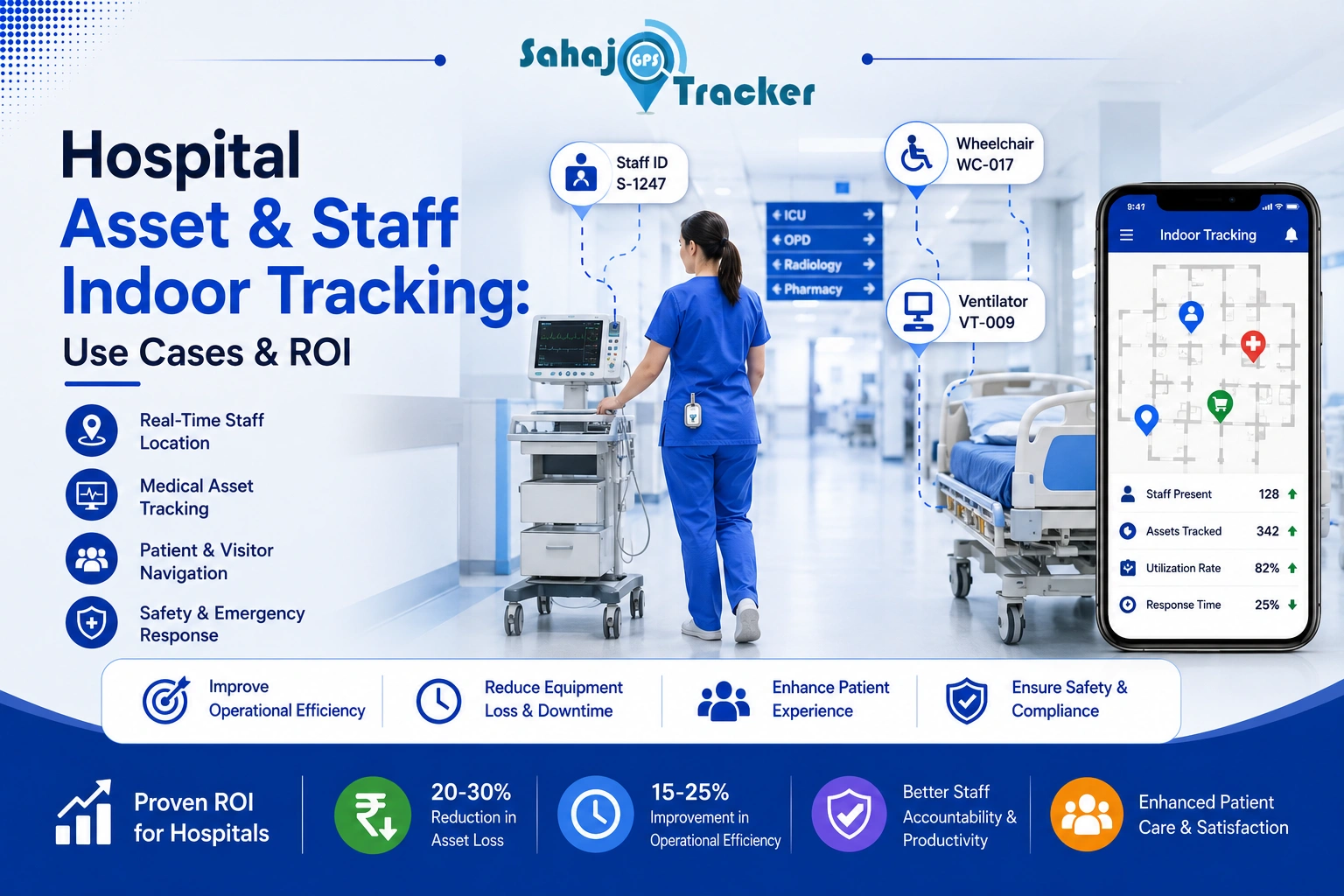
A busy hospital can feel like a small city. Staff move between departments, wheelchairs disappear into another corridor, infusion pumps are needed in two places at once, and valuable equipment sometimes sits unused simply because nobody knows where it is.
A hospital indoor tracking system helps bring some order to this movement. Through indoor asset tracking and real-time location visibility, hospitals can locate equipment, understand staff movement, reduce search time, and improve the way resources are used. It is not about tracking everything just because technology allows it. The real value comes from tracking the things that genuinely affect hospital operations.
What Is a Hospital Indoor Tracking System?
A hospital indoor tracking system uses indoor positioning technology to identify the location of assets, equipment, staff, or other authorised resources inside a facility. Unlike conventional GPS, which is designed mainly for outdoor positioning, indoor tracking can work across corridors, wards, operating areas, storage rooms, laboratories, and other enclosed spaces.
Depending on the solution, hospitals may use technologies such as BLE, RFID, UWB, Wi-Fi, or IoT-based sensors. The choice depends on the building layout, accuracy requirements, number of assets, and budget.
The basic idea is quite simple. Attach a suitable tag to an asset or authorised device, connect the tracking infrastructure, and allow the software to display its location on an indoor map. Suddenly, the question “Where is that wheelchair?” doesn’t require three phone calls.
Why Indoor Asset Tracking Matters in Hospitals
Hospitals depend on equipment being available when it is needed. A nurse shouldn’t have to walk through several floors looking for a portable monitor, and a technician shouldn’t waste twenty minutes searching for a particular piece of equipment.
Indoor asset tracking gives hospital teams better visibility into the location and movement of important assets. Equipment can be categorised by department, floor, room, or asset type, making it easier to find what is needed.
Track High-Value Medical Equipment
Medical equipment can be expensive and frequently shared between departments. Portable ultrasound machines, infusion pumps, patient monitors, wheelchairs, ventilators, and other equipment may move throughout the facility during normal operations.
With healthcare asset tracking, administrators can understand where equipment is located and how frequently it is being used. This can also reveal whether some departments have more equipment than they actually need while another department regularly faces shortages.
That kind of information is useful when purchasing new equipment. Instead of buying another unit immediately, managers can first check whether an existing asset is simply sitting somewhere else.
Real-Time Employee Tracking for Hospital Staff
Equipment isn’t the only thing that moves around a hospital. Doctors, nurses, technicians, housekeeping teams, security personnel, and maintenance staff may cover large areas during a shift.
Real time employee tracking can provide authorised managers with location visibility for specific staff groups where there is a legitimate operational need. For example, a maintenance supervisor may need to know which technician is closest to a service request.
This can improve response times without requiring managers to call multiple employees and ask where they are.
However, staff tracking needs to be handled carefully. Hospitals should clearly define what is tracked, why it is tracked, who can access the information, and how long location data is retained. The purpose should be operational efficiency, safety, and coordination—not unnecessary surveillance.
Use Cases of Indoor Tracking in Hospitals
The practical applications are wider than many hospitals initially expect. Hospital indoor tracking system solutions can support several departments at once when implemented properly.
Emergency Equipment Location
During an emergency, searching for equipment wastes valuable time. Indoor tracking can help staff identify the last known or current location of tagged equipment through a digital interface.
The benefit is especially noticeable in large hospitals where equipment moves between emergency rooms, wards, operating theatres, and storage areas throughout the day.
Wheelchair and Stretcher Tracking
Wheelchairs and stretchers have a funny habit of ending up wherever they are needed last. A hospital may own dozens of them, yet staff can still struggle to find one quickly.
Tracking these assets can reduce search time and provide better visibility into availability. Administrators can also identify areas where equipment frequently accumulates.
Maintenance and Biomedical Equipment
Biomedical and maintenance teams can use location data when equipment needs inspection, servicing, calibration, or repair.
Instead of searching the hospital manually, technicians can check the asset location before starting the job. This can make maintenance scheduling more practical and reduce unnecessary walking between departments.
Healthcare Asset Tracking Can Reduce Search Time
Search time is one of those hidden costs that rarely appears clearly in a budget spreadsheet.
Suppose ten employees each spend fifteen minutes a day looking for equipment. That’s 150 minutes every day. Across a month, the number becomes surprisingly large.
Healthcare asset tracking can reduce this wasted time by making equipment easier to locate. The exact saving depends on the hospital’s size, asset count, workflow, and how often equipment is moved, but the principle is straightforward: less searching means more time available for actual work.
This is one reason hospitals often see value from tracking even before considering larger financial benefits.
How Indoor Tracking Improves Asset Utilisation
Buying equipment is expensive. Letting it sit unused is worse. A hospital may have several devices distributed across departments, but without location and utilisation data, managers may not know which assets are heavily used and which are rarely touched.
A hospital indoor tracking system can help create a clearer picture of asset movement and utilisation. Managers can review how often equipment changes locations and identify resources that could potentially be shared more effectively.
This may delay unnecessary purchases and improve the return from equipment the hospital already owns.
ROI of Hospital Indoor Tracking
Calculating ROI isn’t as simple as subtracting software cost from equipment savings. Hospitals should look at several areas where tracking can create value.
The first is reduced search time. Staff spend less time walking around looking for equipment. The second is better asset utilisation, which can reduce unnecessary purchases. The third is reduced loss and misplacement. The fourth is operational efficiency, particularly for maintenance and support teams.
There can also be indirect benefits. Faster equipment availability can support smoother workflows, while better visibility can help managers make more informed decisions about asset allocation.
Sahaj GPS provides indoor tracking solutions designed to help organisations improve asset visibility and operational control. For hospitals, the useful question is not simply “How much does indoor tracking cost?” but “How much time, equipment utilisation, and operational efficiency can we realistically improve?”
Indoor Tracking for Hospitals in Ahmedabad and Gujarat
Large hospitals in Ahmedabad and across Gujarat often manage multiple departments, floors, specialised units, and large inventories of movable equipment. As facilities grow, manual asset registers become increasingly difficult to maintain.
An indoor tracking solution can provide a digital layer of visibility across the facility. Hospitals can use it for medical equipment, support assets, staff coordination, and maintenance workflows depending on their requirements.
For a hospital expanding into a new building or adding departments, implementing tracking early can also make asset management easier from the beginning. Sahaj GPS can be considered by healthcare organisations looking to introduce indoor location visibility without relying entirely on manual searches and phone-based coordination.
What to Consider Before Implementing Indoor Tracking
The technology should fit the hospital, not the other way around. Start by identifying the assets or staff groups that create the biggest operational problems.
A hospital doesn’t necessarily need to tag every single item. High-value equipment, frequently moved assets, emergency resources, and difficult-to-locate equipment are often better starting points.
Accuracy is another consideration. Some hospitals may need room-level positioning, while others may only require floor or zone-level visibility. More accuracy generally means different infrastructure and potentially higher costs.
Privacy and access controls also matter, particularly when staff location data is involved. Only authorised users should have access to the information they actually need.
Making Indoor Tracking Worth the Investment
Technology alone won’t fix inefficient processes. The hospital also needs clear rules about asset ownership, tagging, maintenance, data access, and how teams respond to location information.
Start small if necessary. Track a specific group of assets, measure search time before and after implementation, and see whether staff actually use the system. If the results are useful, expand gradually. Sahaj GPS can support hospitals with indoor tracking and location visibility, but the strongest ROI usually comes when the technology becomes part of everyday workflows rather than another dashboard that nobody checks.
A hospital is always moving. Equipment moves, people move, patients move, and priorities change by the hour. The goal of indoor tracking isn’t to stop that movement. It’s simply to make it easier to understand—and sometimes, that’s enough to save a surprising amount of time.
FAQs
1. What is a hospital indoor tracking system?
A hospital indoor tracking system helps authorised teams locate tagged assets, equipment, and sometimes staff within a hospital. It can reduce search time, improve asset visibility, and support smoother coordination between departments.
2. How does indoor asset tracking help hospitals?
Indoor asset tracking helps hospitals locate equipment faster, monitor movement, reduce misplacement, improve utilisation, and understand where valuable resources are being used across different departments or facility zones.
3. Can hospitals track staff indoors?
Yes, hospitals can use real time employee tracking for authorised operational purposes such as workforce coordination and emergency response. Clear policies, access controls, and privacy practices should be established before implementation.
4. What equipment can hospitals track?
Hospitals can track movable assets such as wheelchairs, stretchers, infusion pumps, patient monitors, portable scanners, medical devices, maintenance equipment, and other valuable resources that frequently move between departments.
5. How does indoor tracking provide ROI for hospitals?
ROI can come from reduced equipment search time, better asset utilisation, fewer misplaced resources, improved maintenance coordination, and reduced unnecessary purchases. Actual savings depend on the hospital’s size and workflows.