
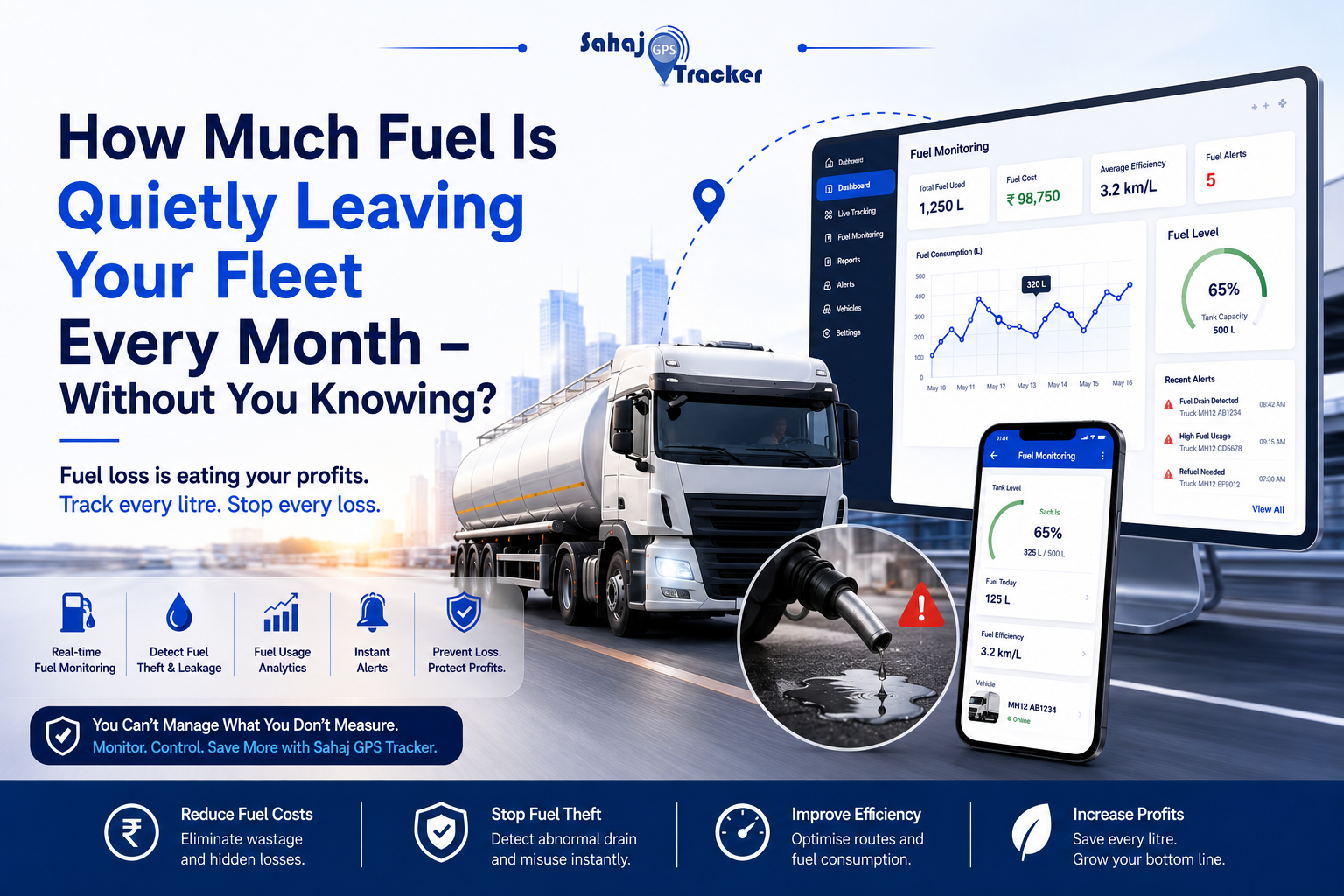
The question is whether you do.
Your truck left the depot yesterday with 400 litres. Came back in the evening. Driver says 200 litres consumed, 200 litres remaining. Receipt matches. Numbers look clean.
But the sensor inside that tank recorded something different.
160 litres consumed. 40 litres gone. Not in the paperwork. Not in any report. Just gone – the way money disappears when nobody’s checking the right place.
This wasn’t a one-off. It happened today. It’ll happen again tomorrow. And the month after. As long as your fuel tracking depends on driver-reported numbers and vendor receipts, the gap between what you pay for and what your trucks actually receive will keep growing – quietly, invisibly, and at a scale that most fleet owners don’t fully see until they run the actual numbers.
Run the Numbers on a 20-Truck Fleet
A logistics operation running 20 trucks, each filling roughly 400 litres per week, spends around ₹31 lakh per month on diesel at current prices.
Industry data from Indian freight operations puts fuel loss between 15 and 20 percent of total monthly spend – through theft, driver pilferage, and invoice fraud. At the conservative end, 15 percent of ₹31 lakh is ₹4.65 lakh every month.
Over a year, that’s ₹55 lakh. No invoice was raised for it. No complaint was filed. The business looked normal the entire time. The money just left.
The harder truth: most of this isn’t recoverable in hindsight. But it’s entirely preventable going forward.
The Methods That Keep Working Because Nobody’s Watching
Fuel theft in Indian logistics doesn’t happen in dramatic, detectable events. It happens in small, consistent amounts – spread across enough vehicles and trips that the losses blend into the general noise of operating costs. That’s precisely why it persists.
Siphoning at overnight halts is the most direct method. Truck parked, engine off, someone drains fuel into a separate container at a highway halt or dhaba stop. By morning the driver is fresh, the truck starts normally, and 30 to 40 litres simply aren’t there anymore.
Invoice padding at fuel stations is often more profitable and carries less physical risk. Driver fills 80 litres. The receipt he brings back reads 100 litres. The company pays for 20 litres that were never in the tank. Across a 20-truck fleet with multiple fills a week, one vendor relationship running this pattern can drain ₹50,000 to ₹80,000 a month in fraudulent billing alone – without a single litre being physically stolen.
Modified fuel return lines are the most technically sophisticated approach. A small pipe modification on the vehicle’s fuel return line diverts a portion of fuel into a hidden container rather than back into the tank. Nothing dramatic happens. Fuel consumption just runs slightly above expected – and the assumption is that diesel prices increased or the road conditions were rough.
Unauthorized fueling outside approved stations adds a different dimension – cheaper, often adulterated diesel that damages engines over time while making cost reconciliation completely impossible.
What all of these methods share is the same structural weakness in manual tracking. The person committing the theft is also the person reporting the fuel numbers. That conflict of information is what a GPS fuel monitoring system eliminates permanently.
What Actually Changes When the System Goes Live
From the first day of installation, the data no longer comes from the driver. It comes directly from inside the tank.
A high-accuracy capacitive sensor fitted inside each vehicle’s fuel tank measures actual fuel levels continuously – transmitting readings every few seconds with GPS coordinates and timestamp directly to your dashboard and to your phone.
Every refuel is captured automatically. Exact litres added, time, GPS location of the fill. Every unexpected drain is logged – whether it happens at a fuel station, a rest stop, or a highway halt at 2 AM. Every kilometre of consumption is tracked against actual route data and load rather than manufacturer consumption tables.
When fuel drops unexpectedly – parked truck, loading bay, overnight halt – an alert reaches your phone within 60 to 90 seconds. Not a morning report. Not a weekly summary. A live notification while the event is still happening and while doing something about it is still possible.
When a vendor invoice arrives claiming 100 litres were filled and the sensor shows 83 – the system flags the discrepancy automatically. No manual cross-checking required. No trying to remember which station was used on which day. The gap is documented, timestamped, and ready to be used in a direct conversation with the vendor.
What changes most fundamentally isn’t the alerts or the reports. It’s what happens to driver behavior once drivers understand the monitoring is real and the data is being reviewed. The majority of behavioral improvement happens before any formal disciplinary action is ever needed. The data being there is sufficient.
What the System Tracks – Across Every Vehicle, Every Day
Live fuel level across the entire fleet. Every vehicle’s current fuel status visible on one dashboard – whether trucks are in Gujarat, Rajasthan, or Maharashtra. Refueling planning shifts from guesswork to actual data, reducing both unnecessary stops and dry-run risk on long hauls.
Instant fuel drain alerts. Any unexpected fuel level drop triggers a phone notification within 60 to 90 seconds. The event is logged with GPS coordinates and timestamp – usable for documentation, driver accountability, and vendor disputes.
Refill detection and invoice reconciliation. Sensor-recorded fill quantities are automatically compared against vendor invoices. Discrepancies above a configurable threshold generate a review flag. This feature alone typically recovers 8 to 12 percent of existing fuel spend within the first billing cycle after installation.
Trip-level consumption per vehicle, per driver. Real sensor-based fuel data – not mileage-table estimates or manufacturer specs. Actual consumption on actual routes under actual load conditions. Outliers surface immediately against fleet averages for the same route type.
Idle fuel burn tracking. Toll plazas, weighbridges, loading docks, border check-posts – engine idling during waits accounts for 8 to 12 percent of total diesel consumption in Indian freight operations. The system separates idle burn from trip consumption so it becomes a specific, measurable number rather than background noise in the monthly bill.
Geofenced fueling zones. Approved fuel stations across the fleet’s operating routes are defined in the system. Any fill outside those zones triggers an immediate alert. Combined with invoice reconciliation, unauthorized fueling and fraudulent billing are eliminated through a single configuration step.
Driver-wise fuel efficiency scoring. Individual performance data built from actual sensor readings – acceleration patterns, idling duration, fuel use per kilometre by route type. Gives operations managers objective numbers for coaching rather than gut feeling and assumptions.
Twelve months of searchable historical data. Every fuel event retained and accessible by vehicle, driver, route, date, and event type. Available when you need it for audits, insurance documentation, vendor disputes, or driver accountability processes.
AIS 140 compliant hardware. Government-approved devices for commercial vehicle compliance. Regulatory requirements for fleet operations are covered without any additional configuration.
Multi-depot, role-based dashboard access. Regional managers see their own vehicles and depots. The operations head or owner sees the full fleet. Alerts route to the right people based on vehicle assignment. The platform scales from 10 vehicles to 500 without requiring a different system.
What Indian Fleets Are Actually Getting Back
A construction company that installed Sahaj GPS fuel monitoring across 12 machines recovered ₹1.8 lakh per month in losses that had been running undetected for years. Their operation was smaller than a typical 20-truck logistics fleet. The figures are proportional.
For logistics fleets, savings accumulate consistently across three separate areas.
Theft prevention is the fastest. Fuel siphoning and driver-side pilferage drop sharply within the first two to four weeks – driven primarily by the awareness that monitoring is live and data is being reviewed. Most of this improvement happens without a single formal conversation.
Invoice fraud recovery typically surfaces 8 to 12 percent in inflated or fabricated billing from fuel vendors. Some vendors self-correct when confronted with sensor records. Others lose the contract. Either outcome reduces cost without any complex legal process.
Consumption efficiency from improved driver behavior – smoother acceleration, less idle time, better speed discipline – produces a further 10 to 15 percent reduction in fuel per kilometre over the first three months as individual scoring becomes part of the operational culture.
Combined, fleets report 20 to 30 percent total fuel cost reduction within the first year. Hardware and software costs recover within four to six months. After that, every month of operation adds directly to the bottom line.
Why Sahaj GPS – Not Just Any Sensor Company
Fifteen years of installation and calibration experience on Indian commercial vehicles. Trucks, tippers, tankers, LCVs, trailers, construction equipment – across road conditions and operating environments that generic tracking companies have never worked in.
Sensor accuracy of 99 percent or above. Basic float sensors carry 2 to 3 percent error margins – large enough for consistent small-scale theft and invoice fraud to hide inside without ever triggering a review. That margin of error is exactly the gap that systematic losses exploit.
Installation and calibration done by Sahaj GPS’s own team – not outsourced. Every vehicle’s tank is individually calibrated to map sensor readings to actual fuel volumes. Generic calibration tables don’t get used because they produce generic accuracy, which means unreliable reconciliation data.
Hardware sourced from Teltonika, Atlanta, and Howen – manufacturers with proven reliability in Indian operating conditions, not spec-sheet reliability from a controlled environment.
Local support across India from a team that understands Indian vehicle types, Indian freight operating conditions, and AIS 140 compliance requirements. Not a call center routing tickets through a generic support queue.
How the First Six Months Actually Go
Week one to four – driver behavior changes before any formal action. The knowledge that fuel is monitored in real time is sufficient to reduce opportunistic theft. Alerts start arriving. The first invoice discrepancies surface.
First billing cycle – fuel vendor reconciliation identifies specific discrepancies. Some conversations are uncomfortable. All of them are financially productive.
Month three – full fleet consumption data is available. Route-level efficiency, vehicle-by-vehicle performance trends, driver scoring patterns. Operational decisions begin reflecting actual data rather than estimates and assumptions.
Month four to six – the system cost is recovered. Every month after that, the savings accumulate as operational gain rather than cost recovery.
Fleet owners who delay this decision lose ₹4 to ₹5 lakh for every additional month they wait. That money doesn’t come back once it’s gone.
FAQs
Does the sensor work across a mixed fleet – trucks, tippers, tankers, and LCVs?
Yes. Every sensor is individually calibrated to match the tank size and shape of each vehicle. This ensures accurate fuel readings across trucks, tippers, tankers, LCVs, and other fleet vehicles. All data is managed through a single dashboard.
What happens to fuel data when a truck enters an area with poor network coverage?
The device securely stores fuel and GPS data while offline. Once the network is restored, it automatically syncs all records with their original timestamps. No fuel data is lost, ensuring accurate reporting.
How does invoice reconciliation work when the fleet uses multiple vendors across different states?
The sensor records the actual fuel filled into each vehicle, regardless of the vendor or location. It automatically compares this data with invoices from every fuel vendor. Monthly reports highlight discrepancies and overbilling patterns.
Can regional managers be restricted to viewing only their own vehicles?
Yes. The platform supports role-based access, allowing managers to view only their assigned vehicles and depots. Fleet owners and administrators retain complete visibility across all regions from a single dashboard.
We tried GPS tracking before and stopped using it. Why is fuel monitoring different?
Unlike basic GPS tracking, fuel monitoring provides insights that directly impact operating costs. It identifies fuel theft, billing discrepancies, and excessive fuel consumption. This helps fleets reduce losses and achieve measurable cost savings.