
Ask a fleet manager what their worst operational day looks like and it almost always involves a vehicle that broke down somewhere inconvenient. Not in the depot, where it could be fixed quietly. On a highway outside Nagpur at 11 PM, with a load of perishables and a driver calling in panicked. Vehicle maintenance software connected to GPS tracking exists primarily to prevent that scenario – and the way it does so is by catching the conditions that lead to that breakdown days or weeks before the breakdown happens, not after.
Preventive maintenance GPS isn’t a new concept in principle. Every fleet operator knows vehicles need regular servicing. The gap between knowing that and actually managing it well – across a fleet of 20 or 50 or 200 vehicles, with different service intervals, different mileage patterns, and different maintenance histories – is where things consistently fall apart in practice.
Why Fleet Maintenance Is the Operational Cost Most Fleets Manage Poorly
Maintenance costs sit in a strange position in fleet economics. They’re significant – typically 15–25% of total fleet operating costs – but they’re also unpredictable in a way that fuel or driver salary costs aren’t. You know roughly what diesel will cost next month. You have no idea which vehicle is going to throw a differential problem or need an emergency injector replacement.
Or rather – you had no idea. That’s changing.
The reactive maintenance pattern that most fleets run on isn’t actually cheaper than preventive maintenance. It feels cheaper because it avoids upfront scheduled service costs.
But breakdown repairs on a commercial vehicle are almost always more expensive than the preventive service that would have prevented them – because you’re paying for emergency labour rates, potentially for towing, definitely for the vehicle downtime, and usually for the commercial consequences of a missed delivery or delayed service.
The Real Difference Between Reactive and Preventive Fleet Servicing
Reactive: the vehicle breaks down. You fix it. You lose whatever was supposed to happen while it was broken.
Preventive: the vehicle shows early signs of a developing issue. You schedule a service before it fails. The vehicle is out of service for a planned half-day rather than an unplanned week.
That difference – planned vs unplanned downtime – is what fleet service management through GPS data enables at a practical level. And across a fleet of any meaningful size, the cumulative impact on costs, vehicle lifespan, and operational reliability is substantial.
How GPS Data Makes Preventive Maintenance Scheduling Actually Work
The traditional preventive maintenance approach is calendar-based. Service every three months, regardless of how much the vehicle has actually been used in those three months. It’s better than nothing, but it’s imprecise – a vehicle that’s been working hard for 8,000 kilometres in three months is not in the same condition as one that did 2,000 kilometres in the same period.
Fleet maintenance GPS enables something more accurate: usage-based maintenance triggered by actual odometer readings, engine hours logged, and vehicle behaviour patterns – not just the passing of calendar time.
Odometer-Based vs Calendar-Based vs Condition-Based Maintenance Scheduling
Odometer-based scheduling is a significant improvement over calendar-only approaches. When the GPS system is tracking vehicle mileage in real time, it can trigger a maintenance alert at exactly 10,000 kilometres since last service – regardless of whether that took three months or six months in calendar terms. The right service interval for the actual wear pattern.
Condition-based scheduling goes further. This is where GPS-connected engine diagnostics become genuinely powerful. Rather than waiting for a mileage or time threshold, the system monitors vehicle health indicators – fuel consumption rate, battery voltage, engine temperature patterns, RPM behaviour – and flags when a specific vehicle is showing signs of developing issues that should be inspected before they progress.
A truck whose fuel consumption has increased 12% over its 30-day rolling average without any change in route or load is probably developing something. An injector issue. A tyre pressure problem. An air filter that needs replacement. The GPS data flags this pattern. The maintenance team investigates before it becomes a roadside breakdown.
Engine Fault Codes and Real-Time Diagnostics Through GPS Integration
Modern commercial vehicles generate OBD fault codes when something goes wrong with engine systems – codes that typically illuminate a dashboard warning light and, if the driver ignores it, eventually become a failure.
Vehicle service tracking systems that integrate with vehicle OBD ports capture these fault codes and transmit them to the fleet management platform in real time. A fault code on a vehicle in Delhi gets seen by the fleet manager before the driver has decided whether to mention it. The service manager can be looking at the code type and determining urgency while the vehicle is still on the road.
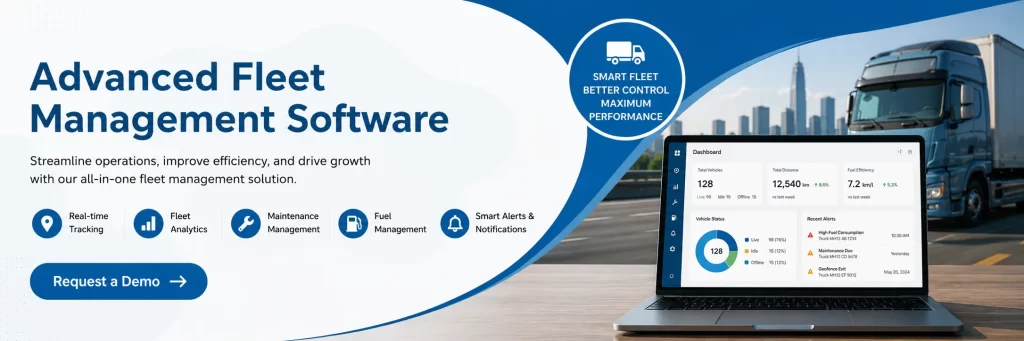
Sahaj GPS captures engine diagnostic data and fault codes alongside standard GPS location and movement data – presenting them in the same fleet dashboard so maintenance managers don’t need a separate diagnostic tool to assess what’s happening with vehicles in the field. When a fault code appears, it’s flagged, categorized by severity, and linked to the specific vehicle’s maintenance history for context.
Vehicle Maintenance Software: What Good Fleet Service Management Actually Looks Like
Vehicle maintenance software that’s genuinely useful for fleet service management isn’t just a digital version of the maintenance logbook that was already getting ignored on a shelf somewhere.
Automated Service Alerts That Reach the Right People at the Right Time
The most important feature is automated alert generation – triggered by mileage thresholds, time intervals, or diagnostic readings – that goes to the right people without requiring anyone to manually check a spreadsheet or remember a service date.
When a vehicle is 500 kilometres from its next oil service interval, the system sends an alert to the maintenance manager. When a vehicle’s tyre rotation interval is due, the workshop gets a scheduled work order generated automatically. When an engine fault code appears, the fleet manager gets an immediate notification with the code type and the vehicle’s current location.
Sahaj GPS service alert configuration lets maintenance managers set multiple alert levels – an advance warning at 80% of the interval, a due alert at 100%, and an overdue escalation if service hasn’t been completed – with different notification routing for each level. That escalation structure is what prevents service due alerts from being acknowledged and then forgotten.
Maintenance History That Follows Every Vehicle
Every service event logged in the system – what was done, what parts were replaced, which service provider did the work, what the odometer reading was at the time – stays attached to the vehicle record permanently.
This history is valuable in multiple ways. It informs trade-in decisions with documented evidence of care. It helps diagnose recurring issues by revealing patterns across service records. It provides compliance documentation for vehicles operating under regulatory requirements. And it gives any new manager or team member who comes to the fleet a complete picture of every vehicle’s condition and service history without relying on institutional memory.
Preventive Maintenance GPS for Mixed Fleets With Different Service Needs
One practical challenge for fleet maintenance management is that different vehicle types have different service intervals, different wear patterns, and different critical maintenance requirements.
A heavy-duty truck doing highway work has different maintenance needs from a light commercial vehicle doing urban deliveries. Cold chain vehicles have refrigeration units with their own separate maintenance schedules. Buses have different brake inspection requirements from goods vehicles.
Sahaj GPS supports vehicle-specific maintenance schedules within the same platform – different alert thresholds, different service intervals, and different diagnostic monitoring parameters for different vehicle categories. Fleet managers with mixed fleets don’t need separate systems for each vehicle type; they need one system with the flexibility to handle multiple types correctly.
Reducing Downtime: How Maintenance Scheduling Connects to Fleet Availability
Unplanned downtime is expensive in ways that go beyond the immediate repair cost.
A vehicle that should be making deliveries but is in the workshop unexpectedly means either a customer gets a late delivery, another vehicle gets overloaded to cover the gap, or a hire vehicle is sourced at short notice – all of which cost money and some of which cost client relationships.
Fleet service management that’s connected to GPS-based scheduling allows maintenance to be planned around operational demand. When the system knows which vehicles are busiest on which days based on historical route data, maintenance can be scheduled for lower-demand periods – keeping maximum fleet availability during peak operational windows.
Sahaj GPS fleet availability reports, combined with maintenance scheduling data, give operations managers a forward-looking view of which vehicles will be in service and which are due for maintenance across any given week – enabling proactive planning rather than reactive scrambling when a vehicle unexpectedly goes offline.
The Real Cost Calculation: Preventive vs Reactive Maintenance in Practice
Here’s how the numbers look when you work them out honestly for a mid-sized Indian commercial fleet.
A scheduled oil service on a commercial truck costs roughly ₹8,000 – ₹15,000 depending on the vehicle. An engine repair following an oil-related failure – bearing damage, piston wear – costs ₹80,000 – ₹3,00,000 plus downtime. A scheduled tyre rotation costs ₹2,000 – ₹4,000. A tyre blowout on a highway costs the tyre replacement, potential vehicle damage, towing, possible cargo loss, and driver safety risk.
The ratio holds consistently: preventive service costs 10–20% of what the resulting failure costs if it’s not done. For a 30-vehicle fleet running on reactive maintenance, switching to GPS-enabled preventive maintenance typically reduces annual maintenance spend by 20–35% – not by spending less on maintenance, but by spending it at the right time.
FAQs
Q1. How does GPS help schedule fleet preventive maintenance more accurately?
GPS tracks real odometer readings, engine hours, and diagnostic data – triggering service alerts based on actual vehicle usage and condition rather than fixed calendar intervals that don’t reflect real wear patterns.
Q2. What’s the actual cost difference between preventive and reactive fleet maintenance?
Preventive maintenance typically costs 10–20% of what resulting failures cost if skipped. Fleets switching to GPS-based preventive scheduling generally see 20–35% reduction in total annual maintenance costs within 12 months.
Q3. What does vehicle maintenance software log and store for each fleet vehicle?
It records every service event, parts replaced, fault codes, odometer readings, and service provider used – creating a complete vehicle history that supports trade-in decisions, compliance documentation, and recurring issue diagnosis.
Q4. How does GPS detect early vehicle maintenance needs before breakdown occurs?
GPS systems monitor fuel consumption trends, engine fault codes, battery voltage, and RPM patterns in real time – flagging deteriorating vehicle condition weeks before it would become a roadside breakdown or costly emergency repair.
Q5. Can fleet maintenance scheduling work across different vehicle types in one platform?
Yes. Good fleet maintenance GPS platforms support different service intervals, diagnostic parameters, and alert thresholds for different vehicle categories – managing trucks, vans, buses, and specialist vehicles within one unified system.