
Ask any fleet manager in India what their single biggest operational headache is and fuel will come up — almost every time. The cost, the uncertainty around where it’s actually going, the mileage claims that never quite add up, the month-end fuel bills that somehow always land higher than expected.
A proper Fleet Fuel Monitoring System doesn’t just track how much diesel enters a tank. Done right, it fundamentally changes how an entire operation is managed — and the improvements reach well beyond the fuel line into maintenance, driver accountability, route efficiency, and client relationships.
Here are ten ways that actually happen in practice.
Why Fuel Costs Keep Rising Without a Monitoring System in Place
Before getting into the ten ways, it’s worth being honest about something. Most fleet operators experiencing fuel budget overruns aren’t being robbed blind by one dramatic problem. It’s a combination of small, invisible leaks — idling that nobody tracks, slight route deviations that add up over hundreds of trips, refueling discrepancies that are hard to verify without sensor data, and driver habits that nobody’s had the data to address.
A fuel monitoring system for vehicles surfaces all of those at once. That’s what makes the business impact so broad.
How Fuel Monitoring Directly Reduces Operating Costs
1. Catching Fuel Theft Before It Quietly Drains the Budget
Fuel theft from commercial fleets happens more than most operators want to admit publicly. It takes different forms — siphoning from tanks overnight, manipulating mileage records to justify extra refueling, short-filling at pumps and pocketing the difference, or unofficial refueling from a second vehicle.
A fuel consumption monitor with tank-level sensors detects sudden unexplained fuel drops immediately. If a truck’s tank loses 40 litres without any corresponding movement or authorized refueling event, the system flags it within minutes — not when someone notices the discrepancy during a monthly review.
Sahaj GPS integrates fuel sensor data directly into the vehicle tracking dashboard, so theft indicators appear in the same place managers are already checking location and movement data. Catching one such incident per month on a mid-sized fleet often recovers the entire monthly subscription cost of the monitoring system.
2. Eliminating Excessive Idling Without a Single Confrontation
Idling is probably the most underestimated fuel drain in Indian fleet operations. Trucks parked outside loading docks with engines running. Vehicles waiting in queues at toll plazas, cold chain trucks keeping the refrigeration unit running while the driver takes a break — engine idling that nobody’s technically doing anything wrong, but that adds up to enormous fuel waste across a fleet.
Real time fuel monitoring tracks engine-on, vehicle-stationary periods and generates idle time reports by vehicle and driver. When fleet managers can show a driver that their idling time cost ₹800 in diesel last week — not as an accusation but as data — the behavior changes. Not always immediately. But it changes.
The average Indian commercial fleet reduces idle-related fuel consumption by 10–15% within three months of introducing idle time monitoring and feedback.
3. Smarter Route Planning That Saves Litres Per Trip
Longer routes burn more fuel. That’s obvious. What’s less obvious is how much route deviation happens invisibly across a fleet without any tracking in place.
A Fuel Monitoring System to Reduce Costs pairs consumption data with GPS route analysis to identify which routes are generating disproportionate fuel use relative to distance. Maybe a particular corridor is consistently causing higher consumption due to traffic, road gradient, or frequent stops. Maybe certain drivers are consistently taking longer paths than the planned route.
Route-level fuel analysis gives fleet managers the specific data they need to optimize planning — not guesses, actual consumption per kilometre by route segment.
The Operational Intelligence That Changes Decision-Making
4. Real-Time Fuel Monitoring During Active Trips
This one matters most for long-haul operations. Knowing a truck’s fuel level and consumption rate in real time — not just after it returns to the depot — changes what fleet managers can actually do with that information.
If a vehicle is consuming fuel at a rate significantly above its baseline, that’s a signal during the trip — not a footnote in a report a week later. It might indicate a mechanical issue, a tyre problem, or route conditions that need to be rerouted. Real time fuel monitoring turns fuel data from a historical record into an active operational tool.
5. Predictive Maintenance Through Consumption Anomalies
Here’s one that surprises people. A fleet fuel monitoring system isn’t just a fuel tool — it’s also an early warning system for mechanical issues.
Sudden increases in fuel consumption that don’t correlate with route changes or load variations often signal engine problems, injector issues, or degrading components well before any dashboard warning light appears. Catching these signals early means scheduling maintenance proactively rather than dealing with a breakdown on NH-44 at 2 AM.
Operators using fuel consumption data for predictive maintenance typically see vehicle downtime reduce by 20–30% over 12 months. That’s a significant operational improvement that most people don’t attribute to their fuel monitoring system — but should.
6. Driver Behavior Scoring That Actually Changes Habits
Aggressive acceleration burns more fuel than smooth, gradual speed increases. Hard braking wastes the momentum that cost fuel to build. Over-speeding on highways pushes vehicles into aerodynamic drag zones where fuel efficiency drops sharply.
A good fuel monitoring system for vehicles scores driver behavior against fuel efficiency metrics — not just speed. Drivers who consistently rank lower on efficiency scores get coached with actual data rather than general reminders to “drive more carefully.” That specificity is what makes behavioral change stick.
Sahaj GPS generates weekly driver efficiency reports that fleet managers can use in one-on-one conversations with drivers — showing individual consumption patterns compared to fleet averages in a format that’s constructive rather than accusatory.
Fleet-Wide Accountability and Compliance Benefits
7. Accurate Fuel Expense Reporting Without the Guesswork
Manual fuel log reconciliation is time-consuming, inaccurate, and frankly a bit of a headache for whoever ends up doing it at the end of the month. Cross-referencing paper receipts with mileage logs with supplier invoices — it’s the kind of task that gets done under time pressure and often has errors that nobody catches until they’ve already affected budget projections.
Automated fuel consumption monitor systems generate digital fuel expense reports continuously. Every refueling event is timestamped, located, and logged against the specific vehicle. Month-end reconciliation goes from a half-day task to a five-minute export.
More importantly, the data is reliable in a way that manually compiled records simply aren’t.
8. Supplier and Vendor Accountability on Fuel Purchases
This is a less-discussed benefit of real time fuel monitoring that fleet operators with managed fuel accounts appreciate enormously. When vehicles refuel at designated pump stations or fuel vendor accounts, the system can verify that the fuel quantity recorded in the pump transaction matches what actually entered the tank.
Discrepancies between what was billed and what was dispensed — even small ones, across hundreds of transactions — add up. Sensor-verified data gives fleet operators the documentation they need to query supplier invoices with evidence rather than suspicion.
Long-Term Business Growth From Better Fuel Data
9. Data-Driven Fleet Expansion Decisions
When a business is considering adding vehicles to its fleet, the decision is usually based on capacity projections and demand forecasting. But fuel economics at the vehicle level should be part of that conversation — and they usually aren’t, because the data isn’t organized enough to be useful.
A well-implemented Fleet Fuel Monitoring System gives fleet managers per-vehicle economics over time — actual fuel cost per kilometre, per route, per vehicle age and model.
That data informs expansion decisions in a way that gut feel can’t: which vehicle types perform best in which operating conditions, which routes are generating the highest fuel cost per unit of revenue, and where fleet composition changes could meaningfully improve margins.
Sahaj GPS export reports can feed this kind of analysis directly into accounting and operations planning tools — making the fuel data useful at a business strategy level, not just an operational one.
10. Building Client Trust Through Operational Transparency
This last one is underrated and doesn’t get mentioned often enough.
Clients who hire fleet operators for logistics, distribution, or transport services increasingly want visibility into how their cargo is being handled — and fuel efficiency data is part of the operational story that responsible fleet operators can now tell. Demonstrating documented, data-backed fuel management practices signals operational maturity. It builds trust with clients who have choices about which fleet operators they work with.
For fleet operators working with larger FMCG, pharma, or manufacturing clients in India — categories where vendor evaluations are increasingly rigorous — documented fuel monitoring systems are becoming part of what separates shortlisted vendors from the rest.
FAQs
Q1. What does a Fleet Fuel Monitoring System actually track?
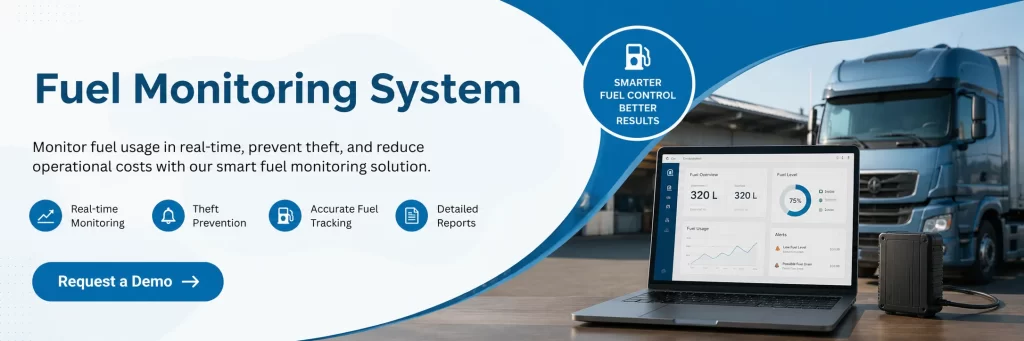
It monitors real-time fuel levels, consumption rates, refueling events, idle time, and anomalies across vehicles — giving fleet managers accurate data to detect theft, reduce waste, and control fuel costs consistently across the entire operation.
Q2. How does real-time fuel monitoring detect theft or misuse?
Fuel sensors detect sudden unexplained tank level drops and trigger immediate alerts. When fuel quantity decreases without a corresponding authorized refueling or movement event, the system flags it for review — enabling fast response before losses accumulate.
Q3. How much can a fuel monitoring system reduce costs for Indian fleets?
Most Indian fleets report fuel cost reductions of 15–25% within 90 days — achieved through theft prevention, idle time reduction, driver behavior improvements, and optimized route planning that eliminates unnecessary fuel consumption across the operation.
Q4. Can fuel monitoring systems improve individual driver behavior?
Yes. Systems track consumption per driver, flagging harsh acceleration, excessive idling, and inefficient patterns. Data-driven coaching through weekly efficiency reports creates specific, actionable feedback that genuinely changes driver habits over time.
Q5. What features should I look for in a fuel monitoring system for vehicles in India?
Prioritize real-time alerts, fuel sensor integration, driver behavior scoring, route-level consumption analysis, automated expense reporting, and compatibility with AIS 140-certified GPS devices for full regulatory compliance across Indian commercial vehicle categories.