
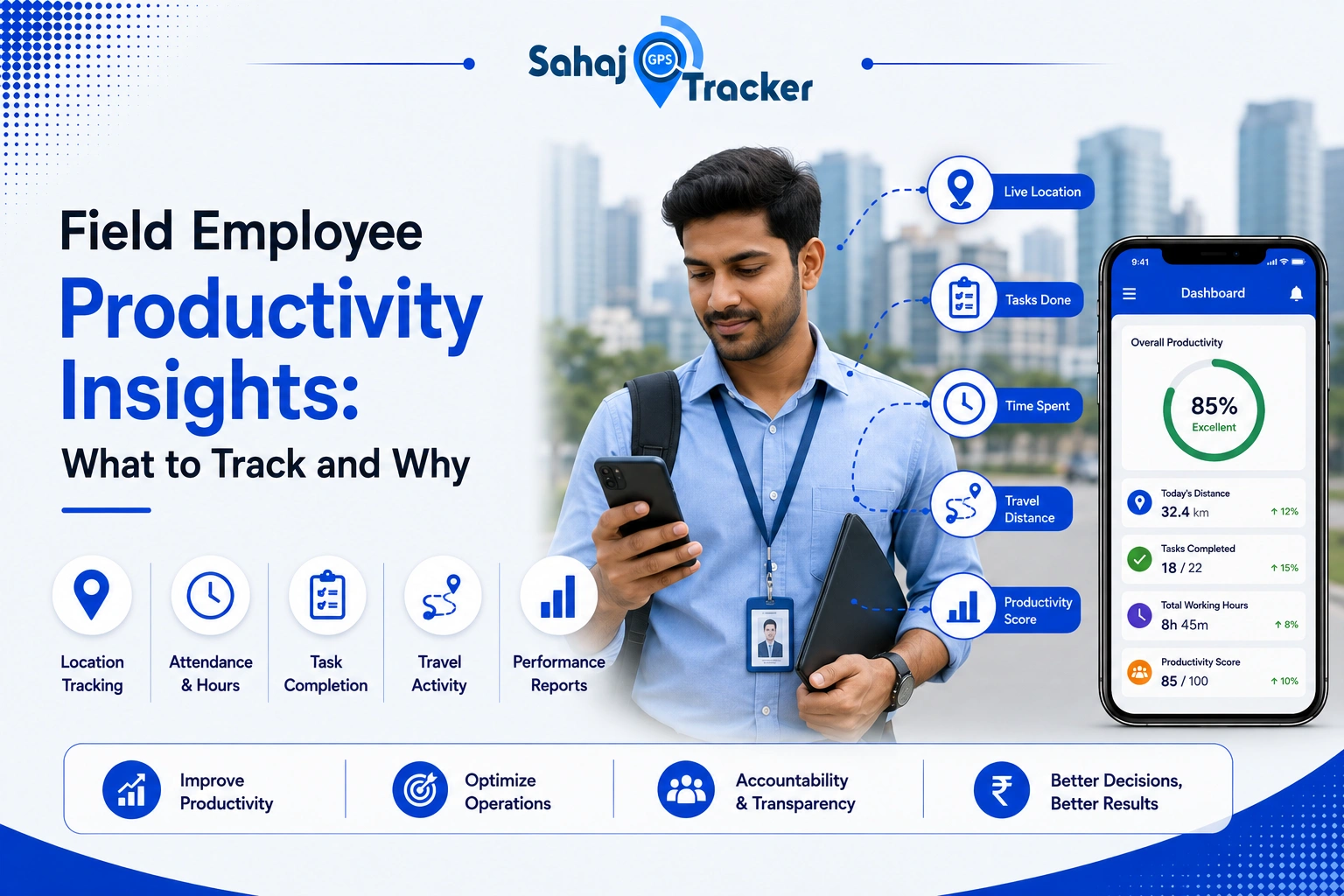
Managing people who spend most of their working day outside the office can get messy. A sales representative may visit five customers, a service technician may attend three sites, and a field executive could spend hours travelling between appointments. Without proper visibility, it becomes difficult to understand what is actually happening during the day.
This is where Field Employee Productivity tracking becomes useful. Instead of judging performance only by end-of-day reports, businesses can look at real activity such as visits, travel time, attendance, completed tasks, and location patterns. Good field employee tracking isn’t about watching people every minute. It’s about understanding where time goes and finding practical ways to help teams work better.
Field Employee Productivity: What Should Businesses Track?
Productivity in a field team isn’t measured by one number. A person who spends six hours travelling may appear less productive than someone sitting in an office, but that travel could be necessary for visiting customers across different locations. That’s why businesses need to look at several connected factors rather than relying on hours worked alone.
Useful productivity data can include customer visits, time spent at each location, travel distance, attendance, task completion, route efficiency, and working hours. When these details are viewed together, managers get a much clearer picture of how field operations are actually running.
The goal is not to create pressure. It is to identify delays, remove unnecessary work, and help employees spend more time on activities that matter.
Track Customer Visits and Time Spent on Site
For sales and service teams, customer visits are often one of the clearest productivity indicators. Knowing how many visits were completed is useful, but the time spent at each location can provide additional context.
For example, a sales representative may complete ten visits in one day, while another completes six. That doesn’t automatically mean the first employee performed better. The second person might have spent considerably more time with high-value customers or handled complex service requests.
A location-based tracking system can help managers review arrival and departure times while keeping the focus on work outcomes rather than simply counting movements.
Field Employee Tracking Helps Reveal Lost Time
Every field team has some unavoidable waiting and travel time. That’s normal. The problem starts when avoidable delays become a regular pattern.
Field employee tracking can help identify excessive travel, long idle periods, repeated route deviations, and unnecessary back-and-forth movement. These insights are particularly useful for businesses with large territories where managers cannot physically observe daily operations.
Suppose a technician regularly spends forty minutes travelling between two appointments even though the locations are relatively close. Looking at route history may reveal that appointments are being scheduled in an inefficient order. That’s a planning issue, not necessarily an employee issue.
This distinction matters.
When businesses use Sahaj GPS, location and activity data can help managers understand these patterns and make better scheduling decisions without relying entirely on manual reports.
Live Employee Tracking Improves Operational Visibility
Field operations change quickly. A customer may cancel a meeting, an urgent service request may come in, or an employee may finish a task earlier than expected. Managers need current information to respond properly.
Live employee tracking gives supervisors visibility into authorised field teams and helps them understand who is available, where employees are working, and which team member may be closest to a new assignment.
This can improve task allocation considerably. Instead of calling several employees to ask where they are, a manager can check availability and assign work more efficiently.
Use Geo Fencing for Field Staff Management
A useful feature for field teams is geo fencing for field staff management. It allows businesses to create virtual boundaries around customer locations, offices, project sites, warehouses, or other authorised work areas.
When an employee enters or leaves a defined location, the system can record the event or generate an alert based on the configured settings. This can simplify attendance verification and customer visit tracking.
For example, a service company may create geofences around customer sites. When a technician arrives, the system can record the visit automatically. Managers then have a reliable digital record instead of depending entirely on handwritten visit sheets.
Field Workforce Management Needs Better Data
Managing a field team becomes increasingly difficult as the number of employees and service locations grows. A supervisor may remember the habits of five employees, but that becomes much harder with fifty or a hundred.
This is where field workforce management benefits from organised data. Managers can review attendance, travel patterns, customer visits, task completion, and route efficiency from one place. Over time, these insights can highlight which processes are working and which ones need adjustment.
Businesses operating across Ahmedabad, Surat, Vadodara, and other parts of Gujarat can especially benefit when employees cover large territories and spend significant time travelling between customer locations.
Don’t Measure Productivity Only by Location
Location data is useful, but it shouldn’t become the entire definition of productivity.
An employee being at a customer site for two hours doesn’t automatically mean two hours of productive work. Similarly, spending less time at a location doesn’t mean the employee performed poorly.
Businesses should combine location information with actual work outcomes, such as completed service tasks, successful customer visits, sales activity, resolved tickets, or completed assignments. This gives a much fairer view of performance.
Sahaj GPS can support this broader approach by providing tracking and reporting information that managers can use alongside their existing operational processes.
Why Travel Time Deserves Attention
Travel is a normal part of field work, but excessive travel can quietly reduce productivity. Employees may spend several hours each week covering unnecessary kilometres because of poor scheduling or inefficient routes.
Tracking travel patterns helps businesses identify these issues. If multiple employees repeatedly travel through the same areas, managers may be able to reorganise territories or assignments.
The benefit isn’t just higher productivity. Reduced travel can also lower fuel expenses, vehicle wear, and employee fatigue.
Sometimes the easiest productivity improvement isn’t asking employees to work faster. It’s removing the unnecessary travelling they were doing in the first place.
Employee Attendance and Working Hours Matter Too
Attendance is another useful productivity indicator, especially for teams that don’t have a fixed office routine. Manual attendance reports can be difficult to verify when employees work across multiple customer locations.
A location-based attendance system can help businesses confirm when employees arrive at authorised work areas and when they leave. This creates a more consistent record of working hours without requiring employees to repeatedly call supervisors or send messages throughout the day.
However, attendance should be treated as one part of productivity, not the whole picture. Someone can be present for eight hours and still struggle with inefficient scheduling, while another employee may complete important work in considerably less time.
Track Task Completion Instead of Just Movement
A field employee may travel extensively during the day, but movement alone doesn’t tell managers whether the work was completed successfully.
Businesses should connect location data with task completion wherever possible. For a service company, this could mean completed repair jobs. For a sales team, it might involve customer meetings or order generation. For installation teams, it could be completed site visits.
This combination creates much better Field Employee Productivity insights because managers can compare activity with actual results rather than simply counting kilometres or locations visited.
Use Reports to Find Patterns, Not to Micromanage
Reports become valuable when managers look for repeated patterns instead of focusing on one unusual day.
Maybe an employee regularly spends too much time travelling between two areas. Perhaps certain customer visits consistently take longer than planned. Another employee might complete assignments quickly but travel significantly farther than colleagues.
These patterns can lead to useful operational changes, such as better territory allocation, improved scheduling, or additional training.
A good reporting system should make these patterns easy to spot. Sahaj GPS can help businesses bring location and activity information together so managers can review field operations with more context.
Improve Field Workforce Management Through Better Planning
Once businesses understand where time is being spent, the next step is improving the way field teams are organised.
Field workforce management can include assigning employees based on location, balancing workloads, planning customer visits, reducing unnecessary travel, and making sure urgent tasks reach the right person quickly.
For example, if three technicians are working in different parts of Ahmedabad and an urgent service request arrives, knowing their current locations can help managers choose the nearest suitable technician. That can reduce response time without adding another vehicle or employee to the job.
Small decisions like this happen repeatedly throughout the day. Better visibility makes them easier.
Protect Employee Trust While Using Tracking Technology
There is an important human side to employee tracking that businesses shouldn’t ignore.
Employees may worry that tracking technology means someone is watching their every movement. If the purpose and boundaries aren’t explained clearly, even a useful system can create resistance.
Businesses should communicate what information is collected, why it is needed, and how it will be used. Tracking should focus on legitimate operational requirements, safety, attendance, customer service, and productivity improvement.
When employees understand that the system is designed to remove unnecessary reporting and improve work planning, adoption tends to be much smoother.
What Businesses in Ahmedabad and Gujarat Can Track
Field teams across Ahmedabad and Gujarat may work in sales, pharmaceuticals, logistics, construction, maintenance, healthcare, utilities, and other industries. Their daily routines can look completely different, but many productivity indicators remain useful across sectors.
Businesses can track authorised employee locations, customer visits, travel time, attendance, site duration, route efficiency, task completion, and field activity. The exact metrics should depend on the job rather than following a one-size-fits-all approach.
A pharmaceutical sales representative, for example, may need customer visit and territory insights, while a maintenance technician may need site arrival and task completion information.
Build Productivity Insights That Actually Help
The purpose of tracking isn’t to collect as much data as possible. It’s to collect the right data and use it sensibly.
Field Employee Productivity improves when businesses understand how employees spend their working hours, where unnecessary delays occur, and which processes create friction. Combining field employee tracking, live location visibility, attendance information, task completion, and geo fencing for field staff management gives managers a more complete picture of field operations.
The useful part comes after the data is collected. Managers can adjust routes, balance workloads, improve scheduling, and remove repetitive administrative tasks. Employees get clearer assignments, while customers may experience faster and more reliable service.
That’s where tracking becomes more than just a map on a screen. It becomes a practical tool for making the workday run a little smoother.
FAQs
1. How can businesses measure Field Employee Productivity?
Businesses can measure Field Employee Productivity through customer visits, completed tasks, attendance, travel time, site duration, route efficiency, and other job-specific outcomes rather than relying on location data alone.
2. How does field employee tracking improve productivity?
Field employee tracking helps identify unnecessary travel, long idle periods, route inefficiencies, and scheduling problems, allowing managers to improve daily planning and allocate field employees more effectively.
3. What is geo fencing for field staff management?
Geo fencing for field staff management creates virtual boundaries around authorised locations and can record employee arrivals and departures, helping businesses verify visits, attendance, and time spent at work sites.
4. Is live employee tracking useful for field teams?
Yes. Live employee tracking provides authorised managers with current location visibility, helping them assign nearby employees to urgent tasks, coordinate field operations, and reduce unnecessary communication.
5. What should businesses track to improve field workforce management?
Businesses can track attendance, customer visits, travel time, task completion, route efficiency, site duration, and authorised location activity. The most useful metrics depend on the team’s actual responsibilities and work model.