
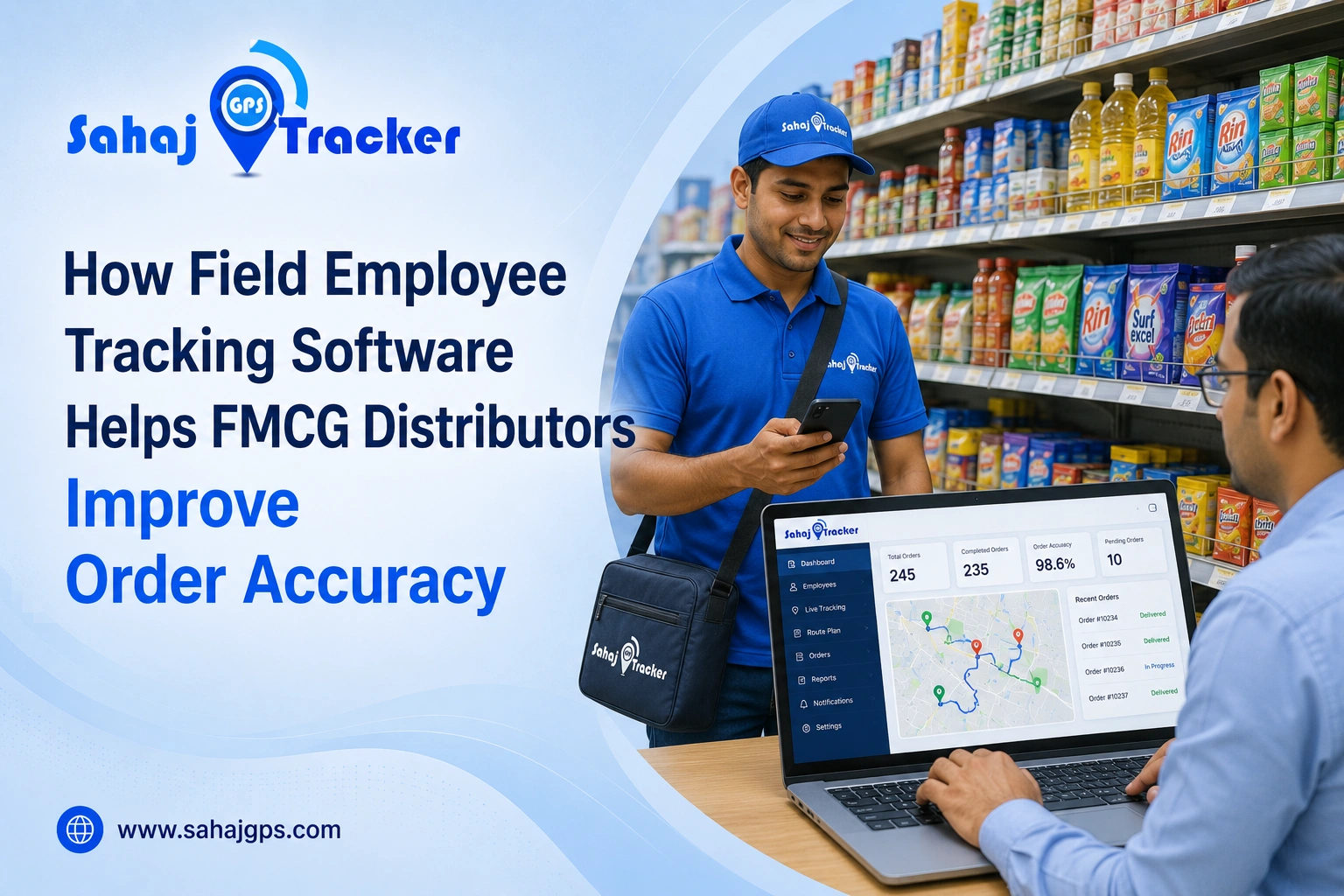
For an FMCG distributor, getting the right order from the right retailer sounds simple. In reality, there are plenty of moving parts. Sales representatives are visiting shops, checking stock, discussing offers, collecting orders and moving to the next outlet, often in a hurry. Field employee tracking software can bring some much-needed visibility into this process, helping distributors understand field activity and identify the small gaps that can eventually lead to wrong quantities, missed orders or delivery issues. Sahaj GPS helps businesses add location-based visibility to their field operations, making it easier to understand what is happening across different territories.
What Is Field Employee Tracking Software?
Field employee tracking software is a GPS-based solution that helps businesses monitor the location and movement of employees working outside the office. In an FMCG business, this usually means sales representatives, merchandisers, collection executives and other field teams who spend most of their day visiting retailers.
A field employee tracking system can provide information such as current employee location, route history, visit activity and time spent in different areas. The useful part is that this information can be considered alongside sales activity. A manager doesn’t have to depend completely on phone calls or end-of-day reports to understand what happened in the field.
Sahaj GPS provides GPS-based tracking capabilities that can help businesses get a clearer picture of employee movements, routes and daily field activity.
Why Order Accuracy Matters in FMCG Distribution
Order mistakes can be surprisingly expensive in FMCG distribution. A salesperson might visit a busy retailer, take an order for several products and enter the quantities while answering questions from the shopkeeper. Maybe two cartons become twenty. Maybe one product is missed completely. It sounds like a small mistake, but when similar errors happen across hundreds of outlets, the impact becomes much bigger.
Poor order accuracy in FMCG distribution can affect the warehouse, delivery team and retailer at the same time. The warehouse may pick incorrect stock, the delivery vehicle may arrive with products the retailer didn’t request, and someone eventually has to arrange a correction.Nobody wants that extra call.
Better field visibility does not automatically prevent every order error, but it can help distributors understand where these problems are happening and whether they are connected to missed visits, rushed routes or inconsistent field processes.
How Field Employee Tracking Software Improves Order Accuracy
Verifying Retailer Visits
One of the most practical uses of field tracking is checking whether assigned outlets were actually visited. If a sales representative records an order from a retailer, managers can review the corresponding location and visit activity for additional context.
This is particularly useful when a distributor manages a large sales territory. Instead of asking every representative to explain every visit, managers can focus on unusual cases or recurring gaps.
The location data is not a replacement for sales records. It simply adds another layer of information that can make the overall process easier to understand. Sahaj GPS can help businesses review field movement and route activity so managers have more useful information when checking retailer coverage.
Reducing Missed Retailer Visits
Retailer coverage is a big part of FMCG sales. If a representative misses an outlet, the distributor may lose an order without even realising it immediately.
With field staff tracking, managers can identify areas where planned visits are frequently incomplete. They can also see whether representatives are spending too much time travelling between outlets.
Sometimes the problem isn’t employee performance at all. The route may simply be unrealistic. A salesperson expected to cover 30 stores across a busy city might spend half the day stuck in traffic. Location history can make that problem visible.
Matching Field Activity With Orders
Another useful application is comparing field movement with recorded sales activity. If an order is entered for a retailer at 12:15 PM, location information can help managers understand whether the representative was working around that outlet at the same time.
This can help identify unusual patterns without manually checking every transaction.
For example, if one outlet repeatedly shows order activity but rarely appears in the representative’s visit history, the distributor can investigate. Maybe the outlet’s information is outdated. Maybe someone else is placing the order. Or perhaps the sales process simply isn’t being recorded correctly.
The data raises the right questions. That’s often half the job.
FMCG Distributor Tracking System for Better Field Management
A reliable FMCG distributor tracking system can help managers understand what is happening across different territories. This becomes increasingly useful when a business has dozens or hundreds of field employees.
Without tracking, managers often depend on calls, spreadsheets and WhatsApp updates. These methods aren’t useless, but they can become messy as the team expands.
A central tracking platform can provide a clearer picture of employee movement, route coverage and field activity. Managers can see whether a territory is being covered properly and where employees are spending most of their time.
Sahaj GPS can support businesses that want to bring location-based visibility into their existing field operations without depending entirely on manual updates.
Improving Routes Can Improve Order Accuracy
Route planning may not seem directly connected to order accuracy, but there is a link.Imagine a salesperson has 25 retailers to visit. The first few stores are close together, but the remaining outlets are scattered across different parts of the city. By late afternoon, the salesperson is rushing. The last few orders are entered quickly, details get missed and the day’s work ends with a headache.
Tracking data can reveal inefficient routes, unnecessary backtracking and areas where employees regularly spend too much time travelling.
Managers can then adjust outlet sequences or territories. Less wasted travel means more time at the retailer, and more time usually means a better chance of checking the order properly.
It is a small operational improvement, but small improvements matter when repeated every day.
How Tracking Supports FMCG Distribution Management
Good FMCG distribution management involves much more than moving products from a warehouse to a retailer. Sales teams need to cover outlets, collect accurate orders, share information with the warehouse and maintain relationships with retailers.
Field tracking can help connect the physical movement of the sales team with these daily activities.
For instance, a manager may notice that one territory has consistently lower outlet coverage than another. Another area might show unusually long travel times. A third territory could have many late-day visits.
These patterns can help managers decide whether they need to change routes, redistribute outlets or adjust daily targets.
Sahaj GPS can provide location and movement information that businesses use as part of this wider operational decision-making process.
Field Employee Tracking Software for FMCG Businesses in India
FMCG businesses operating in India often deal with very different field conditions. A representative working in Mumbai may cover dense markets and heavy traffic, while another employee in a smaller city may travel much longer distances between retailers.
That is why field employee tracking software in India can be useful for understanding territory-level differences instead of applying the same assumptions everywhere.
A distributor operating across Delhi, Bengaluru, Mumbai, Pune, Hyderabad or Ahmedabad may have very different route patterns in each city. Location data can help managers see those differences and plan accordingly.For larger distribution networks, this can also make it easier to compare field coverage and identify territories that need additional attention.
Choosing the Right Field Tracking Solution
The right system should solve a real operational problem. Before selecting one, distributors should decide whether they mainly need employee location tracking, route history, outlet visit visibility or broader fleet and field monitoring.
Ease of use matters too. If the dashboard is difficult to understand, managers won’t use it regularly. Employees also need a system that doesn’t turn normal field work into a complicated reporting exercise.
Sahaj GPS can be considered by FMCG distributors looking for GPS-based field visibility, route monitoring and employee tracking capabilities.
It is also worth checking mobile access, reporting options, GPS accuracy, customer support and subscription terms before making a decision. The cheapest option isn’t always the cheapest once you add recurring costs and operational limitations.
Best Practices for Improving FMCG Order Accuracy
Tracking works better when it is connected to a clear process. Distributors should define outlet visit expectations, maintain updated retailer information and review field activity regularly.
Managers should also avoid excessive alerts. If employees receive notifications for every tiny movement, the useful alerts can get lost in the noise.
Most importantly, use the information constructively. If tracking shows that a representative is struggling to complete visits, find out why before assuming the worst. Traffic, territory size, outlet timings and route design can all affect field performance.
And when the same order errors keep appearing, look for the pattern. Maybe certain outlets have confusing product names. Maybe representatives need better order-entry training. Maybe the daily route simply leaves too little time for careful order collection.
A More Accurate FMCG Sales Process Starts in the Field
Order accuracy isn’t created inside the warehouse alone. It starts much earlier, when a salesperson walks into a retail shop and begins discussing the next order.
If the outlet is visited at the right time, the representative has enough time to check requirements and the order is recorded correctly, the rest of the distribution process becomes much smoother.
Field employee tracking software can support that process by giving distributors better visibility into routes, visits and field activity. It won’t magically remove every mistake. Nothing really does.
But when a business has hundreds of retailers and a large field team, even a little more visibility can make daily operations easier to manage, and that’s where the real value lies.
FAQs
1. How does field employee tracking software improve FMCG order accuracy?
It helps managers verify field visits, review routes and compare employee activity with recorded orders. This can reveal missed outlets, unusual patterns and process gaps that may contribute to order errors.
2. What is a field employee tracking system?
A field employee tracking system uses GPS technology to monitor authorised employees working outside the office. It can provide location, route and visit information, helping managers coordinate field teams more effectively.
3. Can an FMCG distributor tracking system monitor sales representatives?
Yes. It can provide location and route visibility for authorised sales representatives, helping distributors understand territory coverage, retailer visits and field movement without relying entirely on manual updates.
4. Is field staff tracking useful for FMCG distribution management?
Yes. Field staff tracking can help managers review routes, outlet coverage and employee movement. This information can support better territory planning, productivity analysis and day-to-day FMCG distribution management.
5. Does employee tracking guarantee better order accuracy?
No, tracking alone cannot guarantee accurate orders. It provides useful field visibility, while proper order-entry processes, employee training, updated retailer data and regular management reviews are still important.