
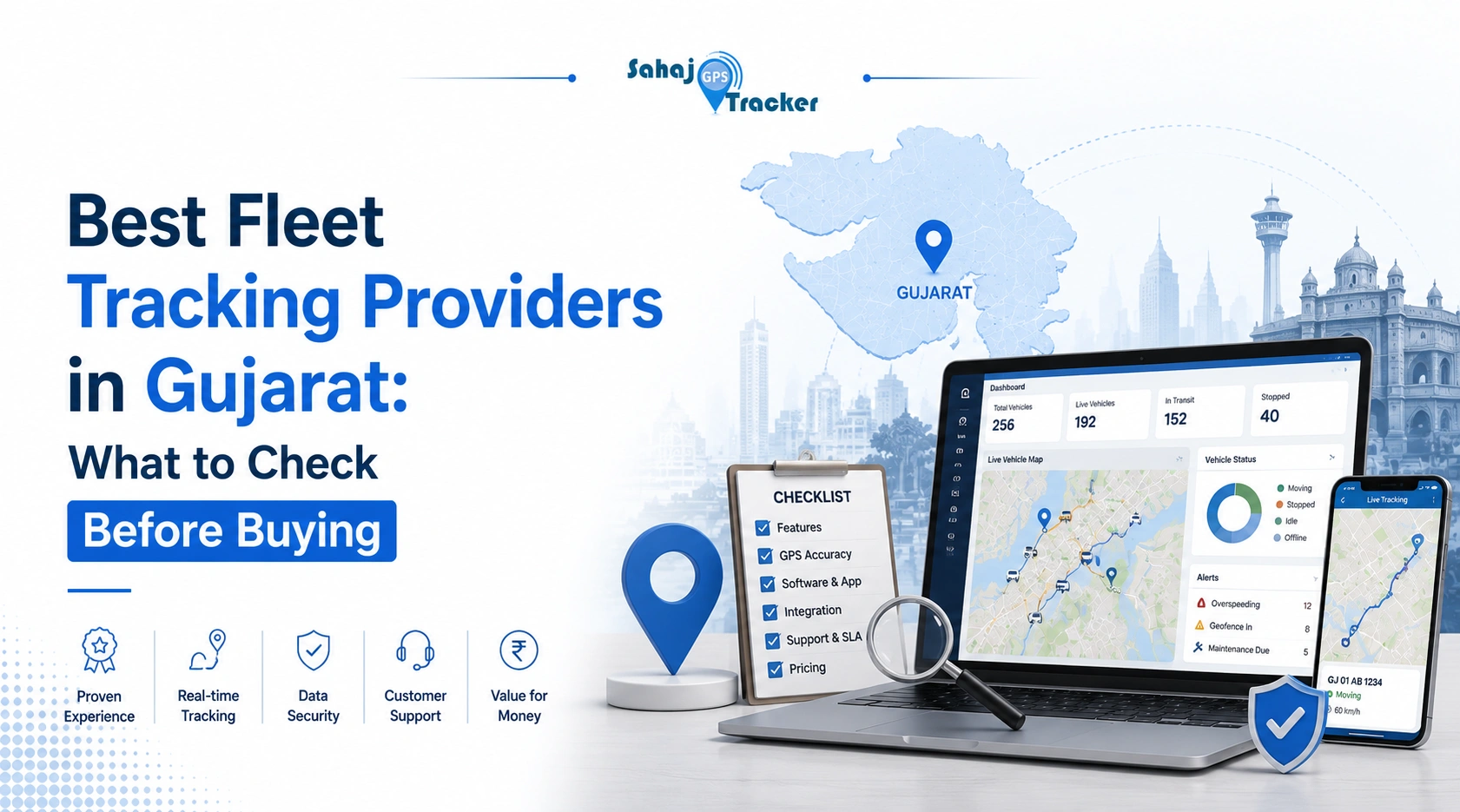
If you’re running a fleet in Gujarat and searching for a vehicle real time tracking system, you’ve probably already discovered that the market has more options than you can realistically evaluate – and most of them say roughly the same things about themselves. Real-time tracking. Fuel monitoring. AIS 140 compliance. Driver alerts. The language is almost identical across providers, which makes the actual comparison surprisingly difficult.
Gujarat has one of the most active commercial fleet markets in India. The Ahmedabad-Surat-Vadodara corridor alone handles billions of rupees in freight movement daily – textiles, chemicals, diamonds, FMCG, agri-produce. Add Rajkot’s manufacturing base and Gandhinagar’s government vehicle fleet requirements, and you have a state where fleet management isn’t a niche concern. It’s central to how business actually moves.
This guide cuts through the provider marketing to show you what actually matters before you buy.
Why Fleet Tracking in Gujarat Has Specific Requirements You Can’t Ignore
Gujarat’s geography and industrial structure create GPS requirements that a generic provider pitch doesn’t account for.
Gujarat’s Industrial Corridors Demand Reliable Connectivity Throughout
The stretches between Surat and Vadodara along NH-48, or between Ahmedabad and Rajkot on NH-947, aren’t uniformly well-covered by all cellular networks. A vehicle gps system that performs well in a city demo but drops connectivity on a state highway between two industrial clusters is operationally useless for exactly the route where you need it most.
Platforms that use multi-network SIM configurations – automatically switching between available operators – handle Gujarat’s mixed connectivity landscape far better than single-operator devices. This isn’t a marketing claim to verify. Ask any provider specifically which network their SIMs operate on and whether automatic failover to another network is built in. The answer tells you a lot.
Chemical and Pharmaceutical Fleets Have Stricter Compliance Expectations
Vadodara and Ankleshwar have significant chemical manufacturing clusters. Fleets moving hazardous cargo have compliance requirements that go beyond standard AIS 140 – real-time route tracking that can be shared with clients and regulators, SOS capabilities, and documentation trails that hold up in inspection.
For this segment specifically, the Fleet Management System you choose needs to be capable of generating regulatory-quality documentation automatically, not just operational dashboards for internal use.
What to Actually Check Before Signing With Any Gujarat Provider
AIS 140 Certification – Verify, Don’t Just Accept
AIS 140 is mandatory for commercial vehicles in India. But “AIS 140 compliant” on a brochure is not the same as a verifiable ARAI certification number that you can check against the official list. Ask for the specific certification number. Look it up. If the provider hesitates or offers a vague assurance instead of a number, that’s your answer.
Also confirm that the device is registered with MoRTH’s Vehicle Location Tracking platform – not just installed and running, but actually transmitting to the government server. Some devices are certified but not registered, which means compliance on paper but not in practice during a permit renewal or inspection.
Geofencing GPS Tracker Features for Industrial Zone Management
Geofencing GPS tracker capability is particularly valuable in Gujarat because of how industrial zones are structured. Chemical plants in Ankleshwar have restricted entry zones. Textile manufacturing units in Surat have designated loading areas with strict timing. Diamond processing facilities in Surat’s SEZ have security perimeters that vehicle access needs to be documented against.
Geofencing that fires alerts the moment a vehicle enters or exits a defined boundary – and logs those events in a timestamped report – supports compliance documentation for client contracts that require it, in addition to the obvious fleet management uses.
Fleet Tracking Providers in Gujarat: An Honest Look
The Provider That Gujarat Fleet Operators Keep Coming Back To
Among the providers serving Gujarat’s commercial fleet market, Sahaj GPS consistently stands out – and the reasons are specific rather than generic.
Coverage in Gujarat is genuinely strong, including on the industrial corridors where single-operator GPS systems tend to develop dead spots. The devices use 4G connectivity with multi-network SIM configuration, which means the coverage gaps that affect some competitors on the Surat-Vadodara-Ahmedabad routes don’t show up the same way in Sahaj GPS deployments.
AIS 140 certification is current and verifiable – the ARAI certification number is available and the VLT platform integration is built into the setup process rather than being a separate configuration step. For Gujarat fleet operators dealing with permit renewals in a state where transport authorities have been active on compliance enforcement, this matters practically.
The feature set covers everything a Gujarat commercial fleet actually needs: real-time location updating every 10 seconds, fuel sensor integration for the kind of consumption monitoring that matters when diesel is 40% of your operating cost, driver behavior scoring that generates weekly reports by driver rather than requiring manual data extraction, and Geofencing GPS tracker functionality that can be configured around industrial zones, client premises, and depot boundaries without requiring IT involvement every time.
Sahaj GPS specifically addresses the customer support reality of Indian fleet operations – which is that something will go wrong with a device or a SIM at an inconvenient time, and the support response quality in that moment determines whether the system is actually usable for operations managers who can’t afford to wait 48 hours for a ticket resolution.
For Gujarat’s FMCG distributors, textile fleet operators, chemical logistics companies, and manufacturing firms with multi-location vehicle fleets – the combination of local connectivity reliability, compliance documentation, and support quality is what keeps Sahaj GPS at the top of evaluations when Gujarat operators compare options seriously.
Other Providers Operating in Gujarat
LocoNav has a visible presence in Gujarat, particularly in the urban logistics space around Ahmedabad. Their last-mile delivery features are well-built and their routing interface is clean. For e-commerce and hyperlocal delivery fleets operating primarily within city limits, they’re worth evaluating alongside any other shortlisted option.
Fleetx has found traction with larger logistics companies running inter-state freight, including routes originating from Gujarat’s industrial zones. Their long-haul analytics and driver management features are genuinely strong. Less optimized for smaller fleets or businesses that need a simpler operational interface.
LetsTrack is present at the affordable entry-level end of the Gujarat market. For small businesses exploring GPS tracking for the first time with 3-5 vehicles, it’s a low-commitment starting point. Feature depth is limited compared to platforms built for serious commercial fleet management, but the price point makes initial adoption accessible.
Vamosys has historically been stronger in South India but has expanded into Gujarat. Their fuel monitoring features are capable. Local support infrastructure in Gujarat is thinner than providers with longer regional presence, which is worth factoring into a decision if your operations are concentrated in tier-2 Gujarat cities.
Fleet Management System Features That Specifically Matter for Gujarat Fleets
Beyond the standard feature checklist that every provider covers, a few things are particularly relevant for Gujarat operations:
Offline data handling. The stretches of NH-48 between Surat and Bharuch, or the rural routes feeding into Rajkot’s manufacturing clusters from surrounding districts, have connectivity gaps. A Fleet Management System that stores location data locally and syncs when connectivity returns maintains a complete trip record. One that simply loses data during coverage gaps creates holes in your operational and compliance documentation.
Scalability for seasonal volume changes. Gujarat’s agricultural produce logistics and textile industry both have seasonal peaks. A platform that handles 20 vehicles cleanly but becomes difficult to manage when you scale to 35 during peak season isn’t a good long-term fit for operators whose fleet size isn’t constant.
Reporting formats that work for client communication. Many Gujarat B2B fleet operators – particularly those serving manufacturing and chemical clients – need to provide delivery confirmation documentation to clients as part of their contracts. GPS reports that can be exported in clean, readable formats save significant administrative time.
Making the Final Decision: What to Prioritise
There’s no universally right answer because Gujarat’s fleet operations cover an enormous range – 5-vehicle textile delivery operations in Surat and 200-vehicle chemical logistics fleets in Vadodara have genuinely different requirements.
What’s consistent across all of them: verify AIS 140 compliance independently, test connectivity on the specific routes your vehicles actually use, evaluate support quality by contacting them during the trial period with a real question, and work out total cost of ownership over 24 months rather than comparing hardware prices.
The vehicle real time tracking system that wins a demo comparison isn’t always the one that delivers after 18 months of actual operations. Gujarat’s fleet operators who’ve gone through a bad GPS deployment and recovered from it will tell you the same thing: ask harder questions before you sign, not after.
FAQs
Q1. What is a vehicle real time tracking system and how does it work?
It uses a GPS device in each vehicle to transmit live location data over cellular networks to a cloud dashboard – updating every few seconds so fleet managers see current position, speed, and status without delays that make real-time management impractical.
Q2. What should Gujarat fleet operators check before buying a GPS tracking system?
Verify AIS 140 certification number on ARAI’s official list, confirm 4G multi-network connectivity, test coverage on actual Gujarat highway routes, check local support availability, and calculate full 24-month cost including hardware and subscription.
Q3. How does a Geofencing GPS tracker help Gujarat industrial fleet operators?
It creates virtual boundaries around client sites, depots, and restricted zones – automatically logging entry and exit events with timestamps, enabling compliance documentation for clients and alerts for unauthorized zone access without manual monitoring.
Q4. Why does Gujarat’s industrial corridor create specific GPS requirements?
The Ahmedabad-Surat-Vadodara corridor has mixed cellular coverage on highway stretches that single-operator GPS devices handle poorly. Multi-network SIM configurations and offline data buffering are essential for maintaining complete trip records across Gujarat routes.
Q5. How quickly do Gujarat fleet operators typically see ROI from GPS tracking?
Most Gujarat fleet operators report full ROI within 2–4 months – primarily through fuel savings from monitoring, route optimization, reduced unauthorized vehicle use, and driver accountability improvements across their commercial vehicle operations.