
A field employee tracking system replaces manual attendance with GPS-based check-ins, live employee tracking, task management, and automated reporting. It helps businesses improve workforce visibility, reduce administrative work, verify customer visits, and manage field teams more efficiently.
Every business wants its field teams to be productive, accountable, and well-coordinated. However, achieving this becomes difficult when attendance and daily activities are still managed through phone calls, spreadsheets, paper registers, or messaging apps. As organisations grow, these manual processes consume valuable time and often fail to provide an accurate picture of what’s happening in the field.
Modern businesses require more than simple attendance records. They need real-time information that helps managers understand where employees are, whether assigned work has been completed, and how field operations are performing throughout the day. A GPS-enabled field employee tracking system addresses these challenges by bringing attendance, employee monitoring, task tracking, and reporting together on one platform.
Why Manual Attendance Creates Operational Challenges
Manual attendance methods may appear simple, but they become increasingly difficult to manage as the workforce expands across different locations.
Managers often spend a considerable amount of time:
- Calling employees for updates
- Verifying attendance
- Reviewing spreadsheets
- Collecting daily reports
- Resolving attendance discrepancies
Apart from increasing administrative work, manual systems also create delays in decision-making because information is usually available only after the workday has ended.
Common Problems Businesses Face
Without a digital attendance system, organisations frequently encounter operational issues such as:
- Delayed attendance reporting
- Unverified client visits
- Attendance errors
- Payroll discrepancies
- Limited workforce visibility
- Inefficient employee scheduling
- Reduced accountability
These problems often affect productivity, customer service, and overall operational efficiency.
Understanding a Field Employee Tracking System
A field employee tracking system combines GPS technology with attendance management, task tracking, route monitoring, and workforce reporting.
Instead of maintaining separate tools for attendance, reporting, and employee communication, businesses can manage field operations through one central dashboard.
Modern solutions generally include:
- GPS-based attendance
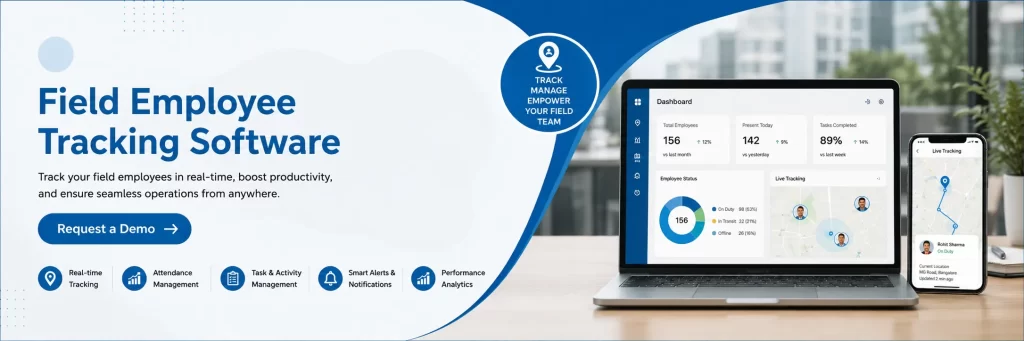
- Live employee tracking
- Mobile check-in and check-out
- Task management
- Route monitoring
- Visit verification
- Performance reports
- Workforce analytics
This simplifies day-to-day management while providing greater visibility into employee activities.
Real-Time Employee Visibility
Managing field teams becomes much easier when managers know where employees are throughout the working day.
Real-time tracking allows organisations to monitor employee movement without interrupting work through frequent phone calls.
Live visibility helps businesses:
- Verify employee location
- Improve workforce planning
- Allocate urgent assignments
- Monitor travel routes
- Respond quickly to operational issues
Accurate information enables managers to make faster and more effective operational decisions.
GPS-Based Attendance Management
One of the biggest advantages of a digital attendance system is location-based check-in.
Instead of relying on manual attendance, employees can record their attendance only after reaching their assigned work location.
GPS attendance helps organisations:
- Improve attendance accuracy
- Prevent proxy attendance
- Simplify payroll processing
- Reduce reporting errors
- Improve workforce discipline
This creates a transparent attendance process for both employees and management.
Customer Visit Verification
For businesses involved in sales, maintenance, healthcare, inspections, or field services, verifying customer visits is an important part of daily operations.
A field employee tracking platform allows employees to record completed visits using:
- GPS location
- Time stamps
- Digital forms
- Photographs
- Visit history
These records help managers confirm completed work while improving customer confidence and employee accountability.
Better Task Management
Assigning work digitally allows managers to monitor progress throughout the day instead of waiting for end-of-day updates.
A structured task management system enables businesses to:
- Assign tasks instantly
- Set priorities
- Track work progress
- Monitor pending activities
- Improve coordination between teams
This reduces communication gaps while helping employees complete their work more efficiently.
Workforce Analytics for Smarter Decisions
Managing a field workforce becomes much more effective when decisions are based on accurate data instead of assumptions. A modern tracking platform continuously records employee activities, allowing managers to evaluate performance through detailed reports rather than manual updates.
Businesses can analyse:
- Daily attendance
- Client visit completion
- Route efficiency
- Time spent at customer locations
- Travel distance
- Employee productivity
- Task completion rates
These insights help organisations identify operational gaps, improve workforce planning, and optimise resource allocation over time.
Reduce Administrative Workload
Manual attendance management often requires HR teams and supervisors to spend hours collecting attendance records, verifying reports, preparing payroll data, and resolving discrepancies.
A digital tracking solution automates these routine processes, allowing administrative teams to focus on more strategic responsibilities.
Automation helps reduce:
- Manual paperwork
- Attendance verification time
- Payroll calculation errors
- Report preparation effort
- Duplicate data entry
This improves operational efficiency while ensuring attendance records remain accurate and up to date.
Supports Multiple Industries
A field employee tracking system is useful for any organisation whose employees regularly work outside the office.
It is widely adopted across industries such as:
- Sales and distribution
- Healthcare and pharmaceuticals
- Facility management
- Logistics and delivery
- Construction
- Maintenance services
- Utilities
- Inspection and survey companies
Although operational requirements vary across industries, the need for workforce visibility and accurate attendance remains the same.
Better Workforce Accountability
Transparency plays an important role in improving field operations. When attendance, customer visits, and assigned tasks are recorded automatically, managers gain greater confidence in operational reporting while employees have a clear understanding of their responsibilities.
A structured tracking system encourages:
- Timely attendance
- Better task completion
- Improved customer service
- Responsible field operations
- Consistent reporting
Rather than increasing supervision, it creates a more organised and accountable work environment.
Faster Operational Planning
Real-time workforce information allows businesses to respond quickly whenever priorities change. Managers can assign urgent tasks, redistribute workloads, or support employees without waiting for manual status updates.
Improved visibility supports:
- Faster task allocation
- Better territory management
- Efficient employee scheduling
- Improved customer response time
- Better utilisation of field resources
This flexibility becomes increasingly valuable as field operations continue to expand.
Features That Improve Daily Operations
Modern field employee tracking platforms combine several workforce management tools into one solution.
Key features typically include:
- Live GPS tracking
- Mobile attendance
- Geo-fencing
- Task assignment
- Route history
- Customer visit verification
- Expense management
- Performance reports
- Workforce analytics
- Leave management
Having these features within one platform reduces complexity while improving overall operational control.
How Sahaj GPS Helps Businesses Manage Field Teams
Managing a growing workforce requires reliable information and efficient coordination. Sahaj GPS provides a comprehensive field employee tracking solution that combines GPS-based attendance, real-time employee monitoring, customer visit verification, task management, workforce analytics, and automated reporting through a single dashboard.
By replacing manual attendance methods with intelligent automation, Sahaj GPS helps organisations improve operational visibility, strengthen employee accountability, reduce administrative work, and make faster business decisions using real-time workforce data.
Final Thoughts
Manual attendance systems often struggle to meet the demands of today’s mobile workforce. As businesses expand their field operations, accurate attendance management, employee visibility, and task monitoring become increasingly important for maintaining productivity and delivering better customer service.
A modern field employee tracking system simplifies workforce management by automating attendance, verifying field activities, and providing valuable operational insights. With accurate data available throughout the working day, businesses can improve efficiency, strengthen accountability, and manage field operations with greater confidence.
Frequently Asked Questions
What is a field employee tracking system?
A field employee tracking system is a GPS-enabled workforce management solution that helps businesses monitor employee attendance, location, tasks, and field activities in real time.
How does GPS attendance improve workforce management?
GPS attendance records employee check-ins based on location, improving attendance accuracy, reducing manual verification, and simplifying payroll processing.
Can the system verify customer visits?
Yes. Modern platforms record GPS location, timestamps, photographs, and digital visit information to verify completed customer visits.
Which industries can use field employee tracking software?
It is suitable for sales, healthcare, logistics, construction, maintenance services, utilities, facility management, inspection companies, and many other businesses with mobile workforces.
5. How does employee tracking software improve productivity?
Employee tracking software improves productivity by providing real-time visibility, attendance automation, workforce analytics, task monitoring, and performance reporting.