
An advanced indoor tracking system helps businesses monitor the real-time location of employees, equipment, and valuable assets inside buildings where GPS signals are unreliable. Using technologies such as Bluetooth Low Energy (BLE), Ultra-Wideband (UWB), Wi-Fi, and RFID, it improves operational visibility, enhances workplace safety, reduces asset search time, and supports smarter business decisions.
The biggest operational delays don’t always happen on the road—they often happen inside the workplace. Employees spend valuable time searching for equipment, managers struggle to locate critical assets, and workflows slow down simply because there is no clear visibility into what’s happening inside the facility. As businesses grow, these small inefficiencies quickly become expensive operational challenges.
Traditional GPS tracking performs exceptionally well outdoors, but it loses accuracy inside warehouses, hospitals, factories, and large commercial buildings. This is where advanced indoor tracking becomes valuable. It gives businesses precise, real-time visibility into people, assets, and equipment, helping organisations improve productivity, strengthen safety, and manage operations more efficiently.
What Is Advanced Indoor Tracking?
An advanced indoor tracking system is an indoor positioning solution that continuously monitors the movement and location of assets, employees, and equipment inside enclosed environments. Unlike conventional GPS, it uses multiple wireless technologies to deliver accurate positioning even in complex indoor spaces such as warehouses, hospitals, manufacturing plants, offices, and retail facilities.
Instead of relying on manual searches or paper records, businesses receive real-time location data that supports faster decision-making and better operational control.
Why GPS Alone Isn’t Enough Indoors
GPS signals depend on satellites, making them highly effective in open outdoor environments. Inside buildings, however, walls, ceilings, machinery, and structural materials weaken those signals, reducing positioning accuracy.
Businesses operating large indoor facilities require technology specifically designed for enclosed spaces. An indoor positioning system provides reliable location tracking without depending on satellite coverage, allowing organisations to monitor daily operations with greater confidence.
This improved visibility helps businesses:
- Locate assets instantly
- Monitor employee movement
- Improve operational efficiency
- Reduce search time
- Strengthen workplace safety
Technologies That Power Advanced Indoor Tracking
Modern indoor tracking solutions combine multiple wireless technologies depending on business requirements, facility size, and the level of accuracy needed.
Bluetooth Low Energy (BLE)
Bluetooth Low Energy (BLE) is one of the most widely used technologies for indoor positioning. Small beacons installed throughout a facility communicate with tagged assets or employee devices, providing accurate location updates while consuming very little power.
BLE is ideal for:
- Warehouses
- Office buildings
- Hospitals
- Educational campuses
- Distribution centres
It offers reliable room-level or zone-level tracking at a relatively low deployment cost.
Ultra-Wideband (UWB)
When businesses require extremely accurate positioning, Ultra-Wideband (UWB) provides one of the highest levels of precision available.
UWB technology is commonly used for:
- Manufacturing plants
- High-value asset tracking
- Industrial automation
- Equipment positioning
- Worker safety monitoring
Its centimetre-level accuracy makes it suitable for environments where even small positioning errors can affect productivity.
Wi-Fi-Based Indoor Tracking
Many organisations already have extensive wireless infrastructure installed throughout their facilities. Wi-Fi-based indoor tracking allows businesses to utilise this existing network for employee and asset location tracking without requiring major infrastructure changes.
Although its accuracy is generally lower than BLE or UWB, it remains a practical solution for organisations seeking cost-effective indoor visibility.
RFID Tracking
RFID technology is commonly used where businesses need to monitor assets moving through specific checkpoints rather than continuously tracking their exact location.
Typical applications include:
- Inventory management
- Warehouse storage
- Asset identification
- Access control
- Material movement
RFID provides reliable tracking while simplifying inventory and stock management.
IoT Sensors
Modern IoT sensors extend indoor tracking beyond location monitoring by collecting additional environmental information such as temperature, motion, occupancy, and equipment status.
This combination of location and environmental data allows businesses to make smarter operational decisions while improving workplace safety.
Where Advanced Indoor Tracking Creates the Biggest Impact
Different industries experience different operational challenges, but one common requirement remains the same—better visibility into daily activities.
Warehouses and Distribution Centres
Warehouses handle thousands of moving assets every day. Searching for misplaced pallets, forklifts, scanners, or inventory wastes valuable working hours and delays order fulfilment.
An indoor asset tracking system provides live visibility into equipment, inventory, and employee movement, allowing warehouse managers to improve storage planning, optimise picking routes, and reduce unnecessary travel throughout the facility.
The result is faster operations, better inventory accuracy, and improved warehouse productivity.
Hospitals and Healthcare Facilities
Healthcare professionals cannot afford to spend valuable time searching for medical equipment during emergencies.
An indoor tracking system enables hospitals to locate wheelchairs, infusion pumps, emergency carts, medical devices, and other critical equipment immediately. Staff can respond faster while improving patient care and reducing equipment loss.
The same technology also improves staff safety by helping supervisors monitor employee locations during emergency situations.
Manufacturing Plants
Manufacturing environments depend on accurate coordination between workers, machinery, and production tools. Misplaced equipment or unauthorised access to restricted areas can disrupt production while increasing operational risks.
An industrial indoor positioning system allows manufacturers to monitor equipment usage, improve tool accountability, strengthen worker safety, and maintain accurate operational records without relying on manual reporting.
Corporate Offices and Smart Workspaces
Modern workplaces are becoming more dynamic, with employees working across multiple departments, meeting rooms, and shared spaces. Without accurate occupancy data, organisations often struggle to utilise office space efficiently while maintaining smooth daily operations.
An indoor tracking solution provides valuable insights into workspace usage, meeting room occupancy, employee movement, and common area utilisation. Facility managers can optimise office layouts, improve resource allocation, and make better decisions based on actual workplace activity rather than assumptions.
This helps businesses:
- Improve workspace utilisation
- Reduce unused office space
- Optimise meeting room availability
- Support hybrid working models
- Improve facility management
Retail Stores and Shopping Centres
Retail businesses need complete visibility over both customer flow and staff movement to deliver a better shopping experience.
An indoor positioning system helps retailers monitor employee availability, analyse customer movement patterns, and improve product placement within stores. Understanding which areas receive the highest footfall allows businesses to optimise store layouts and improve operational efficiency.
Retail managers can also use indoor tracking to allocate staff more effectively during peak shopping hours and improve customer service across different sections.
How Advanced Indoor Tracking Improves Business Performance
The biggest advantage of advanced indoor tracking is not simply knowing where assets or employees are—it’s understanding how daily operations can become faster, safer, and more efficient through accurate operational data.
Businesses using indoor tracking solutions often experience:
- Reduced asset search time
- Better workforce productivity
- Improved operational visibility
- Faster decision-making
- Higher equipment utilisation
- Enhanced workplace safety
- Better inventory control
- Lower operational costs
As organisations continue expanding their facilities, having real-time operational visibility becomes a major competitive advantage.
Features to Look for in an Indoor Tracking System
Choosing the right indoor tracking system requires more than comparing technologies. Businesses should look for features that simplify operations while supporting future growth.
Important capabilities include:
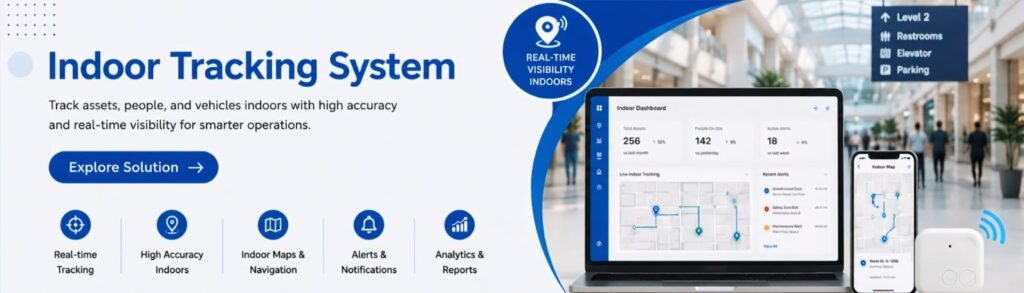
- Real-time indoor location tracking
- Zone-based alerts and notifications
- Indoor geofencing
- Heatmaps and movement analytics
- Multi-floor tracking support
- Asset and employee tracking
- IoT sensor integration
- Activity history and reporting
- Mobile and web dashboards
- Role-based user access
A flexible solution allows businesses to scale their tracking infrastructure as operational requirements continue to evolve.
What to Expect During Implementation
Many organisations assume indoor tracking requires lengthy deployment or major infrastructure changes. Modern systems are designed to minimise disruption while allowing phased implementation based on operational priorities.
The deployment process generally includes:
- Site assessment
- Facility mapping
- Beacon or sensor installation
- Asset tagging
- Dashboard configuration
- Employee training
- System testing
Many businesses begin with one warehouse, production line, or office floor before expanding the solution across the entire facility after seeing measurable operational improvements.
How Sahaj GPS Supports Indoor Tracking Solutions
Managing indoor operations becomes easier when businesses have complete visibility into assets, employees, and equipment from one central platform. Sahaj GPS provides intelligent indoor tracking solutions that combine real-time asset tracking, employee location monitoring, indoor positioning, zone-based alerts, and advanced reporting to improve operational efficiency.
Whether managing warehouses, hospitals, manufacturing facilities, corporate offices, or retail environments, Sahaj GPS helps organisations reduce search time, improve workforce productivity, strengthen workplace safety, and make faster business decisions using accurate location intelligence.
Final Thoughts
As businesses continue investing in digital transformation, indoor visibility has become just as important as outdoor fleet tracking. Knowing the real-time location of employees, equipment, and valuable assets helps organisations improve efficiency while reducing unnecessary operational delays.
An advanced indoor tracking system provides accurate location intelligence that supports smarter workflows, better asset utilisation, improved safety, and stronger operational control. By adopting intelligent solutions such as Sahaj GPS, businesses can build more efficient, data-driven workplaces while preparing for future operational growth.
Frequently Asked Questions
What is the difference between indoor tracking and GPS tracking?
GPS tracking relies on satellite signals and performs best outdoors, while an indoor tracking system uses technologies such as BLE, UWB, Wi-Fi, and RFID to provide accurate positioning inside buildings where GPS signals are weak or unavailable.
How accurate is an indoor positioning system?
Accuracy depends on the technology used. BLE-based systems generally provide room-level accuracy, while Ultra-Wideband (UWB) can deliver centimetre-level precision for high-value asset tracking and industrial applications.
Can indoor tracking work across multiple floors?
Yes. Modern indoor positioning systems support multi-floor facilities by creating separate floor maps and monitoring movement between different levels in real time.
Is indoor tracking suitable for small businesses?
Yes. Indoor tracking solutions are highly scalable and can be deployed in warehouses, offices, retail stores, hospitals, or manufacturing units of any size. Businesses can start with a small deployment and expand as operational needs grow.
Why should businesses choose Sahaj GPS?
Sahaj GPS offers advanced indoor tracking with real-time asset visibility, employee tracking, indoor positioning, zone-based alerts, movement analytics, and intelligent reporting, helping businesses improve productivity, workplace safety, and operational efficiency.