
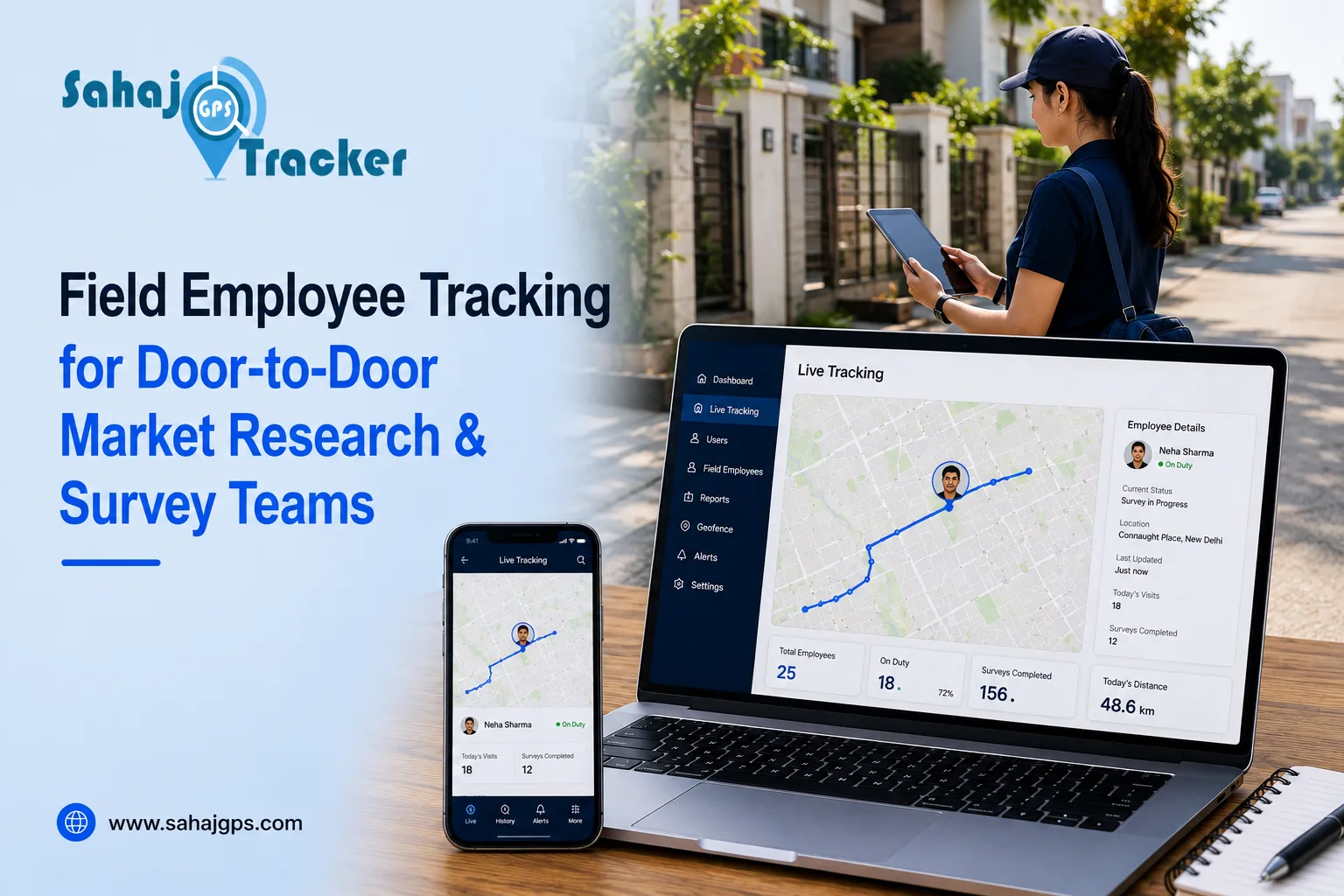
Door-to-door market research and survey teams often work across large areas, making it difficult for managers to know where employees are, which locations they have covered, and whether daily field activities are progressing as planned. Field employee tracking gives businesses better visibility into field operations by helping managers monitor employee locations, movement, assigned areas, and work progress without relying entirely on phone calls or manual reporting.
Why Door-to-Door Survey Teams Need Better Tracking
Market research teams usually visit multiple homes, shops, offices, or public locations during a working day. When several employees are working in different areas, managers may struggle to maintain accurate information about their movements and coverage. Delayed updates can also make it difficult to identify missed locations or redistribute work when one team falls behind.
A field employee tracking system provides a more organised way to manage these activities. Managers can view employee locations, understand movement patterns, and get a clearer picture of how the field team is progressing. This can be particularly useful when projects involve strict timelines or large survey areas.
How a Field Employee Tracking System Works
A typical field staff tracking software solution uses GPS-enabled mobile devices to share location information with authorised managers. Depending on the system, businesses can view current or recent employee locations, monitor routes, define working areas, and review movement information.
The main advantage is improved visibility. Instead of repeatedly calling employees to ask about their location, managers can use tracking information to understand where field staff are working. This allows communication to focus on genuine issues rather than routine location updates. Sahaj GPS provides GPS-based tracking solutions that can help businesses manage field teams with greater visibility and control.
Employee Location Tracking for Survey Teams
An employee location tracking system can make it easier to coordinate survey workers across different locations. Managers can see whether employees have reached their assigned areas and whether field activities are progressing according to the planned schedule.
This becomes even more useful when teams are responsible for different neighbourhoods or customer segments. Location information can help managers understand which areas have already been covered and where additional visits may still be required. Over time, the collected information can also support better planning for future survey campaigns.
Improving Visibility Without Constant Phone Calls
Constantly contacting employees for location updates can consume valuable working time. With real-time employee tracking, managers can check field activity remotely and contact employees only when assistance or clarification is genuinely required.
This approach can also help reduce confusion between field workers and supervisors. When everyone has clearer information about assigned areas and current activity, daily coordination becomes more straightforward.
Geo-Fencing for Field Teams
Geo-fencing for field teams can be useful when employees are expected to work within specific geographical areas. A virtual boundary can be created around a location, allowing managers to receive information when an employee enters or leaves the defined area, depending on the tracking system’s available features.
For market research projects, this can help supervisors manage area-based assignments more effectively. If a survey team has been assigned to a particular neighbourhood, territory, or business zone, geofencing can provide additional visibility into whether the team is operating within the expected area.
Field Survey Team Tracking for Better Area Coverage
Large survey projects often involve dividing cities or regions into smaller territories. Without proper coordination, some locations may receive repeated visits while other areas remain uncovered. Field survey team tracking can help managers maintain a clearer view of team movements and territory coverage.
This information can support better allocation of work. If one employee finishes an assigned area early, managers may be able to assign additional work nearby instead of sending another employee unnecessarily. This can improve the utilisation of field teams and reduce avoidable travel.
Using GPS Tracking to Improve Field Productivity
GPS tracking does not automatically make employees more productive, but it can provide useful information for identifying operational problems. Managers can analyse travel patterns, time spent moving between locations, and the distribution of field activities to understand where delays may be occurring.
For example, if employees spend a significant part of their working day travelling between widely separated locations, managers may be able to redesign territories or assignments. Better planning can reduce unnecessary travel and give employees more time to focus on actual survey work.
Field Staff Tracking Software for Real-Time Monitoring
A reliable field workforce management solution should provide information that managers can actually use. Simply knowing an employee’s location is not enough. Businesses may also need route information, area-based monitoring, historical movement data, and alerts depending on their operational requirements.
Sahaj GPS can be used as part of a broader field workforce tracking approach, helping businesses gain visibility into employee movement and field operations. When tracking information is combined with proper task allocation and reporting processes, supervisors can make more informed decisions throughout the working day.
Managing Door-to-Door Research Across Indian Cities
Door-to-door research can become particularly challenging when teams operate across multiple cities. Different locations may have different traffic conditions, travel distances, population densities, and working patterns. A centralised GPS tracking for field employees approach can help managers maintain visibility even when teams are spread across different regions.
For businesses conducting surveys in cities such as Ahmedabad, Mumbai, Delhi, Pune, Bengaluru, Hyderabad, or Jaipur, location-based monitoring can make coordination more manageable. Instead of depending only on end-of-day reports, supervisors can have a better understanding of field activity as the project progresses.
Privacy and Responsible Employee Tracking
Employee tracking should always be implemented responsibly. Businesses should clearly communicate why tracking is being used, what information is collected, who can access it, and when tracking is active. A transparent approach can help employees understand that the system is intended to support operational coordination rather than unnecessary surveillance.
Companies should also establish appropriate access controls and data-handling practices. Tracking information should only be available to authorised personnel and should be handled according to applicable organisational policies and legal requirements.
Choosing the Right Tracking Solution for Survey Teams
When selecting a field employee tracking software in India, businesses should look beyond basic location tracking. The solution should be practical for employees, easy for managers to use, and suitable for the size and structure of the survey project.
Important considerations include real-time location visibility, geofencing capabilities, route history, mobile accessibility, alerts, reporting, scalability, and ease of implementation. Sahaj GPS offers tracking solutions designed to help businesses manage employees and field operations while maintaining better visibility over daily activities.
Making Door-to-Door Survey Management More Practical
A well-planned door-to-door survey tracking system can bring greater structure to field operations. Managers can use location information to coordinate employees, understand area coverage, identify potential delays, and make better decisions during an ongoing project.
The real value comes from using tracking data alongside good management practices. Clear assignments, realistic schedules, regular communication, and responsible use of technology are still essential. GPS tracking simply gives managers an additional layer of visibility that can make these processes easier to manage.
Conclusion
Managing door-to-door market research teams becomes easier when businesses have better visibility into employee movements and field activities. geo-fencing for field teams can support area-based monitoring, improve territory coordination, reduce unnecessary travel, and help managers understand daily field progress more effectively.
FAQs
1. What is field employee tracking?
Field employee tracking uses GPS technology to help managers monitor the location and movement of employees working outside the office.
2. How does GPS tracking help survey teams?
It helps managers check employee locations, monitor assigned areas, improve territory coverage, reduce unnecessary travel, and coordinate field activities more efficiently.
3. Can field tracking software monitor multiple employees?
Yes, a field tracking system can allow managers to monitor multiple employees from a central platform, making large survey teams easier to coordinate.
4. What is geo-fencing for field employees?
Geo-fencing creates virtual geographical boundaries around specific areas. Managers can use it to understand when employees enter or leave assigned locations.
5. Is employee GPS tracking useful for door-to-door surveys?
Yes. It can provide better visibility into field movements and help managers understand area coverage, employee activity, and progress during door-to-door survey projects.