
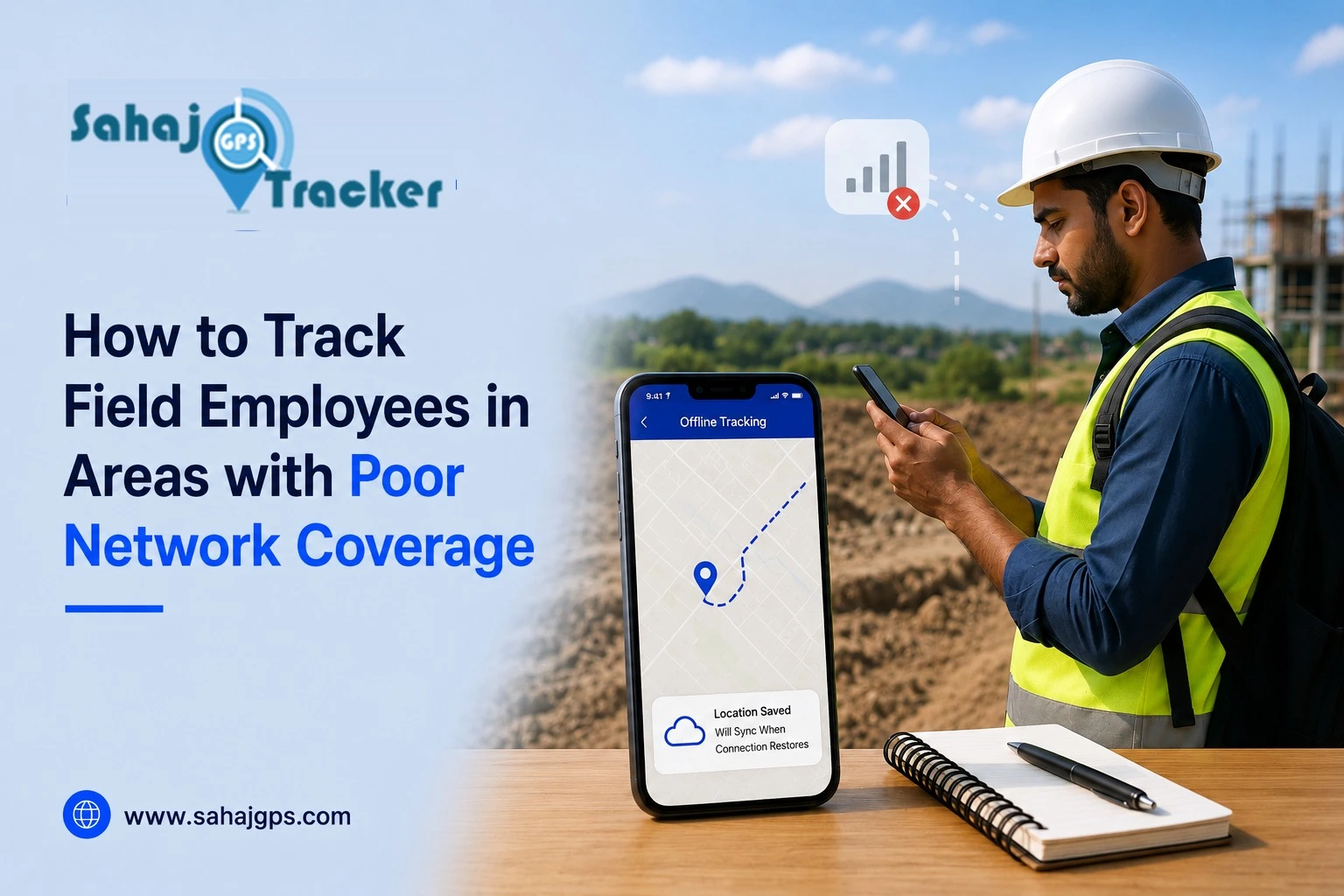
Tracking employees is fairly easy when they work in cities with stable mobile connectivity. But things become difficult when your team travels through villages, highways, forests, mining areas or remote industrial sites. The phone suddenly shows one bar, then nothing.
So, how do you track field employees in poor network areas without calling everyone again and again? This is where a reliable field employee tracking system can help. Instead of depending completely on continuous internet connectivity, a suitable GPS solution can record location data during network gaps and synchronise it once the connection becomes available.
Why Poor Network Coverage Creates Tracking Problems
Field employees don’t always work in places with strong mobile signals. A technician may visit a remote factory, a sales representative may travel through rural areas, or a service team may spend hours on a highway where network coverage keeps changing. In some locations, there may be no connectivity at all for a while.
Traditional online tracking depends on communication between the employee’s device or GPS tracker and the tracking platform. When the connection disappears, new location updates may stop reaching the manager. From the dashboard, it can look as if the employee has stopped moving, even though they are still travelling.
The important thing to understand is that GPS and mobile connectivity are not the same thing. GPS can determine location using satellite signals, while the mobile network is generally used to send that information to the tracking platform. So, poor network coverage doesn’t automatically mean the GPS has stopped working.
Sahaj GPS provides GPS-based tracking solutions that can help businesses maintain better visibility of employee and vehicle movement across different working environments, including locations where connectivity may not always be consistent.
How GPS Tracking Works When the Network Is Unavailable
A common assumption is that GPS tracking completely stops when there is no internet. Not necessarily. The GPS component can continue determining the device’s position even when mobile connectivity is unavailable. The bigger issue is communication. If the device cannot reach the server, fresh location updates cannot be displayed in real time.
A suitable tracking device can handle this by temporarily storing location records. Once the network connection returns, those records can be uploaded to the tracking platform. This gives managers a more complete view of the employee’s journey rather than leaving a large unexplained gap.
For companies operating in remote parts of India, this can be particularly useful. A field worker may lose connectivity for 20 or 30 minutes and then reconnect near the next town. The journey during that offline period can still be valuable operational information.
What Is an Offline Employee Tracking System?
An offline employee tracking system is designed to handle temporary network interruptions. Instead of simply losing location information when connectivity disappears, the tracker can store relevant GPS data locally and synchronise it later.
Consider a technician travelling between two rural service locations. The network works at the first site, disappears on the road and becomes available again near the second site. During that middle section, live updates may not reach the manager. However, if the system supports offline tracking, those location records can remain stored on the device. Once connectivity returns, the information can be transferred to the platform.
This feature can be especially useful for field teams working in rural areas, construction zones, highways, large industrial sites and remote project locations.
How a Field Employee Tracking System Handles Network Loss
A field employee tracking system usually has two separate jobs. It needs to determine the employee’s location, and it needs to communicate that information to the tracking server.
GPS positioning can continue even when mobile connectivity is unavailable. Communication, however, depends on the network.
When a connection is lost, the device can store location points instead of immediately sending them. After reconnecting, the stored information can be synchronised, allowing managers to review the route covered during the offline period.
The exact storage capacity and synchronisation process can differ between devices and platforms. So businesses should check these specifications before selecting a system, particularly if employees regularly work in areas with weak connectivity.
Real-Time Employee Tracking vs Offline Tracking
Real-time employee tracking is extremely useful when network connectivity is available. Managers can view the latest location, monitor movement and check whether employees are travelling toward their assigned destinations.But real-time tracking has one obvious limitation: fresh data needs to be transmitted.
If an employee enters an area with no mobile connectivity, the platform cannot receive new information immediately. This is why businesses working in remote areas should look beyond live tracking alone.
A combination of real-time tracking and offline storage is generally more practical. When the network is available, managers receive current information. When the signal disappears, the device can continue recording and synchronise the stored data later.
Sahaj GPS can support businesses that need location visibility across field operations where network availability changes throughout the working day.
Why an Employee Location Tracking System Helps Remote Teams
An employee location tracking system can provide useful information about employee movement, travel routes and field visits. This can be valuable for businesses whose teams spend most of their working hours outside the office.
Imagine a maintenance company with technicians covering several districts. One technician may visit three customer sites during the day while travelling long distances between them. Without location information, managers may have to rely on phone calls and manually submitted reports.
With GPS tracking, there can be a clearer record of movement. If the employee enters an area with poor connectivity, offline records can preserve part of that journey and upload it later.
That means managers aren’t left with a completely blank section in the route history just because the mobile signal disappeared.
Field Staff Tracking System for Rural and Remote Areas
A field staff tracking system can be useful for businesses operating across rural and remote regions. Field sales teams, utility workers, telecom technicians, agricultural service teams, infrastructure workers and maintenance companies often deal with inconsistent network coverage.
For example, a field sales representative might visit retailers across rural Gujarat. The employee may have strong connectivity in one town and almost no signal on the road to the next. Managers shouldn’t have to worry every time the employee disappears from the map for a short period.
A tracking system with offline support can make this situation easier to handle. Once connectivity returns, stored information can provide a clearer picture of the employee’s movement and completed journey.
Live Employee Tracking When Connectivity Is Available
Live employee tracking remains valuable whenever a stable connection is available. Managers can view the latest location, monitor movement and respond when plans change.
Suppose a technician is delayed at one customer location and another urgent service request arrives nearby. The manager can check which employees are currently in the area and make a more informed assignment.
However, businesses should remember that live tracking depends on communication availability. If an employee enters a complete network dead zone, fresh information cannot reach the platform until connectivity is restored. That’s a network limitation, not necessarily a GPS failure.
Geofencing in Poor Network Areas
Geofencing can also support field employee management. Businesses can create virtual boundaries around offices, customer locations, warehouses, project sites and service areas. When location information reaches the platform, the system can identify whether an employee has entered or left those areas.
Poor connectivity can affect how quickly these events reach the server. If an employee enters a geofenced location while offline, the event may need to be stored and processed after the device reconnects.
This is why businesses operating in remote locations should specifically ask about offline geofence events before choosing a GPS tracking solution.
Benefits of Tracking Field Employees in Poor Network Areas
One obvious benefit is better visibility. Managers don’t have to depend completely on phone calls or handwritten reports to understand where employees have travelled.
Another advantage is better historical information. Without offline support, a network outage can create unexplained gaps in an employee’s route history. With suitable offline storage, those gaps can potentially be filled when the data is synchronised.
It can also improve operational coordination. Managers can use the last available live location and later review the stored route to understand the complete journey. Sahaj GPS can help businesses improve field workforce visibility, route monitoring and employee movement tracking across areas where mobile connectivity isn’t always dependable.
Common Mistakes Businesses Make
One common mistake is assuming that every GPS tracker handles network loss in the same way. They don’t. Offline storage capacity, data retention and synchronisation behaviour can vary significantly between systems. Another mistake is focusing only on live tracking. If employees regularly travel through remote areas, offline functionality may be just as important as real-time updates.
Businesses should also avoid treating GPS tracking as a replacement for communication. Employees still need clear procedures for emergencies, unexpected route changes and situations where the tracking device itself loses power.
Battery life matters too. A tracker that runs out of power during a remote trip won’t provide useful information, regardless of how good its offline functionality is.
How to Choose the Right Tracking Solution
Before choosing a solution, think about where employees actually work. If most of the workforce stays within cities, standard real-time tracking may be enough. If employees regularly travel through rural roads, highways or remote industrial areas, offline tracking should be an important consideration.
Look for accurate GPS positioning, offline data storage, automatic synchronisation, route history, geofencing and useful alerts. It is also worth checking how much location data the device can store without connectivity and how quickly it synchronises after reconnecting. A short field test can reveal more than a long product brochure. Especially when network coverage is unpredictable.
Why Offline GPS Tracking Matters for Field Operations
The real purpose of employee tracking isn’t simply to watch a moving dot on a screen. It’s about having useful information when managers actually need it.
If an employee works in a strong-network area all day, continuous live updates may be enough. But when the job involves remote roads and weak connectivity, the system needs to be more flexible.
A capable setup can provide live information when the network is available and preserve location history when it isn’t. That combination gives businesses a more complete view of field operations without pretending that mobile coverage is perfect everywhere. Sahaj GPS can be considered by businesses looking for GPS-based employee and vehicle tracking across locations where network availability can change from one area to another.
Conclusion
Learning how to track field employees in poor network areas is less about finding a tracker with a stronger signal and more about choosing technology that can handle connectivity gaps. GPS positioning can continue even when mobile communication temporarily disappears, while offline storage can preserve location records until the connection returns. live employee tracking can still remain effective when the system is designed to handle these temporary connectivity issues.
For businesses with employees working across rural roads, highways, remote project sites and industrial areas, this approach can provide much better visibility than relying only on calls and manual reports. The signal may disappear for a while. The employee’s journey doesn’t have to disappear with it.
FAQs
1. Can GPS track employees without internet?
Yes. GPS can determine a device’s location without mobile internet. However, sending that location to a tracking platform requires connectivity. Offline-enabled trackers can store the data and upload it after the network returns.
2. How does offline employee tracking work?
An offline employee tracking system can continue collecting GPS location points when network connectivity is unavailable. The information is stored on the device and synchronised with the platform after a connection becomes available again.
3. Can real-time employee tracking work in remote areas?
Yes, whenever network connectivity is available. During a network gap, live updates may pause, but an offline-enabled tracker can continue recording locations and synchronise the stored information once connectivity is restored.
4. What should I look for in a field staff tracking system?
Look for accurate GPS positioning, offline data storage, automatic synchronisation, route history, geofencing and useful alerts. Testing the system in the actual remote locations where employees work is also a smart step.
5. Does poor mobile network affect GPS accuracy?
Poor mobile network coverage doesn’t necessarily stop GPS positioning because GPS and cellular communication perform different functions. However, weak connectivity can delay the transfer of location data to the tracking platform.