
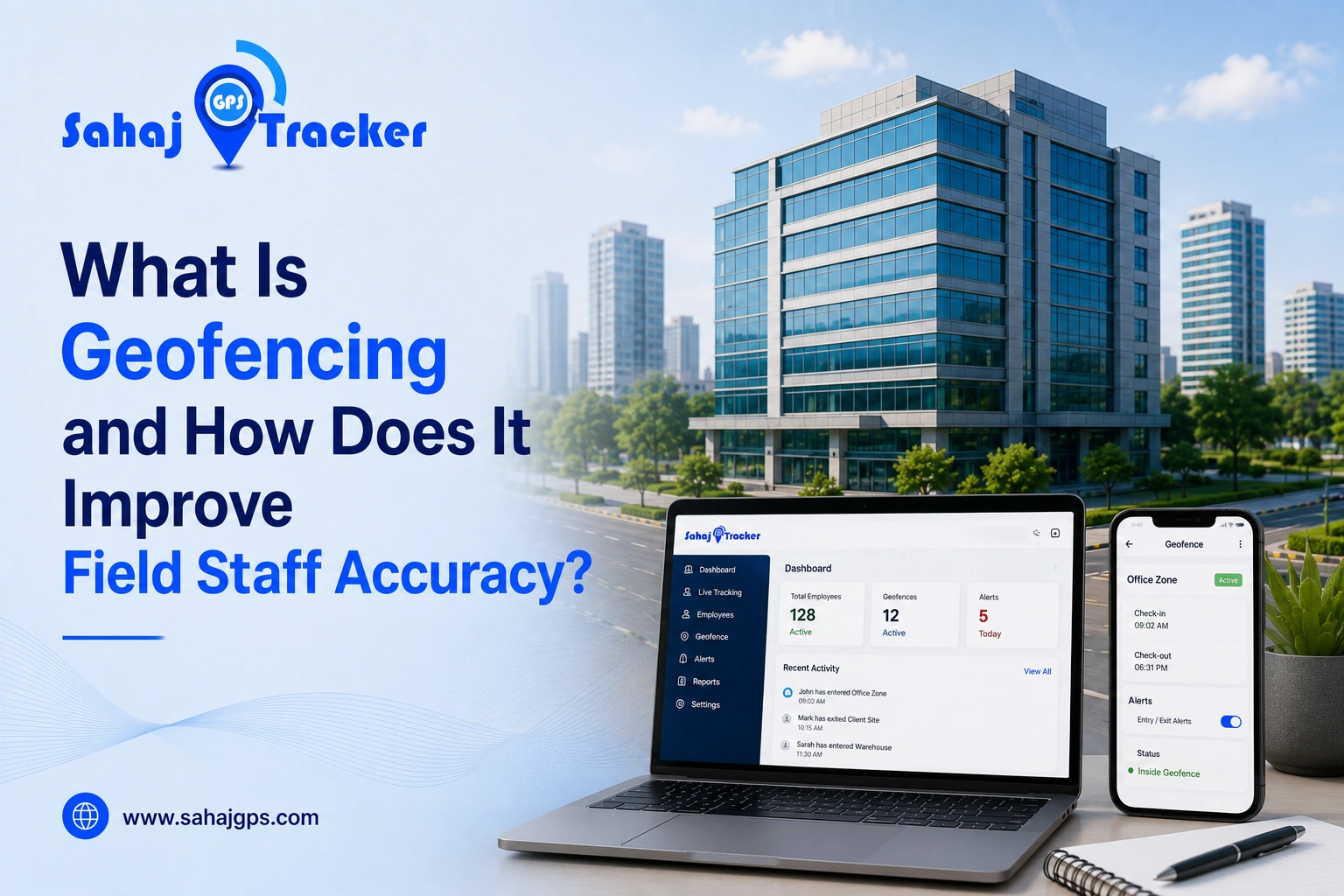
Managing employees who spend most of their working day outside the office can get messy. A sales representative may visit several retailers, a service technician may move between customer sites, and a delivery employee may cover a large part of the city before the day ends. This is where geofencing for field staff becomes useful. Instead of only showing an employee’s location on a map, geofencing connects that location to a specific place by creating a virtual boundary. When an employee enters or leaves that area, the system can record the activity and give managers a clearer picture of field visits, routes and daily work.
What Is Geofencing?
Geofencing is a location-based technology that creates a virtual boundary around a real-world location. That location could be a customer office, retail outlet, warehouse, service centre, project site or defined working area. When a GPS-enabled device enters or exits the boundary, the tracking platform can record the event or send an alert to an authorised user.
The idea is pretty simple. Regular GPS tracking tells a manager where an employee is. Geofencing adds context by showing whether that employee reached a particular place. Sahaj GPS provides GPS-based tracking capabilities that can help businesses use location information for field monitoring, route visibility and location-based operations.
How Does Geofencing for Field Staff Work?
Creating a Virtual Work Zone
The first step is creating a virtual boundary around a location. For example, a company with 50 sales representatives may create geofences around important customer outlets assigned to each employee. When a representative reaches the defined area, the system can recognise the entry and record the visit.
The size of the boundary matters too. A small retail shop in a crowded market may need a relatively tight geofence, while a large factory or warehouse could require a wider area. There isn’t one perfect setting for every location.
Recording Employee Entry and Exit
Once a geofence is active, the system can record when a tracked employee enters and leaves the location. This can be particularly helpful for businesses that need to verify scheduled field visits.
For example, if a technician is expected to visit a customer between 2 PM and 3 PM, the location record can provide supporting information about whether the technician reached the site during that period. It doesn’t replace service records or customer confirmation, but it gives managers another useful piece of information.
How Geofencing Improves Field Staff Accuracy
One of the biggest advantages of geofencing for employee tracking is that it adds context to employee location data. Knowing that someone is somewhere in Mumbai doesn’t tell a manager much about the day’s work. Knowing that the employee entered three assigned customer locations gives a much clearer picture.
Suppose a sales representative has 15 outlets scheduled for the day. At the end of the day, the manager can review which locations were reached and which were missed. If three outlets show no entry activity, there is something worth checking. Maybe the shops were closed. Perhaps traffic caused a delay. Or the route was simply too ambitious.
This is where geofencing can improve field accuracy without turning the whole system into constant employee surveillance. Sahaj GPS can help businesses review field movement and location events so managers have more useful information when checking planned visits and actual field activity.
Geofencing and Real-Time Employee Tracking
Real-time employee tracking shows where a field employee is currently located, while geofencing connects that movement to important places. Used together, these features can provide a more complete picture of field activity.
Imagine a service technician travelling across Pune. Live tracking shows the technician moving along the road. When the technician enters a customer’s geofenced location, the system can record the arrival. When the technician leaves, another event can be recorded. Managers can later review the route and visit history instead of relying completely on calls or manual updates.
This combination is especially useful when teams are spread across large territories and supervisors cannot physically visit every location.
How Geofencing Helps Verify Field Visits
Confirming Customer Visits
Field visits are often recorded through reports, forms or employee updates. These methods can work, but they can also leave room for mistakes. A location-based event can provide additional information showing whether a field employee reached the assigned site.
For a sales team, this might mean creating geofences around retailer outlets. For a service company, the boundaries could be created around customer premises. For delivery operations, they could be placed around warehouses and delivery points.
The point isn’t to treat GPS as an unquestionable source of truth. Location signals can sometimes be affected by buildings, network conditions or device settings. Geofence information works best when considered alongside the rest of the field data.
Identifying Missed Locations
Geofencing can make missed visits easier to identify. If an employee has ten scheduled locations but the system records entry into only seven, the remaining three can be reviewed.
This can help managers find recurring coverage problems. If the same locations are repeatedly missed, perhaps the route needs changing. Maybe those customers have unusual operating hours. Sometimes the issue is with the plan, not the person.
That distinction is important.
Field Staff Tracking System With Geofencing
A field staff tracking system can use geofencing to make routine field management more organised. Instead of continuously checking a live map, managers can review location events and receive alerts when employees enter or leave important zones.
A field service business, for example, could create geofences around customer sites. Managers can then compare scheduled appointments with actual arrival and departure activity. A sales business could use the same approach for retailer visits, while a logistics company could create boundaries around hubs and delivery locations.
Sahaj GPS can support businesses looking to bring GPS-based field visibility and location-based monitoring into their existing operations.
GPS Tracking for Field Employees and Geofencing
GPS tracking for field employees provides movement visibility, but geofencing makes that information more meaningful. A normal map might show that an employee stopped somewhere for 25 minutes. A geofence can indicate that the stop happened at a registered customer location.
That extra context can be valuable when managers review daily activity. It can help them understand whether employees are reaching assigned locations, spending excessive time travelling or regularly missing particular areas.
For companies with large field teams, even small improvements in visibility can make day-to-day management easier.
How Geofencing Can Support Field Productivity
Productivity is a tricky thing to measure. Location data cannot tell you whether a salesperson had a great conversation with a customer or whether a technician solved a problem properly. What it can provide is information about movement, visits and time spent at defined locations.
Over several weeks, these patterns can become useful. A manager might discover that one employee spends an unusual amount of time travelling between customers. Another may have an inefficient route. A third may regularly miss the final few appointments of the day.
Instead of immediately assuming poor performance, managers can investigate the reason. Maybe the territory is too large. Maybe traffic is the problem. Maybe the schedule needs adjusting. Sahaj GPS can provide location information that helps businesses identify these operational patterns and make more informed field management decisions.
Geofencing for Different Field Teams
Sales Representatives
Sales teams can create geofences around retailers, distributors and customer outlets. This can help managers review whether representatives reached assigned locations and identify gaps in territory coverage.
Service Technicians
For service technicians, geofencing can help record arrival and departure at customer sites. This may make appointment tracking easier and help businesses identify repeated delays between service calls.
Delivery Employees
Delivery teams can use geofences around warehouses, hubs and customer locations. Entry and exit events can provide useful information about delivery movement, waiting times and route activity.
Inspection and Collection Teams
Employees handling inspections, collections or field surveys can also benefit from location-based visit verification. If a particular location needs to be visited, the geofence can provide supporting information that the employee reached the defined area.
Geofencing for Field Staff in India
Field operations in India can vary dramatically depending on the city and territory. A representative working in Mumbai may spend significant time dealing with dense traffic, while someone covering smaller towns may travel much longer distances between customers.
This makes field employee location tracking useful for understanding actual territory conditions. Businesses operating across Delhi, Mumbai, Bengaluru, Pune, Hyderabad, Ahmedabad and other cities can review differences in travel patterns and field coverage.
Geofences can then be created around the locations that matter most to each team. It is a more practical approach than treating every territory exactly the same.
Best Practices for Using Geofencing
A geofence should have a clear purpose. Creating hundreds of unnecessary boundaries can lead to too many alerts, and after a while people simply stop paying attention to them. Choose locations that genuinely matter to the field operation and set sensible boundary sizes according to the surroundings.
Businesses should also explain the tracking process to employees. People are generally more comfortable with location monitoring when they understand what is being collected, why it is required and how the information will be used.
It is also worth reviewing geofence accuracy from time to time. If a boundary is too small for a large industrial site or too large around a small shop, the resulting data may not be very useful. Sahaj GPS can be used as part of a broader approach where GPS tracking and geofencing support route planning, visit verification and day-to-day field coordination.
What Geofencing Cannot Do
It is worth keeping expectations realistic. Geofencing cannot tell whether a salesperson had a productive conversation with a customer. It cannot guarantee that an order was entered correctly, and it cannot measure every part of employee performance. What it provides is location-based information.
Used properly, that information can remove some of the uncertainty from field operations. Managers can understand where teams went, which locations were reached and where delays or missed visits may have occurred. That’s useful, especially when a business has a large workforce spread across different areas.
Making Field Operations More Accurate With Location Data
Field staff accuracy isn’t only about knowing where employees are. It is about making field activity easier to verify, understand and improve. Geofencing for field staff provides a practical way to connect employees with the locations they are expected to visit.
When combined with real-time employee tracking, route history and sensible field processes, geofencing can help businesses reduce uncertainty, identify missed visits and improve territory planning. For a small company with only a handful of field employees, the difference may be modest. For a business managing hundreds of employees and thousands of customer locations, it can be much more noticeable.
Sometimes better field management starts with something fairly simple: knowing whether the right person actually reached the right place.
Conclusion
Geofencing makes field employee tracking more useful by connecting employee movement with specific work locations. Instead of only knowing where a field employee is, businesses can understand whether the right locations were actually visited, where delays happened and which visits may have been missed. When combined with GPS tracking, route history and proper field processes, geofencing for field staff can improve visibility and make everyday field operations easier to manage.
FAQs
1. What is geofencing for field staff?
Geofencing creates virtual boundaries around specific locations and records when tracked field employees enter or leave them. It can help businesses verify visits, monitor routes and improve field coordination.
2. How does geofencing improve employee tracking?
Geofencing for employee tracking adds location context by connecting employee movement with specific places. Managers can see whether employees reached assigned locations, missed visits or entered defined work zones.
3. Is geofencing useful for sales representatives?
Yes. Businesses can create geofences around retailer and customer locations to support visit verification. This can help managers compare planned visits with actual field activity and identify coverage gaps.
4. Does GPS tracking for field employees require geofencing?
No. GPS tracking for field employees can work without geofencing. However, adding geofences makes location information more useful by showing when employees enter or leave important customer, office, warehouse or service locations.
5. Can a field staff tracking system improve productivity?
A field staff tracking system can provide information about visits, routes and time spent at locations, but it cannot measure complete productivity. Managers should also consider results, service quality and territory conditions.