
Managing employees who spend most of their day outside the office is a little different from managing an in-house team. A field worker might start the morning at a client site, travel across the city, make several visits, and finish the day somewhere completely different. That is why precision time tracking for field teams has become useful for businesses that need a clearer picture of working hours, attendance, travel, and daily activity without turning everything into paperwork.
What Is Precision Time Tracking for Field Teams?
Precision time tracking means recording when field employees start work, where they begin, how long they spend at different locations, and when their working day ends. Instead of depending entirely on manual attendance sheets or messages from employees, businesses can use digital tracking tools to capture time and activity more consistently.
For companies with sales representatives, service engineers, delivery staff, technicians, installation teams, or maintenance workers, this can solve a very ordinary problem: knowing what actually happened during the working day.
An employee may say they reached a customer at 10:00 AM, but the business still needs a reliable way to verify attendance. Field employee time tracking connects attendance information with location and movement data, making daily records easier to understand.
Why Field Employee Time Tracking Matters
Time is easy to lose when employees are constantly travelling. A few minutes here, a longer stop there, an unexpected traffic delay. By the end of the week, managers may have no clear idea where working hours actually went.
This does not automatically mean employees are wasting time. Sometimes the opposite is true. A technician could spend an hour stuck in traffic between two service calls. Without proper data, that hour may simply look like unexplained downtime.That is where digital tracking becomes practical.
Moving Beyond Manual Attendance
Traditional attendance methods work reasonably well when everyone reports to one office. Field teams are different. Employees may start their day directly at a customer location, warehouse, project site, or service area.
With GPS-based attendance tracking, businesses can record attendance using location information. A manager can see whether an employee checked in from the expected area rather than relying only on a manual entry.
The goal should not be to watch every movement obsessively. It is to create a dependable record that both the employee and manager can refer to when questions come up.
How GPS Time Tracking for Employees Works
GPS time tracking for employees generally combines mobile location data with attendance and activity records. Depending on the system, an employee may check in when reaching an assigned location, while the platform records the time and location associated with that event.
Throughout the day, authorised managers may be able to view current employee positions, completed visits, travel routes, and working hours.
A typical process is fairly simple. The employee begins the day, reaches the assigned site, checks in, completes the task, and moves to the next location. The system records relevant timestamps and location information along the way.
This makes it easier to compare planned schedules with actual activity. And honestly, that comparison can reveal things that spreadsheets usually miss.
Real-Time Employee Tracking for Better Visibility
Real-time employee tracking gives managers a live view of field staff while they are working. This can be particularly useful when a customer needs urgent assistance or when a new task suddenly appears.
For example, imagine a service company receives an emergency repair request in Ahmedabad. Instead of calling five technicians individually, the supervisor can check which employee is nearby and assign the job accordingly.
That saves time for the manager and the technician. More importantly, the customer gets a quicker response.
Sahaj GPS provides tracking capabilities that can help businesses monitor field employees, understand their working patterns, and improve coordination between teams.
Employee Activity Monitoring Without Micromanagement
The phrase “employee monitoring” can make people uncomfortable, and that’s understandable. Nobody enjoys feeling like every second of their day is being watched.
Good employee activity monitoring software should therefore focus on useful operational information rather than unnecessary surveillance.
Managers may need to know whether a scheduled visit happened, how long a service call took, how much travel was involved, or whether an employee reached the assigned location. Those are business-related questions.
Track Work, Not Every Little Movement
A sensible field tracking policy should clearly explain what information is collected and why. Employees should know how the system works and what the business expects from them.
When the technology is used to remove disputes, improve scheduling, and provide help during field assignments, employees are often more comfortable with it.
It can actually work both ways. If a customer claims that a technician never arrived, location and time records can help establish what happened.
Field Employee Tracking Software for Daily Operations
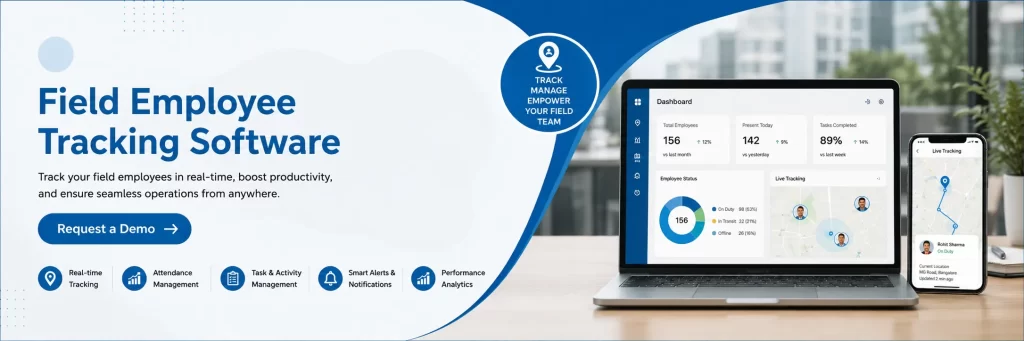
Choosing suitable field employee tracking software is not only about live location. Businesses should look at how easily the system handles attendance, visit records, route history, geofencing, alerts, and reports.
A useful platform should make information easy to understand. Managers should not need to dig through complicated screens just to find out whether an employee reached a customer site.
Attendance and Visit Verification
Location-based attendance can help confirm when employees arrive at designated workplaces or customer locations. Visit history can then provide a record of completed field activity.
This is particularly useful for businesses where employees make multiple visits every day, such as HVAC services, appliance repair, medical equipment servicing, telecom maintenance, pest control, and facility management.
Travel and Working Hours
Travel is part of field work, but it should not become an invisible part of the day.
Tracking can help managers understand total travel time, distance covered, and time spent at work locations. Over several weeks, these patterns can highlight inefficient schedules or areas where workloads need adjustment.Sahaj GPS can support businesses that want to combine employee location visibility with attendance and field activity information.
How Precision Tracking Improves Field Team Productivity
Productivity is not simply about making employees work faster. Sometimes productivity improves because the workday is organised better.
Suppose a technician has six appointments spread across a city. If the schedule sends them back and forth across the same areas, a large part of the day disappears on the road. Tracking data can expose this pattern.
Managers can then adjust assignments based on location, workload, and travel distance.This is where field tracking becomes more than an attendance tool. It becomes an operational planning tool.
Location-Based Attendance for Different Industries
Precision time tracking can be useful across many industries. In Ahmedabad and other Indian business hubs, companies with mobile workforces often need better visibility because teams are spread across multiple service areas.
For field sales teams, it can help verify customer visits. For service engineers, it can show arrival and departure times. Construction businesses can use it to monitor staff presence across project sites. Facility management companies can track teams moving between different client locations.
Healthcare equipment companies, logistics businesses, security services, and telecom maintenance teams can also benefit from similar tracking workflows.
The exact use case changes, but the basic need stays the same: reliable information about where work happened and when.
Key Benefits of Precision Time Tracking
One of the biggest advantages is better accountability. Employees have a clearer record of their visits, while managers have better visibility into daily operations.
It can also reduce manual paperwork. Attendance sheets, WhatsApp updates, repeated phone calls, and end-of-day reports can take surprisingly long to manage when a company has dozens of field workers.
Another benefit is faster decision-making. When a manager can see current locations and recent activity, assigning new jobs becomes easier.
Sahaj GPS helps businesses use field tracking data to improve attendance visibility, workforce coordination, and day-to-day operational efficiency.
What to Check Before Choosing a Tracking System
Before investing in a tracking platform, businesses should first identify what they actually need. A small field team may only require attendance and location tracking, while a larger operation might need route history, geofencing, reports, alerts, and workforce analytics.
Accuracy matters too. If location information is unreliable, the rest of the system becomes difficult to trust.The interface should also be simple enough for employees and managers to use without constant technical support. Mobile compatibility, reporting options, data security, battery usage, and customer support are worth checking before making a decision.
And don’t ignore the human side. Explain the purpose of tracking clearly. When employees understand that the system is meant to improve scheduling and reduce confusion rather than create unnecessary pressure, adoption is usually much smoother.
Making Field Work Easier to Understand
Field teams are always going to involve a little uncertainty. Traffic happens. Customers change timings. A technician gets stuck at one site longer than expected. That’s normal.
The real problem starts when businesses have no reliable information to understand those situations.
Precision time tracking gives managers a clearer picture of attendance, travel, visits, and working hours. Combined with GPS location data and sensible workforce policies, it can help businesses plan better without making field employees feel buried under paperwork.
For a company managing people across different locations, sometimes knowing where the team is and how their time is being used is all the visibility needed to make the next decision a lot easier.
FAQs
1. What is precision time tracking for field teams?
Precision time tracking records field employees’ working hours, attendance, visits, and location data. It helps businesses create more accurate work records without depending entirely on manual timesheets or phone updates.
2. How does GPS time tracking work for employees?
GPS time tracking uses location data from an authorised mobile device or tracking system to record employee attendance, visits, travel, and working activity. Businesses can review this information through a central dashboard.
3. Is GPS-based attendance tracking suitable for field workers?
Yes. GPS-based attendance tracking is useful when employees work away from a fixed office. It can verify attendance at customer sites, project locations, service areas, and other approved workplaces.
4. What can field employee tracking software monitor?
Depending on the platform, it can monitor employee locations, attendance, visit duration, travel routes, working hours, geofences, task activity, and field reports. Features vary between tracking providers and plans.
5. Can employee tracking improve field team productivity?
Yes. Tracking data can help identify travel delays, inefficient schedules, missed visits, and workload issues. Managers can use these insights to assign jobs more effectively and reduce unnecessary travel and downtime.