

Stop Paying for Fuel That Never Reached Your Trucks
Fuel is the largest controllable cost in any logistics operation. For most supply chain businesses running 20 or more vehicles, it’s also the cost with the most untracked leakage – theft, invoice fraud, inefficient driving, unauthorized fills – happening daily across a distributed fleet that nobody can physically watch.
The gap between what a logistics company pays for fuel and what actually goes into its trucks is rarely small. Industry data across Indian freight operations consistently puts that figure between 15 and 20 percent of total monthly fuel spend. On a fleet of 30 trucks consuming 400 litres per vehicle per week, that’s roughly ₹5 to ₹7 lakh disappearing every month into a gap that paper logs and driver-reported fill-ups will never close.
Sahaj GPS fuel monitoring system was built specifically to close that gap – with sensor-level accuracy, real-time alerts, AIS 140-compliant hardware, and 15 years of experience installing and calibrating systems on Indian commercial vehicle types.
What the System Does – In Plain Terms
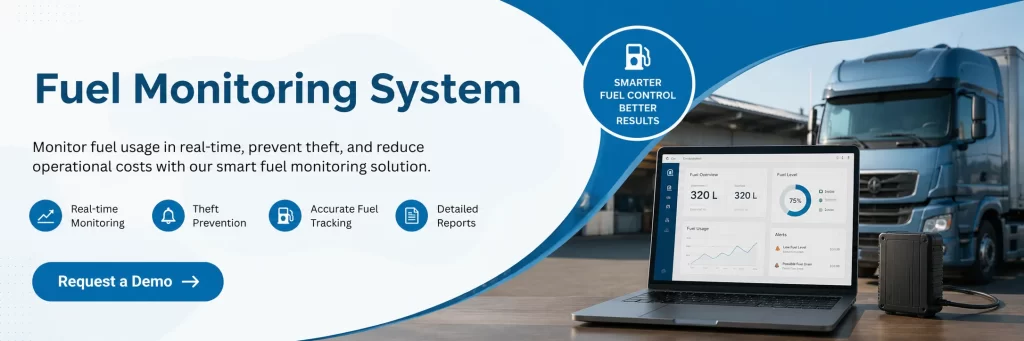
A high-accuracy capacitive sensor is installed directly inside each vehicle’s fuel tank. The sensor measures actual fuel levels continuously and transmits that data – every few seconds – through the GPS device to the Sahaj platform. Every fill, every drain, every kilometre of consumption is logged, timestamped, and location-tagged automatically.
Fleet managers see a live dashboard showing the fuel status of every vehicle in the fleet simultaneously. When something unexpected happens – a sudden fuel drop while the vehicle is parked, a fill at an unauthorized location, a refueling quantity that doesn’t match the vendor invoice – an alert reaches the manager’s phone within minutes.
No manual entry. No dependency on driver reporting. No end-of-week reconciliation that’s already too late to act on.
The system works across trucks, tippers, tankers, LCVs, trailers, and construction vehicles – calibrated to the specific tank geometry of each vehicle type for accuracy that generic float sensors cannot match.
Core Features Built for Logistics Operations
Real-Time Fuel Level Tracking Live fuel level data for every vehicle on a single dashboard. Managers operating multi-depot fleets across states can see exactly how much fuel each vehicle is carrying at any point – removing the guesswork from refueling planning and helping avoid both unnecessary stops and dry-run risks on long hauls.
fuel drain alerts Instant notification when fuel level drops unexpectedly – while parked, at halts, at loading docks, or anywhere the vehicle isn’t actively burning fuel on a trip. The alert arrives within minutes of the event, while action is still possible.
Refill Detection and Invoice Reconciliation Every refueling event is captured automatically – quantity added, time, and GPS location. The system compares sensor-recorded fill quantities against vendor invoices. Any discrepancy above a set threshold generates a review flag. Across a large logistics fleet, invoice padding at fuel stations is one of the most common and least-detected forms of fuel loss. This feature makes it systematically visible.
Fuel Consumption Tracking per Trip Actual fuel consumed per trip, per vehicle, per driver – not estimated from mileage tables or manufacturer specs. Real sensor-based consumption data that reflects actual road conditions, load weights, and driver behavior. Fleet managers can compare consumption across similar routes to identify outliers, spot vehicles aging into inefficiency, and evaluate driver performance objectively.
Idle Fuel Burn Monitoring In Indian logistics operations, waiting is unavoidable – toll plazas, weighbridges, border check-posts, loading and unloading queues. Engine idling during these waits accounts for 8 to 12 percent of total diesel consumption on most freight routes. The system isolates idle burn separately from trip consumption so it becomes a number that can be tracked, targeted, and reduced.
Geofenced Fueling Zones Define approved fuel stations across the fleet’s operating routes. Any refueling event outside those geofenced zones triggers an immediate alert. Combined with invoice reconciliation, this eliminates both unauthorized fueling and fraudulent billing simultaneously.
Driver-Wise Fuel Efficiency Scoring Individual driver fuel consumption scores based on real data – acceleration patterns, idling behavior, speed profiles, and fuel use per kilometre by route type. Identifies top performers and flags drivers consistently underperforming fleet averages. Gives operations managers the data needed for targeted coaching rather than generalized policy.
Historical Fuel Data and Audit Reports Complete fuel event history for every vehicle – searchable by date, vehicle, driver, location, and event type. Twelve months of data retained and accessible for audits, insurance claims, driver accountability processes, and vendor dispute resolution. Every fuel drain incident is documented with timestamp and GPS coordinates.
What Logistics Companies Are Actually Saving
The return on a fuel monitoring system in logistics is more predictable than most operational investments because the losses it addresses are measurable before and after implementation.
A 20-truck logistics fleet consuming an average of 400 litres per vehicle per week spends approximately ₹33 lakh per month on diesel at current prices. A 15 percent reduction in fuel losses – conservative against the 20 to 30 percent improvements reported by Indian fleet operators after implementation – recovers ₹4.95 lakh per month. Against hardware and software costs, the system pays for itself in under 4 to 6 months. After that, the savings are recurring, every month, without additional investment.
The areas where savings accumulate most consistently:
Theft prevention – fuel siphoning and driver-side pilferage drop sharply once drivers understand the monitoring is live and the data is reviewed. The behavioral change precedes any formal disciplinary action.
Invoice fraud recovery – identifying and confronting vendor-side invoice padding either recovers overcharges or prompts switching to vendors where the discrepancy disappears. Both outcomes reduce cost.
Driver efficiency improvement – fuel consumption per kilometre improves measurably when drivers know their individual scores are tracked and visible to management. Smoother acceleration, less idle time, and better speed discipline are the behaviors that change first.
One construction company that installed Sahaj GPS fuel monitoring across 12 machines recovered approximately ₹1.8 lakh per month in previously untracked losses. For logistics operations with larger fleets and higher fuel volumes, the figures are proportionally larger.
Why Logistics and Supply Chain Operations Specifically
General fleet monitoring tools are built around vehicle tracking as the primary function. Fuel monitoring is added as a secondary feature. For logistics businesses where fuel is 35 to 45 percent of total operating cost, that ordering is wrong.
Sahaj GPS fuel monitoring was developed with logistics operational realities built into the design – the multi-depot structures that require regional management views, the vendor billing complexity across multiple fuel station relationships, the driver behavior patterns specific to long-haul freight, the vehicle type diversity that requires per-vehicle sensor calibration rather than one-size-fits-all hardware.
The platform integrates with existing GPS tracking and fleet management dashboards rather than requiring a separate system for fuel data. Fleet managers see vehicle location, fuel status, driver behavior, and route performance in one place – not across fragmented tools.
For supply chain operations managing fleets across multiple states, the centralized visibility this creates changes how fuel decisions get made. Regional managers see their own fleets. The operations head sees everything. Fuel cost becomes a metric that’s tracked, discussed, and managed rather than simply paid.
AIS 140 Compliance and Technical Reliability
All Sahaj GPS hardware is AIS 140 compliant – the government standard for commercial vehicle GPS devices in India. This matters specifically for logistics companies operating commercial vehicles that require regulatory compliance.
Sensor accuracy on the Sahaj system is 99 percent or above – significantly higher than the 2 to 3 percent error margins of basic float sensors, which miss small consistent theft and produce reconciliation numbers that can’t be trusted for vendor accountability.
The system runs on hardware from Teltonika, Atlanta, and Howen – established GPS hardware manufacturers with documented reliability records in Indian freight conditions. Installation and calibration are handled by Sahaj GPS’s own team, not third-party contractors, with local support available across India for ongoing maintenance and troubleshooting.
Data transmission is continuous, with alert generation within 60 to 90 seconds of triggering events. For theft prevention, that response window is operationally significant – it’s the difference between an alert that stops something and a report that documents what already happened.
Implementation – What the Process Looks Like
Initial consultation covers fleet size, vehicle types, current fuel management processes, existing GPS setup if any, and operational priorities. This shapes the sensor selection, calibration requirements, and dashboard configuration specific to the fleet.
Installation is done vehicle by vehicle, typically two to four hours per vehicle. For large fleets, a phased rollout starts with high-value vehicles or routes with known fuel loss patterns – producing early ROI data before the full fleet is onboarded.
Calibration maps the sensor reading to actual fuel volumes for each vehicle’s specific tank geometry. This step is what separates accurate monitoring from approximate monitoring, and it’s done individually for every vehicle rather than using standard calibration tables.
Training covers dashboard navigation, alert management, report generation, and reconciliation workflows for the operations team. The platform is designed for non-technical users – fleet managers without IT backgrounds are the intended daily users.
Ongoing support is provided by Sahaj GPS’s own team with 15 years of India-specific GPS experience. The support structure understands Indian vehicle types, Indian operating conditions, and the specific scenarios that logistics fleets encounter – including regulatory questions around AIS 140 compliance.
FAQs
Will it work across our mixed fleet – trucks, tippers, tankers, and LCVs?
Yes. Capacitive sensors are individually calibrated to each vehicle’s tank shape and capacity. Mixed fleets with different vehicle types, tank sizes, and fuel systems are handled as a standard installation. The dashboard manages all vehicle types under one view.
How does the system handle fuel cards and multi-vendor billing?
The sensor records what actually enters the tank regardless of payment method. Invoice reconciliation flags discrepancies between sensor-recorded fill quantities and billing records from any vendor. Multi-vendor operations benefit from the reconciliation feature specifically because discrepancy patterns by vendor become visible in the reports.
What happens at remote locations with poor network coverage?
The GPS device stores data locally during periods of connectivity loss and syncs when coverage is restored. Alert delivery may be delayed in areas with consistently poor signal, but fuel data is not lost. For operations in areas with known coverage gaps, this is addressed in the hardware configuration stage.
Can regional managers see only their own fleet segment?
Yes. The dashboard supports role-based access controls. Regional managers are configured to see vehicles assigned to their routes or depot. The operations head or owner has full fleet visibility across all regions and depots from a single login.
How long before we see measurable results?
Behavioral changes in drivers – less idling, fewer unauthorized fills – typically appear within the first two to four weeks as the monitoring becomes part of the operational environment. Invoice reconciliation identifies vendor discrepancies from the first billing cycle after installation. The full picture of fuel cost reduction, including consumption efficiency improvements, becomes clear within sixty to ninety days.