
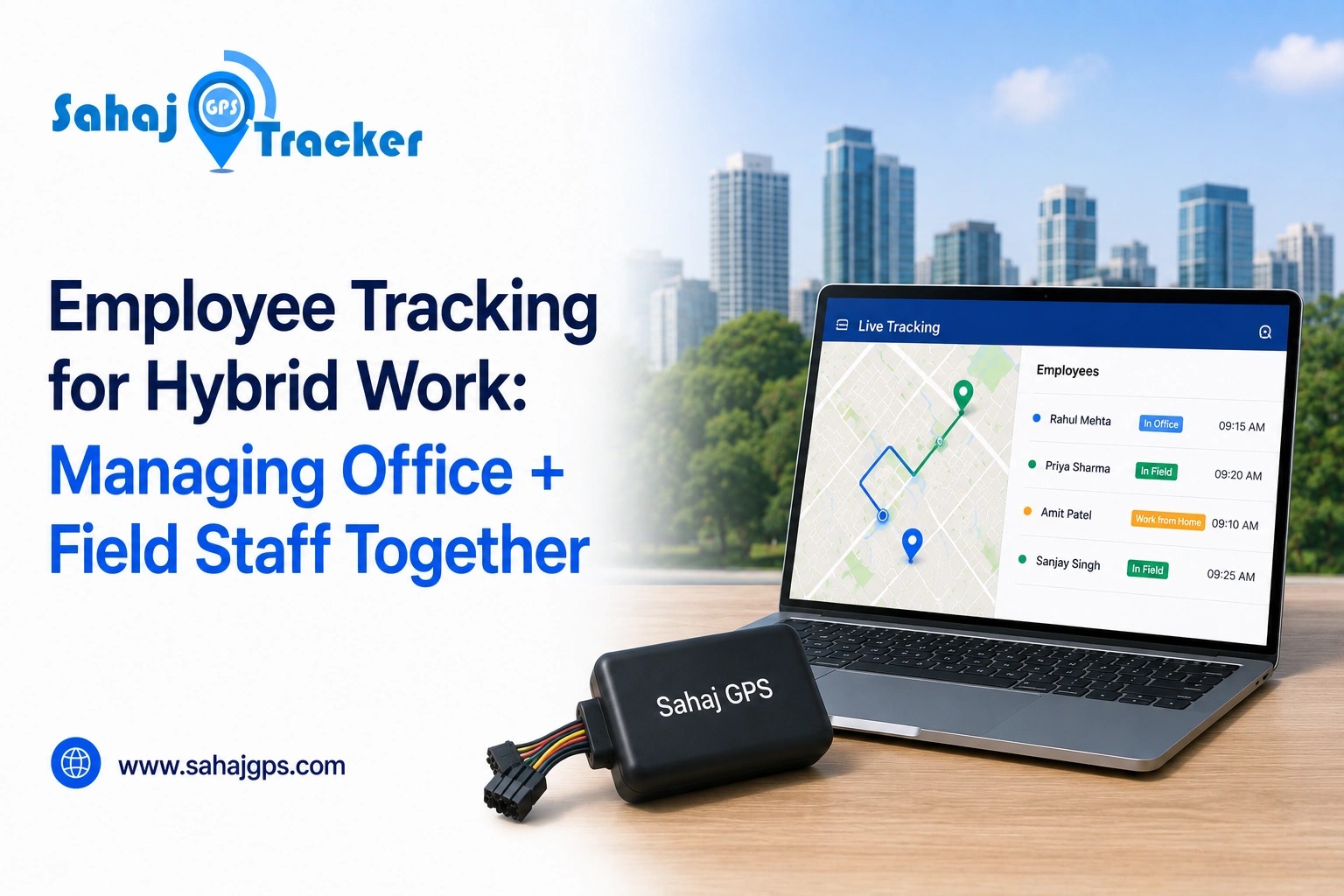
Here’s a situation most Indian business owners recognize immediately. Your office team checks in at 9:30 AM -or at least that’s what the attendance register says. Your field sales team is supposedly visiting clients from 10 AM onwards.
And you, sitting somewhere in the middle trying to manage both, have no reliable way to verify either one. What you actually need is a hybrid workforce tracking system that handles both simultaneously -not two separate tools stitched together with hope and WhatsApp messages.
This is the quiet operational crisis in thousands of Indian businesses in 2026. Not the dramatic kind that makes headlines. The slow, expensive kind where accountability slips away in small increments, every single day.
Why Managing Office and Field Employees on Separate Systems Fails
The default setup for most businesses goes something like this. Office staff tracked through biometric punching machines or an attendance app. Field staff on a separate GPS tracking platform -if tracked at all. Finance trying to reconcile data from both at month end. HR maintaining a third spreadsheet to make sense of it.
Three systems. None of them talking to each other. All of them generating work that didn’t need to exist.
The real cost isn’t just administrative time, though that’s significant. It’s the visibility gap that opens up between the two systems. A pharma company in Ahmedabad with 20 office staff and 35 medical representatives has fundamentally different monitoring needs for each group -but the data about both groups needs to sit in one place for the business to be managed intelligently. That’s the thing that most individual tools don’t actually solve.
Why Standard Tools Cover Only Half the Problem
Screen monitoring software -the kind that tracks application usage and takes screenshots -works fine for desk-based employees. It tells you almost nothing useful about a field executive who spends 70% of their day in a car or at client premises.
GPS fleet tracking platforms solve the opposite half. They’re built for vehicles and mobile workers but have no mechanism for tracking office attendance or desk-based productivity.
The hybrid team needs both -in one system -and that specific combination is genuinely hard to find and harder to implement well.
What a Hybrid Workforce Tracking System Actually Needs to Do
A proper hybrid workforce tracking system should handle three distinct realities simultaneously without requiring manual reconciliation between them.
The office-based employee who works from a fixed location. The field employee who moves between client sites and has no fixed workspace. And increasingly -the hybrid employee who might be in the office Monday and Wednesday, visiting clients Tuesday and Thursday, and working from home Friday. Tracking that person cleanly across all three modes without creating three separate attendance records is genuinely non-trivial.
Digital Attendance Management for Office Staff
Digital attendance management system for office-based employees sounds solved by every biometric machine manufactured since 2015. And to some extent it is -for basic punch-in, punch-out. The problem is that biometric attendance doesn’t capture anything about where an employee is after they’ve checked in, whether they’re actually working, or when they’ve left the premises for an extended break.
A GPS-integrated digital attendance system changes this. When an employee checks in via a mobile app, the system captures their GPS coordinates at the time of check-in. When they’re in the office zone, the check-in is valid. When they’re not -say, they checked in from the parking lot and then left -the system flags it. Subtle. But the kind of thing that changes behaviour without anyone having to have an awkward conversation.
Sahaj GPS handles this for office staff through mobile app-based attendance with geofenced office boundaries -attendance only registers when the employee’s GPS places them within the defined office zone. It sounds simple. In practice, it eliminates a category of attendance gaming that biometric machines can’t catch.
Field Employee Monitoring Software for On-Ground Teams
Field Employee Monitoring software for genuinely mobile workers needs a different set of features. Location tracking throughout the day, not just at check-in and check-out. Client visit verification through geofenced site boundaries. Travel route logging. Task completion tied to physical presence at specific locations.
The average pharma sales representative claims 8-10 client visits daily. The average verified visit rate, when GPS verification is implemented, is often 20-30% lower. Not because everyone’s lying -but because self-reported data drifts without accountability structures in place.
Field monitoring software that shows where staff were, for how long, and in what sequence -without requiring them to manually update anything -creates a verified record that’s genuinely more accurate than any report they could write.
GPS-Based Employee Location Tracking: The Layer That Connects Both
Employee location tracking software is the thread that runs through both sides of the hybrid workforce problem. For office staff, it’s a check-in verification layer. For field staff, it’s a continuous operational record. But when both run through the same platform, something more useful happens -the data is comparable.
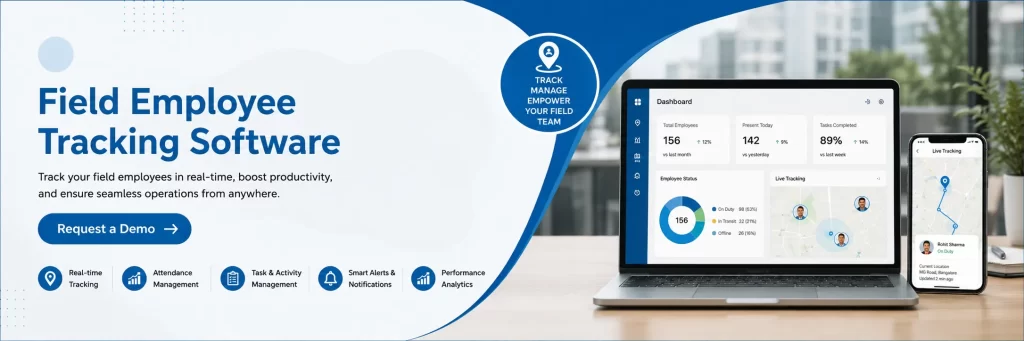
A manager with both office and field staff under their responsibility can see everything in one view. Who’s at their desk. Who’s at which client location. Who’s running late. Who hasn’t started their day. Not from separate dashboards with separate logins. From one.
Geofencing as the Common Language for Both Teams
Geofencing is the technical feature that makes unified tracking work for genuinely different workforce types.
For office employees: a geofence around the office building validates attendance. For field employees: geofences around client premises validate visits. For warehouse staff: geofences around loading bays track activity in specific zones. For delivery workers: geofences around delivery addresses confirm completion.
Same technology. Same platform. Completely different use cases applied to completely different worker types. This is what a properly built hybrid workforce tracking system looks like when the underlying architecture is sound.
Sahaj GPS applies geofencing across both office and field contexts within the same platform -so a business managing a reception team and a delivery team doesn’t need separate systems just because the two groups operate in different environments.
One Dashboard for Two Workforce Types: What Good Actually Looks Like
An HR manager at a mid-sized distribution company in Pune has 12 office staff and 28 delivery and sales staff. Her morning check used to involve reviewing two separate systems, calling supervisors for field team updates, and manually compiling attendance data from the biometric system before she could send a single morning report.
With a unified tracking platform, her morning looks different. One dashboard. Office attendance auto-verified by geofenced check-ins. Field staff positions live on a map. Any exceptions -late starts, unapproved zone entries, missed client visits -flagged automatically.
The report writes itself. The calls to supervisors don’t happen because the data is already there.
Sahaj GPS provides this unified view specifically because the reality of most Indian businesses -particularly in distribution, pharma, FMCG, and service industries -involves exactly this combination of office and field staff that needs to be managed in one operational picture rather than two parallel ones.
What Indian Businesses Are Finding Out in 2026
The companies that have implemented unified hybrid tracking report something interesting. The productivity gains come less from catching people doing something wrong and more from the operational improvements that become possible when you can actually see what’s happening.
Route optimization for field staff becomes possible when you have real movement data. Office attendance patterns reveal whether hybrid work schedules are actually being followed. Manager accountability improves because every team’s data is visible in a single system rather than siloed by team type.
There’s also the payroll accuracy improvement. When digital attendance management system data feeds directly into payroll -with field visits, office hours, and travel time all captured automatically -the manual reconciliation that used to happen at month end either shrinks dramatically or disappears entirely.
The businesses seeing the biggest impact from unified tracking are usually the ones that had the biggest visibility gap before -companies where the left hand genuinely didn’t know what the right hand was doing because office data and field data lived in completely separate systems.
FAQs
Q1. What is a hybrid workforce tracking system?
It monitors both office and field employees on one platform -combining GPS location tracking, digital attendance, and activity data for unified visibility across all staff types without separate systems.
Q2. How does field employee monitoring software work for mobile staff?
It uses GPS and geofencing to track location, site visits, and working hours -providing verified attendance and activity records without requiring field staff to manually update check-ins or visit logs.
Q3. How does employee location tracking software prevent attendance fraud?
It captures GPS coordinates at check-in, validates presence within authorized zones, and flags entries from outside defined boundaries -eliminating fake check-ins that biometric machines and manual registers can’t detect.
Q4. What does a digital attendance management system do differently from biometric machines?
It captures GPS-verified location at attendance time, works for mobile employees without fixed locations, and feeds data directly to payroll and HR reports -without manual reconciliation between multiple systems.
Q5. Can one tracking platform manage both office and field employees effectively?
Yes. Modern platforms use role-based dashboards and geofencing to serve different workforce types from one system -giving HR managers and team leads a single view of all staff regardless of where they work.