
There are two types of schools in India right now when it comes to student transport-those with School Bus monitoring Solutions that give parents real-time visibility and those still relying on driver phone calls, manual registers, and hopeful timing. The gap between those two experiences is enormous. For parents, for school administrators, and honestly for the drivers too who spend half their mornings fielding “where are you?” calls from anxious parents while trying to navigate morning traffic.
GPS tracking for school buses has matured significantly over the last few years. What’s available now goes well beyond a simple location dot on a map-and understanding which features actually matter, versus which ones are marketing additions that sound impressive but don’t change daily operations, is what this post is about.
What Parents and Schools Actually Need From a Bus Tracking System
Before getting into features, it’s worth being clear about what the real problems are. Because solutions that don’t address actual problems-however technically impressive they look in a demo-don’t change anything on the ground.
Parents want one thing above all else: to know their child is safe, where the bus is, and when it’s arriving. Simple. But that simple need generates an enormous amount of phone traffic to school offices and transport coordinators every single morning, and creates real anxiety on the days when buses run late with no communication.
School administrators want accountability without administrative overhead. Route compliance. Driver behavior documentation. Proof that their transport operation is running to standard-something they can show parents who ask and regulators who inspect.
Drivers want a system that doesn’t create more work or make them feel constantly surveilled without purpose.
A genuinely good School Bus monitoring Software serves all three of these stakeholders simultaneously. Here’s what that actually looks like in features.
Feature 1: Real-Time GPS Tracking With Live Parent Access
This is the foundation. Non-negotiable. Everything else builds on it.
GPS tracking for school buses in 2026 means parents can open an app or a link on their phone and see exactly where the bus is, right now, with an estimated arrival time at their child’s stop. Not a 10-minute-delayed location. Real-time, updating every few seconds.
The parent app should require no technical setup-a shareable link that works in any browser is significantly more practical for diverse parent populations than a dedicated app that needs to be downloaded, installed, and learned. Schools that provide a simple link see much higher parent adoption than those requiring separate app installations.
Sahaj GPS provides live parent tracking through a browser-accessible link that schools can distribute via WhatsApp, email, or SMS-without parents needing to install anything. For schools managing transport across multiple buses and hundreds of families, the simplicity of this setup makes adoption near-universal rather than partial.
Feature 2: Student RFID Boarding and Drop-Off Alerts
Knowing where the bus is matters. Knowing whether your child is actually on it matters more.
RFID-based student attendance on school buses uses card tags-usually embedded in school ID cards-that students tap or swipe as they board and exit. The system logs each student’s boarding and drop-off with a timestamp and GPS location, and automatically sends a notification to the parent: “Arjun has boarded Bus 3 at Sector 14 stop, 7:42 AM.”
Why RFID Attendance Changes the Safety Picture Completely
Without RFID, a parent’s trust that their child is on the bus is based entirely on the assumption that the normal routine happened normally. With RFID boarding alerts, that assumption is replaced by confirmation. When a child doesn’t board at their usual stop, the parent gets a “no-show” alert immediately-not a discovery at drop-off that something went wrong.
The same applies at the other end. A drop-off alert tells parents their child has exited the bus at the correct stop at the correct time. For parents of younger children especially, this single feature shifts the emotional experience of school transport from anxious to genuinely reassured.
Feature 3: Speed Monitoring With School-Specific Alert Thresholds
Standard commercial vehicle speed monitoring isn’t sufficient for school buses. The risk profile is different-a bus carrying 40 children has zero tolerance for the kind of aggressive driving that might be unremarkable in a logistics truck.
School Bus monitoring Software should set separate speed alert thresholds calibrated for school transport specifically. Residential pickup zones deserve a lower threshold-30 to 40 km/h-than highway stretches where 60 km/h is reasonable. The system should alert both the supervisor and the driver when these thresholds are crossed, with incidents logged for review and driver coaching.
Sahaj GPS supports zone-specific speed thresholds-lower limits near school campuses and residential pickup areas, with different thresholds for highway sections-giving transport managers a nuanced speed compliance picture rather than a single flat threshold that’s either too strict for highway travel or too lenient for school zones.
Harsh braking events and rapid acceleration should also be logged. Both indicate driver behavior that creates passenger safety risk and, over time, build a behavioral profile that supervisors can use for targeted coaching.
Feature 4: Route Deviation and Geofence Alerts
A school bus that leaves its approved route without authorization is a safety event, full stop. Geofencing and route deviation monitoring are what make this detectable in real time rather than discoverable after the fact.
Geofences around the school campus trigger an alert when the bus arrives-useful for school staff managing student dismissal timing. Route deviation alerts fire when a bus leaves its planned path by more than a defined distance threshold. A driver who takes an unauthorized detour-for any reason-is flagged immediately.
For schools operating under regulatory frameworks that require documented route adherence, automatic route compliance logs generated by the tracking system provide the administrative documentation needed without any manual record-keeping.
Feature 5: SOS Emergency Button for Drivers and On-Board Staff
School buses can face genuine emergencies-accidents, medical situations with students on board, mechanical breakdowns in isolated locations, security incidents. The SOS emergency button built into AIS 140-compliant devices is there for exactly these moments.
One press sends the bus’s precise GPS coordinates to the transport coordinator, school administration, and designated emergency contacts simultaneously. No need to navigate a phone while managing a crisis. No uncertainty about where to send help.
Sahaj GPS SOS alerts include real-time location coordinates, vehicle identification, and timestamp-giving emergency responders the information they need to dispatch appropriately rather than searching a general area.
Feature 6: School Transport Management Software Integration
Individual features become significantly more powerful when they’re integrated into a complete School Transport Management Software platform rather than operating as standalone tools. This is where the operational picture comes together.
Connecting Transport, Attendance, and Parent Communication in One System
A proper transport management layer handles student roster management-adding new students, changing stops, updating routes mid-year-without requiring manual reconfiguration of multiple separate systems.
It connects bus tracking data with student attendance records, so the school knows not just where the bus is but whether each student arrived at school as expected. It generates parent communication automatically-daily attendance confirmations, delay notifications, pickup reminders-without creating additional manual work for transport staff.
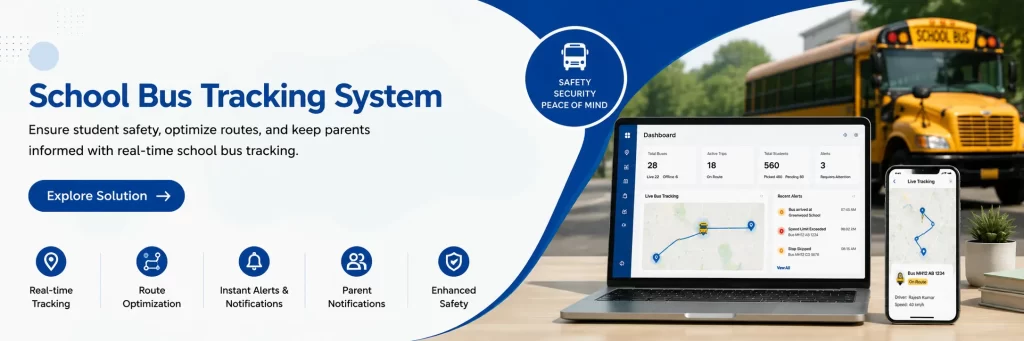
Sahaj GPS provides a transport management dashboard that connects GPS tracking, RFID student attendance, route management, and parent communication in a single system-replacing the combination of manual registers, WhatsApp groups, and spreadsheets that most schools are currently managing transport with. The operational simplification alone is meaningful, quite apart from the safety improvements.
AIS 140 Compliance: The Technical Layer Every School Bus Needs
In India, Vehicle Tracking for school buses isn’t just a best practice-it’s a legal requirement. AIS 140-certified GPS devices are mandatory for school buses, with certification verified against ARAI’s official list and installation required through an authorized service provider.
The AIS 140 requirement means real-time location transmission to MoRTH’s VLT government platform, a functioning emergency panic button, and defined data communication standards. A tracking system that doesn’t meet AIS 140 certification doesn’t satisfy legal requirements regardless of how well it functions technically.
Sahaj GPS devices carry current ARAI AIS 140 certification for school bus deployment, with installation through authorized partners and VLT platform registration handled as part of the setup process-so schools get compliance and operational functionality in the same deployment rather than having to manage them separately.
FAQs
Q1. How does live GPS tracking for school buses work for parents?
Parents access a browser link showing real-time bus location and estimated stop arrival time-no app installation needed. The bus position updates every few seconds, eliminating the need to call the school or driver for updates.
Q2. How does RFID student tracking on school buses work?
Students tap RFID-enabled ID cards on a bus reader when boarding and exiting. The system logs each event with a GPS timestamp and sends instant boarding or drop-off notifications to parents-flagging no-shows automatically.
Q3. What speed thresholds should school bus tracking software set for alerts?
School bus monitoring should set zone-specific thresholds-typically 30–40 km/h near schools and residential areas, 60 km/h on highways-lower than standard commercial limits given the student passenger profile involved.
Q4. Is AIS 140 compliance mandatory for school buses in India?
Yes. AIS 140-certified GPS devices are legally mandatory for school buses, requiring ARAI-certified hardware transmitting real-time location to MoRTH’s VLT platform with a functioning emergency SOS button installed by an authorized provider.
Q5. What does School Transport Management Software do beyond GPS tracking?
It integrates student rosters, route planning, RFID attendance, parent notifications, and route compliance documentation-replacing manual registers and fragmented communication with a single connected transport management system.