
Every school transport coordinator in India knows what 7:30 AM looks like from behind the desk. Parent calls trickling in. “Where’s the bus?” “It’s been 20 minutes.” “My child will be late.” And meanwhile, someone’s trying to track down the driver on a mobile number that isn’t picking up. A proper School Bus Tracking System doesn’t just answer those parent calls with real data – it prevents most of them from happening in the first place, because routes are planned better, schedules actually hold, and everyone with a legitimate need to know where the bus is can see it on their phone without calling anyone.
But the tracking piece is really just the visible tip of what school bus route optimization actually delivers. The deeper benefits – the ones that show up in fuel bills, fleet utilization numbers, and driver overtime – are worth understanding before any school or transport contractor decides whether the investment makes sense.
The Real Reason School Bus Routes Get Messy Over Time
Here’s something that happens at almost every school that’s been running transport for more than a few years. Routes were set up once – probably when the school first launched or when transport was first organized – and they made reasonable sense at the time.
Then students moved. New residential colonies opened. Traffic patterns shifted as cities expanded. A road got dug up and never quite recovered. And the routes… mostly stayed the same. With small informal adjustments that drivers made on their own over time, that nobody really tracked.
The result is a collection of routes that are partially optimized for a city and student population that no longer quite exists. Buses are going further out of the way than they need to. Some pickup sequences take 20 minutes longer than a different sequence would for the same set of stops. Two buses cover adjacent areas in ways that made sense three years ago but could now be merged into one bus with a modified route.
None of this is obvious without data. Which is exactly why it persists.
Why Manual Route Planning Hits a Wall Fairly Quickly
A transport coordinator managing 15 buses with a spreadsheet and Google Maps can do a reasonable job. Managing 40 buses covering 400 student addresses across a sprawling city like Bengaluru or Pune – that’s a different problem entirely. The number of possible route combinations grows faster than any manual process can evaluate.
Optimize school bus route tools exist specifically for this scale challenge. They ingest student address data, apply defined constraints (maximum ride time, school arrival window, vehicle capacity), and generate routes that a human planner simply couldn’t calculate manually – because the calculation space is too large and changes too frequently as students join, leave, and relocate across the academic year.
What School Bus Route Optimization Actually Changes Day-to-Day
How a Bus Route Planner Builds More Efficient Pickup Sequences
Bus routing optimization works by treating each student pickup as a node in a network and finding the sequence that minimizes total travel time and distance while respecting every constraint. Maximum ride time for students. Arrival at school within the required window. Avoiding road segments with known congestion during school hours. Grouping pickups geographically rather than by the alphabetical or chronological order they were added to a roster.
The output isn’t just a more efficient route. It’s also a more consistent one – drivers are following an optimized sequence rather than making judgment calls at each turn, which means punctuality becomes more predictable and parent expectations can be set more accurately.
School Bus Schedule Software: More Than a Digital Timetable
School bus schedule software in 2026 does considerably more than store route information in a digital format. It manages route assignments dynamically across the academic year, handles mid-year student additions and removals without manual recalculation, generates parent-facing pickup time estimates for each stop, and produces the administrative documentation that school management needs for transport compliance – attendance logs, route histories, incident records.
The scheduling layer also manages what happens when something goes wrong. A vehicle breakdown doesn’t mean scrambling to manually figure out how to redistribute students – the software generates a redistribution option across available vehicles almost immediately, with revised times automatically pushed to parents.
School Bus Tracking System: The Data Foundation That Makes Everything Else Work
You can’t optimize what you can’t measure. School bus route optimization depends fundamentally on having real GPS movement data – not planned routes, but actual routes taken, actual stop durations, actual travel times through different road segments at different times of day.
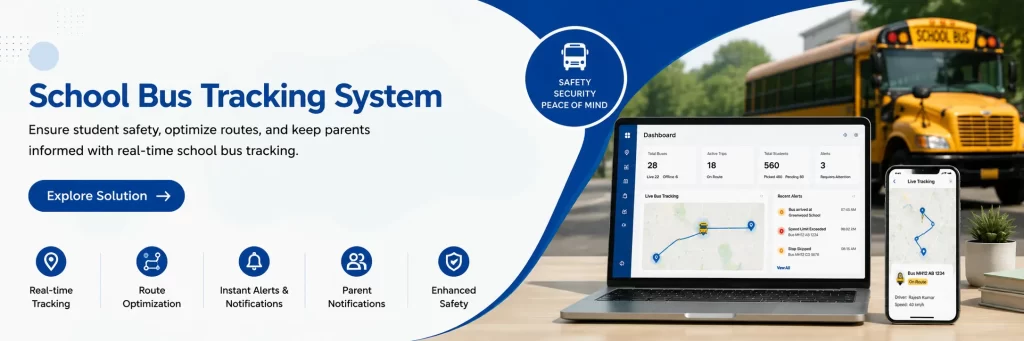
This is where a School Bus Tracking System becomes more than a safety or parent-communication tool. Every trip the bus makes generates data. Over weeks and months, that data builds a picture of where routes are consistently running behind schedule, where drivers are deviating from planned paths, which stops are taking longer than estimated, and how traffic conditions vary across the week.
Sahaj GPS captures this trip data continuously and surfaces it in the administrative dashboard as route performance analytics – showing transport managers which routes are meeting schedule and which are consistently running 8 or 12 minutes late, along with the specific segments where the delay is occurring. That’s the input that makes route revision conversations specific and evidence-based rather than anecdotal.
Real-Time GPS Bus Scheduling That Adapts to Live Conditions
Bus scheduling GPS that’s connected to real-time traffic data can do something that static route planning can’t: adapt during the trip itself. When congestion builds on a planned route segment, a system monitoring live traffic conditions can suggest an alternative path and alert the driver – reducing the impact of predictable morning traffic events rather than absorbing them as unavoidable delays every single day.
This matters especially in Indian school transport contexts where urban traffic is genuinely unpredictable. The route that flows smoothly on a Tuesday might be 25 minutes slower on a Thursday when there’s a delivery truck stopped near a school zone. Static route plans get destroyed by this variability. Dynamic bus route planning that accounts for it in real time doesn’t.
Parent-Facing Live Tracking: The Operational Win Nobody Expected
Schools and transport contractors who implement live parent tracking apps consistently report something they didn’t fully anticipate: a significant drop in inbound phone calls to the school office during morning arrival windows.
When parents can see on their phone exactly where the bus is and get a real-time ETA for their child’s stop, they don’t call. The anxiety is answered by the data before it becomes a phone call. For a school managing transport for 300 students, eliminating 40 or 50 redundant morning status calls is a real administrative relief.
Sahaj GPS provides a parent-facing live tracking link – shareable as a URL without requiring parents to install a separate app – that shows the bus’s current position and estimated arrival time at each stop. It’s one of those features that parents appreciate enormously and that generates noticeably positive feedback for schools that implement it.
The Cost-Cutting Case: Where the Savings Actually Come From
Fuel, Driver Hours, and Fleet Size: The Three Levers Route Optimization Pulls
Fuel savings from school route optimization are the most straightforward to calculate. Shorter total route distance means fewer litres consumed per day. For a fleet running 20 buses twice daily, a 15% reduction in average route distance translates to a meaningful monthly fuel saving – typically in the range of ₹20,000–₹60,000 depending on fleet size and diesel prices.
Driver overtime is less obvious but equally real. Buses that consistently run late require drivers to stay on beyond scheduled hours – which costs money and, over time, creates driver fatigue and compliance issues under transport labour regulations. Routes that actually run on schedule don’t generate this hidden cost.
Fleet size rationalization is the biggest potential saving – and the one that requires the most courage to act on. When optimize school bus route tools show that two adjacent routes can be efficiently combined with modified pickup sequences, the math sometimes supports reducing the active fleet by one vehicle. That’s not just fuel – it’s driver salary, vehicle maintenance, insurance, and permit costs eliminated permanently.
Sahaj GPS generates route efficiency reports that specifically surface these fleet rationalization opportunities – showing route overlap, underutilized capacity, and projected cost impact of consolidation – in a format that school management can take to a board or finance committee with actual numbers rather than estimates.
Punctuality: Why It’s Both Operational and Reputational
A school bus that’s reliably on time is something parents talk about positively. A school bus that’s reliably late is something parents escalate. In an era where school choice is increasingly competitive – especially in urban India where parents have real alternatives – transport punctuality genuinely affects school reputation in ways that leadership teams are aware of but don’t always connect directly to route efficiency.
Traffic Pattern Learning and Seasonal Route Adjustments
Good bus scheduling systems learn over time. They observe where delays consistently occur across multiple weeks, identify which route segments are vulnerable to predictable congestion events, and build that learning into route recommendations for subsequent adjustments.
Seasonal adjustments matter too. Monsoon months in cities like Mumbai or Hyderabad change traffic patterns significantly – routes that flow in October may be genuinely slower in July due to waterlogging, diversions, and school zone congestion. A school bus route optimization system with historical trip data can proactively flag these seasonal adjustments rather than waiting for complaint season to arrive first.
Sahaj GPS supports seasonal route review through its historical trip analytics – giving transport managers a data-backed basis for pre-monsoon or pre-exam-season route revisions rather than realizing adjustments were needed after several weeks of delays have already affected parent satisfaction.
FAQs
Q1. What is school bus route optimization and how does it work?
It uses GPS trip data and route planning algorithms to create the most efficient pickup sequences – reducing total travel distance, fuel costs, student ride times, and the number of vehicles needed to cover all stops.
Q2. How does a School Bus Tracking System improve route planning?
It captures real GPS trip data – actual routes taken, stop durations, and travel times – giving transport managers evidence-based insights into where routes are inefficient before making adjustments.
Q3. How much can schools save through GPS-based school bus route optimization?
Most schools see 15–25% fuel savings and measurable punctuality improvement within 60–90 days. Larger fleets with scope for route consolidation often see even greater savings through fleet size reduction.
Q4. Can school bus schedule software adjust routes when conditions change mid-year?
Yes. Modern platforms handle student roster changes, seasonal traffic pattern shifts, and mid-year route revisions – automatically recalculating optimized routes rather than requiring manual replanning from scratch.
Q5. Does live parent tracking actually reduce school transport complaints?
Significantly. Real-time bus location and stop ETA visibility eliminates most “where’s the bus” calls – reducing school office inbound calls during morning windows and improving parent satisfaction measurably.