

Here’s a question that comes up quietly in almost every operations meeting involving a field team: how much work is actually getting done out there? Not the logged work. Not the self-reported numbers.
The real output. Workforce productivity GPS tools have become the most practical answer to that question – not because they catch people doing nothing, but because the data they generate changes how field teams are managed, scheduled, and supported in ways that genuinely move productivity numbers.
This isn’t about surveillance for its own sake. The most interesting thing about GPS-based productivity monitoring isn’t what it reveals about bad behaviour – it’s what it reveals about systems, schedules, and structural inefficiencies that nobody realised were there.
The Productivity Gap That Quietly Exists in Field Operations
Let’s be honest about the starting point. If you manage a field team – whether that’s sales reps, service technicians, delivery staff, or territory executives – you’re operating with a significant information gap every single day.
You know where people are supposed to be. You know what they’re supposed to accomplish. What you don’t know, in real time, is whether the two are actually aligning. Manual reporting fills part of that gap. But it fills it with the story your field staff choose to tell, compiled at the end of a day when memory is imperfect and incentives to round things upward are entirely natural.
A sales rep who visited six clients can report eight without any particular guilt. It’s not malicious – it’s self-preservation in a culture where numbers are what get noticed. That small gap between actual and reported output, multiplied across a team of 30 and across 250 working days, becomes a significant distortion in how productivity is understood and managed.
What Field Employee Output Actually Looks Like Without GPS Data
The most common picture: a team that looks reasonably productive on paper, with reported visit counts and task completions that seem plausible, but with delivery outcomes – client satisfaction, revenue per territory, issue resolution times – that don’t quite match the reported activity levels.
The gap between those two things is usually where the real productivity story lives. And without Employee GPS Tracking, most managers only ever see the paper version, not the ground truth.
How Employee GPS Tracking Connects Location to Real Productivity
Employee GPS Tracking in a field context does one fundamental thing that changes everything downstream: it creates an objective, continuous record of where each employee was, when, and for how long.
That record isn’t the productivity measure itself – but it’s the foundation on which actual productivity measurement becomes possible. Visit duration at a client location. Transit time between stops. Time at unscheduled locations. Departure and arrival patterns relative to planned schedules. None of this is visible without GPS data, and all of it matters when you’re trying to understand what’s actually driving field team output.
Real Time Employee Tracking That Actually Informs Decisions
Real time employee tracking changes the management dynamic from retrospective to active. Instead of reviewing what happened yesterday in a morning call, managers can see what’s happening now and intervene or support appropriately.
A field executive who’s been stuck at a difficult client site for two hours might need backup – or information – that a call from the manager could provide. A service technician who’s completed their scheduled jobs early could be assigned an additional task that’s nearby and time-sensitive. Neither of those interventions is possible without real-time visibility.
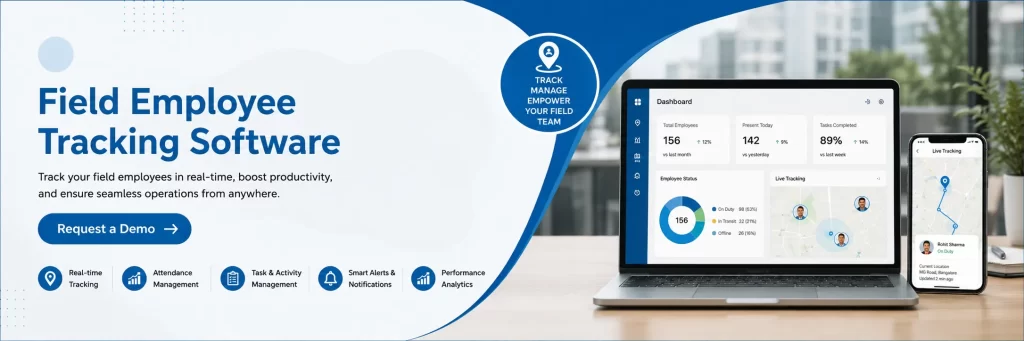
Sahaj GPS provides this through a live dashboard that updates continuously – not on a lag that makes real-time decision-making impractical. For operations managers covering large territories, the ability to see 30 or 40 employees’ status simultaneously and identify who needs attention versus who’s running smoothly is genuinely different from relying on individual check-in calls.
Field Team KPIs That GPS Data Makes Possible for the First Time
This is where things get interesting from a management perspective. Field team KPI measurement has always been hard because the most meaningful metrics – actual time spent at client locations, real visit frequency per territory, transit efficiency, task completion sequence – simply couldn’t be captured manually at any reasonable scale.
Workforce productivity GPS systems generate these metrics automatically. Visits per day (verified, not reported). Time at location (actual, not estimated). Route efficiency relative to a planned sequence. First-visit resolution rates for service teams. Territory coverage density over a week or month.
These aren’t data points that require additional effort to collect. They’re a byproduct of tracking that happens anyway – it’s just a matter of whether the system you’re using surfaces them in a way that’s actually usable for management decisions.
Workforce Productivity Monitoring: What Shifts When Managers Can See
Workforce productivity monitoring through GPS does something that pure performance reviews never quite managed: it gives managers information that’s continuous, objective, and granular enough to be genuinely useful rather than just indicative.
But there’s a behavioral dimension that matters just as much as the data quality. And it’s worth talking about honestly.
The Psychology of Visibility – How Tracking Changes Field Behaviour
When field employees know their location and activity is being tracked, behaviour changes. That’s not a criticism – it’s just how accountability mechanisms work. The question is whether that change is positive or punitive in experience, and that’s almost entirely determined by how monitoring is introduced and used.
Teams where GPS tracking is introduced alongside clear communication – here’s what we’re tracking, here’s how it connects to your performance review, here’s how we’ll use this data to give you better routes and scheduling – respond differently than teams where tracking appears with no explanation and is immediately used to flag individual shortfalls.
The former tends to see productivity gains from the accountability effect alone, in the range of 15–20% improvement in verified output, without any additional management intervention. The latter sees resistance, resentment, and often higher staff turnover.
From Reactive to Proactive: How GPS Efficiency Transforms Daily Management
Without GPS data, field management is mostly reactive. Something goes wrong, a client complains, a delivery doesn’t happen on time – and then you investigate. With GPS efficiency data running continuously, the management posture shifts forward.
Patterns become visible before they become incidents. A territory with consistently lower visit rates than expected is flagged by the data before it shows up as declining revenue. A driver taking inefficient routes three days in a row gets a routing conversation before the fuel bill arrives. A service technician with rising first-visit-to-resolution times gets coaching support before client satisfaction scores drop.
Sahaj GPS flags these patterns through automated weekly productivity reports that give operations managers a ranked view of team performance – not just who’s top and bottom, but where specific improvements in scheduling, routing, or individual coaching would have the highest impact on overall team output.
GPS-Powered Task Scheduling and Route Optimisation for Field Teams
One of the less-discussed productivity gains from field team efficiency tools is what happens when GPS data is used to make scheduling smarter rather than just monitoring execution of existing schedules.
Smart Scheduling That Uses GPS Data to Reduce Dead Time
Transit time between field visits is often the biggest single drain on field productivity – time during which nothing billable or productive is happening. AI GPS systems use historical movement data to identify routing patterns that minimize transit time between appointments, group visits by geographic proximity, and flag scheduling inefficiencies where employees are being routed past nearby clients to reach distant ones unnecessarily.
For a field team doing 6–8 client visits daily, cutting average transit time between visits by even 12 minutes adds roughly an hour of productive field time per employee per day. Across a team of 25, that’s 25 hours of additional productive field time. Daily. Without adding headcount, extending hours, or making anyone work harder.
Dynamic task assignment matters too. When a field employee completes their schedule early, or when a high-priority client request comes in within a territory, GPS visibility of who is where makes real-time task reallocation possible in a way that manual scheduling simply can’t support.
Employee Performance GPS: Turning Field Data Into Coaching
Employee performance GPS data is most valuable not as a monitoring mechanism but as a coaching tool – and the distinction matters enormously for how field teams experience and respond to tracking.
Performance Reviews That Field Staff Can Actually Engage With
The traditional field performance review is based on outcomes: revenue generated, tasks completed, client satisfaction scores. These are meaningful but backward-looking and often feel arbitrary to field staff who can point to circumstances outside their control.
GPS-based performance data adds a process layer: how the outcomes were achieved, or why they weren’t. A sales rep who’s visiting the right clients but spending less time at each one than the team average. A service technician whose first-visit resolution rate is low because their scheduling routes them to complex jobs late in the day when time pressure affects thoroughness.
These are coachable patterns that GPS data reveals and that outcome metrics alone don’t surface.
Sahaj GPS generates individual employee productivity profiles over rolling periods – not just snapshots – that show trends, improvement over time, and specific behavioural patterns. That’s the kind of data that makes a coaching conversation genuinely useful to the person on the receiving end, rather than just uncomfortable.
What Indian Field Operations Are Actually Seeing From GPS Productivity Tools
Field teams across industries in India – FMCG distribution, pharma sales, telecom infrastructure, banking field executives, utility service teams – are seeing consistent patterns after GPS productivity monitoring goes live.
Verified visit rates improve within the first 30 days, typically by 15–25%, as the reporting gap between actual and logged activity closes. Route efficiency improvements start showing in fuel and transit costs within 60 days. And by 90 days, the data is usually rich enough to make meaningful scheduling and territory adjustments that compound the initial gains.
The teams that see the biggest improvements are almost never the ones with the worst-performing employees. They’re the ones where scheduling and routing were inefficient – and where GPS data made those inefficiencies visible for the first time.
FAQs
Q1. How does workforce productivity GPS actually measure field employee output?
It tracks location, visit duration, transit time, and task completion for each employee in real time – creating objective productivity data that replaces self-reported logs with verified, measurable field performance metrics.
Q2. What does real time employee tracking show that manual reporting doesn’t?
It shows actual visit timestamps, genuine time spent at each location, route taken, and idle periods – data that self-reported logs can’t reliably capture and that managers need to make accurate productivity assessments.
Q3. How does employee GPS tracking improve individual field performance?
It creates data-driven accountability, enables smarter task scheduling, and generates individual performance metrics that make coaching conversations specific, fair, and actionable rather than based on general impressions.
Q4. What field team KPIs can GPS tracking measure that weren’t trackable before?
Verified visits per day, actual time at location, route adherence, transit efficiency between stops, task completion sequence, and territory coverage density – none of which are reliably capturable through manual field reporting alone.
Q5. How quickly do field teams see productivity improvement after GPS deployment?
Most operations see measurable improvement within 60–90 days. Verified visit completion rates and output quality typically improve 20–30% compared to pre-tracking baselines, with scheduling efficiency gains adding further over time.