
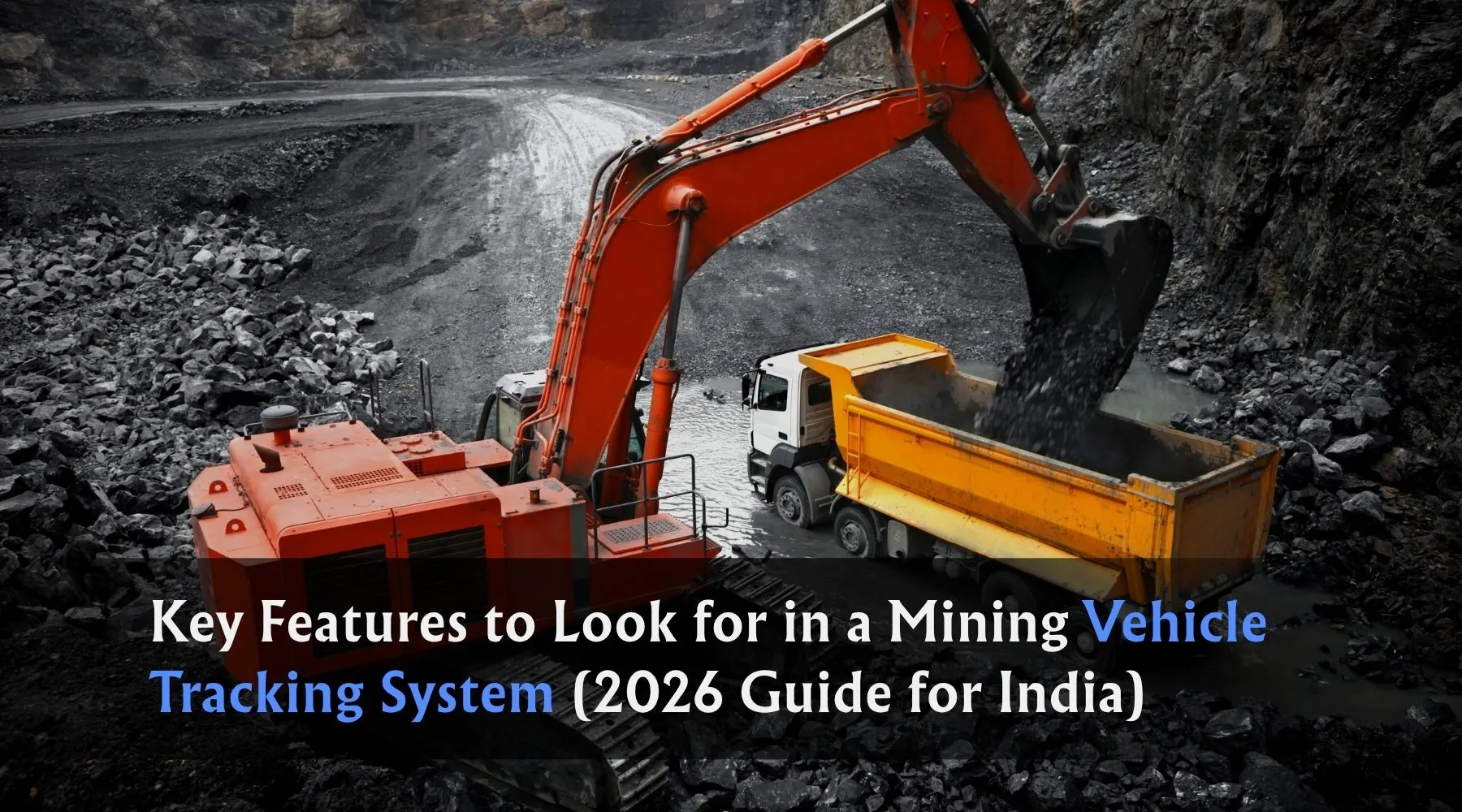
Why Mining Vehicle Tracking Is Different From Standard Fleet Tracking
Most GPS tracking guides are written for logistics companies, delivery fleets, or passenger transport. Mining is a completely different operating environment — and a tracking system that works perfectly for a delivery fleet in Pune will fall short in a limestone quarry in Rajasthan or a sand mine in Uttar Pradesh.
Three things make mining vehicle tracking uniquely demanding:
The environment is hostile to hardware. Dust, vibration, extreme temperatures, water splash, and rough terrain are daily conditions — not exceptional ones. Hardware failure in heavy-dust environments is a common problem that separates mining-grade GPS devices from standard commercial trackers. A device rated IP65 may be adequate for a delivery truck on city roads. For a tipper operating in a stone quarry, IP67 is the practical minimum.
The compliance framework is state-specific and increasingly strict. Mining vehicle tracking in India operates under a layer of state-level mining department mandates — on top of the national AIS 140 requirement — that are separate from standard RTO compliance. All mineral-transport vehicles must install AIS 140 automotive tracking devices and register on the VTSDGM portal to obtain eMM-11 forms. As of November 2025, non-GPS vehicles are treated as illegal transporters. Each state has its own portal: MineMitra in UP, Mahakhanij in MP, e-Khanij in Chhattisgarh, OMEPS in Odisha, ILMS in Karnataka. Your tracking system must integrate with the right one.
Illegal mining prevention is a government priority. The Vehicle Tracking System enables identification of hidden routes used by drivers to avoid checkgates, control over illegal transportation, and prevention of illegal mining. Mining departments are specifically monitoring route deviations, transit pass compliance, and vehicle movement patterns to detect illegal mineral extraction — which means your tracking system is being watched by authorities, not just your own team.
This guide covers every feature that matters for mining operations specifically — not generic fleet tracking features repurposed for a mining context.
Feature 1 — AIS 140 Certification With Mining Portal Integration
This is the non-negotiable starting point. Every other feature is secondary if the device is not AIS 140 certified and integrated with your state’s mining portal.
What AIS 140 certification requires for mining vehicles:
- ARAI or ICAT certification number — verifiable and printed on the device
- Real-time data transmission to the central VAHAN/NIC government server
- Hardwired panic button with emergency alert capability
- Minimum 90 days of trip data storage
- Tamper-proof hardware with internal power backup
- Offline data caching with automatic sync on network restoration
State mining portal integration — what to check:
India’s mining states each operate their own digital mineral management systems, and your GPS tracking system must be authorised to integrate with the correct one for your operating state:
- Uttar Pradesh: VTSDGM portal (vtsdgm.up.in) — registration mandatory. Any vehicle transporting minerals (sand, stone, or Moram) without an AIS 140-compliant VLTD integrated with the MineMitra portal is flagged as illegal transportation.
- Madhya Pradesh: Mahakhanij portal — AIS 140 devices mandatory for minor-mineral vehicles registered on the platform
- Chhattisgarh: e-Khanij portal — continuous vehicle monitoring mandated
- Odisha: OMEPS (Odisha Mineral E-Permit System) — ICAT-approved AIS 140 devices required with live tracking and SOS integration
- Karnataka: ILMS (Integrated Land Management System) — accurate tracking and route monitoring required
- Gujarat: VTMS framework — Commissioner of Geology and Mining Industries (CGM) has approved GPS-based Vehicle Tracking and Monitoring System for mining activities across the state
- Rajasthan: e-Rawanna portal integration required
Ask every vendor directly: is your device authorised and integrated with the specific state mining portal for your operations? A device that is AIS 140 certified but not portal-integrated is only half-compliant for mining use.
Feature 2 — Military-Grade Hardware: IP67 Rating and Vibration Resistance
This is where most standard GPS trackers fail in mining environments within weeks of deployment.
Mining vehicles — tippers, dumpers, bulldozers, excavators, tractor-trailers — operate in conditions that destroy consumer-grade and standard commercial GPS hardware quickly. Dust penetration, continuous vibration on rough terrain, water ingress during rain and equipment washing, temperature extremes, and physical impacts are daily realities, not edge cases.
What to specify for mining-grade hardware:
- IP67 rating minimum — fully dust-tight and immersion-resistant up to 1 metre for 30 minutes. IP65 (dust-tight, water jet resistant) is adequate for standard commercial vehicles but frequently insufficient for mining.
- Vibration resistance — tested to IEC 60068-2-6 or equivalent standard. Specify that the vendor has tested the device under mining-equivalent vibration profiles, not just vehicle road vibration.
- Operating temperature range — devices operating in Rajasthan quarries in May (ambient 45°C+) or in Jharkhand mines need a verified extended temperature range.
- Tamper-proof casing — real-time alerts to relevant stakeholders whenever a VTS is tampered is a DGM requirement, and the physical casing must support this with enclosure security that detects and reports interference.
When evaluating vendors, ask for the specific IP rating of the device enclosure — not the IP rating of the SIM compartment alone. These are sometimes specified separately, and the lower-rated component determines real-world protection.
Feature 3 — Route Deviation Detection and Checkgate Compliance
Mining vehicles are issued transit passes (eMM-11, FORM-C, or equivalent) that specify the approved route from mine to destination. Deviating from this route — whether to avoid a checkgate, deliver to an unauthorised buyer, or transport illegally extracted material — is a primary enforcement target for mining departments.
The mCheck app used by inspectors will trigger an automatic alert if a vehicle deviates more than 500 metres from the path specified on the eMM-11 transit pass.
Your GPS tracking system needs to:
- Monitor real-time route adherence against the approved transit pass route
- Generate automatic alerts when deviation exceeds the threshold (500m for eMM-11 in UP)
- Record all deviations with timestamps, GPS coordinates, and duration for audit purposes
- Integrate with the state mining portal’s inspection app where applicable
For the fleet operator, this feature is protective as much as it is a compliance mechanism. If a driver takes an unauthorised route — whether deliberately or due to a genuine road obstruction — having the data means you can demonstrate compliance or investigate the deviation with objective evidence.
Geofencing for mine sites and checkgates:
Draw virtual zones around the mine boundary, loading areas, weighbridges, checkgates, and permitted delivery destinations. Alerts fire when:
- A vehicle leaves the mine boundary without a valid transit pass
- A vehicle passes through a checkgate at an unexpected time
- A vehicle approaches a restricted zone outside permitted hours
- A vehicle stops in an unauthorised location for an extended period
Geofencing technology combined with over-speed alerts allows mining companies to manage multiple mines, sites, and vehicles from a single dashboard.
Feature 4 — Royalty Generation and Automated Compliance Reporting
This feature is specific to mining and absent from most generic fleet tracking solutions — but it is one of the highest-value capabilities for mining operators.
Every mineral transport trip in India requires royalty calculation and payment to the state government based on the quantity of mineral transported. Manual royalty calculation is error-prone, time-consuming, and creates disputes with authorities.
An advanced royalty generation algorithm designed specifically for mining operations ensures accurate and automated calculation of royalties based on vehicle trips and load data. This eliminates manual errors, saves time, and guarantees compliance with government-mandated royalty norms. Mining companies can generate royalty-related reports instantly and submit them to authorities with confidence.
What to look for in royalty integration:
- Automatic trip counting per vehicle per day
- Load data integration (if weighbridge data is available) for quantity-based royalty calculation
- Portal-specific royalty report generation in the format required by your state’s DGM
- Historical royalty records accessible for audit
- Alerts when royalty calculation anomalies are detected
For large mining operations processing hundreds of vehicle trips daily, automated royalty generation eliminates a significant manual workload and reduces the risk of under-reporting or calculation errors that trigger penalties.
Feature 5 — Load Monitoring and Overloading Detection
Mining vehicles are among the most frequently overloaded vehicle category on Indian roads. Overloading — running a tipper or dumper beyond its rated GVW — increases accident risk, accelerates road and vehicle wear, and creates legal liability for the mine operator.
A mining vehicle tracking system with load monitoring integrates with:
- Weighbridge data feeds — if your operation has on-site weighbridges, the GPS system should pull load data from each weighing event and associate it with the specific vehicle and trip
- Axle load sensors — some advanced deployments use on-vehicle axle load sensors that provide real-time weight data without requiring a weighbridge stop
- Load-based alerts — automatic notification when a vehicle departs the loading area with a load that exceeds the vehicle’s rated capacity
Overload alerts that fire before the vehicle reaches the public road are significantly more useful than records of overloading after the fact.
Feature 6 — Real-Time Driver Behaviour Monitoring for High-Risk Operations
Mining vehicle operators drive heavy equipment — 20-tonne tippers, bulldozers, large dumpers — often on unpaved mine tracks, steep gradients, and public roads that connect mines to processing or delivery sites. Driver behaviour in this context directly affects both safety and operational cost.
Key driver behaviour features for mining:
- Speed monitoring with site-specific limits — mining site internal speed limits are typically lower than highway limits. The system should support zone-based speed thresholds: strict limits within the mine site, separate limits on approach roads, and standard limits on public highways.
- Harsh braking and acceleration — particularly important for tippers carrying mineral loads. Harsh braking with a loaded tipper creates both safety risk and load security issues.
- Night operation monitoring — remote immobilisation enables operators to disable a fleet remotely when the vehicle enters any restricted geofenced zone or is operated during prohibited night hours. Many state mining departments restrict mineral transport during night hours to prevent illegal extraction. The GPS system should support time-based geofencing that prevents or alerts on vehicles moving during prohibited hours.
- Driver identification — for multi-driver vehicles, RFID or iButton driver identification links behaviour data to a specific driver rather than just a vehicle.
Feature 7 — SOS Panic Button and Emergency Response
Enhanced safety and security through an emergency SOS button is a core requirement. In the event of a vehicle breakdown during the transportation of minerals, drivers can send a notification to the Mining Department directly.
For mining operations specifically, the panic button serves multiple functions:
- Driver emergency — accident, health emergency, security threat, vehicle breakdown on remote route
- Regulatory requirement — AIS 140 mandates a hardwired panic button on all commercial vehicles. For mining vehicles, this is checked during state portal inspections in addition to RTO fitness checks.
- SOS button failure during a surprise inspection can result in the vehicle being blacklisted. Regular maintenance verification of the panic button is not optional — it is an operational requirement.
What to specify for mining-grade SOS:
- Hardwired installation — not a clip-on or Bluetooth connected button
- Dust and shock resistant button housing (IP65 minimum)
- Alert transmission to both the fleet operator and the relevant mining department emergency contact
- GPS coordinates transmitted with the alert
- Regular test functionality that verifies the button is operational
Feature 8 — Offline Data Storage and Network Resilience
Mining sites in India are frequently in areas with poor or no cellular coverage — remote districts of UP, Rajasthan, Jharkhand, Odisha, and Chhattisgarh where most of India’s mineral extraction occurs. A GPS system that stops recording when the network drops is fundamentally unsuitable for mining operations.
AIS 140 devices are required to have internal memory to store data when the network is unavailable. The data is automatically uploaded as soon as the vehicle enters a network zone.
For mining operations, specify:
- Minimum internal storage for 72 hours of continuous trip data (beyond the AIS 140 minimum)
- Automatic high-priority sync when connectivity restores — trip data, alerts, and panic events upload first
- No data loss on power interruption — internal battery maintains recording
- Transmission confirmation — the platform should confirm that synced data matches on-device records
Feature 9 — Multi-Vehicle and Multi-Site Dashboard
Large mining operations run multiple sites simultaneously — different quarries, different minerals, different state compliance requirements. A GPS platform that requires separate logins or separate accounts per site creates administrative complexity that defeats much of the efficiency benefit.
Multitenant support allows mining companies to manage multiple mines, sites, and vehicles from a single dashboard.
What to look for in the dashboard specifically for mining:
- Site-based vehicle grouping — view all vehicles at Site A separately from Site B, with consolidated reporting across all sites
- Role-based access — site supervisors see their site, operations managers see all sites, compliance officers see compliance data across all sites
- Transit pass status per vehicle — which vehicles have active passes, which are at the loading point, which are en route, which have completed delivery
- Compliance status per vehicle — AIS 140 status, portal registration status, next fitness renewal date
- Audit-ready export — trip history, deviation records, royalty calculations, and alert logs in formats accepted by state DGM auditors
Feature 10 — Anti-Tamper Detection and Alerts
Tampering with GPS devices in mining vehicles is a documented problem — drivers or operators attempting to disable tracking to enable illegal mineral transport or unauthorised route deviation.
A mining-grade GPS system must:
- Detect and immediately alert when the device enclosure is opened
- Detect and alert when the power connection is interrupted
- Detect fake GPS spoofing attempts
- Log all tamper events with timestamp, GPS location at time of event, and vehicle identification
- Transmit tamper alerts to both the fleet operator and the state mining portal where required
Real-time alerts to relevant stakeholders whenever a VTS is tampered is a specific requirement from UP’s DGM framework — and similar requirements exist in other major mining states.
Mining Vehicle Types and Specific Tracking Needs
Different vehicle types in mining operations have different tracking priorities:
Tippers and dumpers (mineral transport) Priority: Transit pass compliance, route deviation alerts, load monitoring, checkgate verification, royalty calculation integration.
Excavators and bulldozers (on-site equipment) Priority: Site geofencing, equipment idle time monitoring, fuel consumption, unauthorised movement outside site boundary, maintenance scheduling based on engine hours.
Water tankers and fuel bowsers (support vehicles) Priority: Route tracking, fuel dispensing records (for bowsers), geofencing to prevent unauthorised fuel dispensing, AIS 140 compliance for any vehicle operating on public roads.
Conveyor and crusher support vehicles Priority: On-site movement tracking, equipment maintenance scheduling, driver identification.
State-Specific Compliance Summary for Indian Mining Operators
| State | Mining Portal | Compliance Requirement | AIS 140 Mandatory |
| Uttar Pradesh | VTSDGM / MineMitra | eMM-11 transit pass linked to GPS; deviation >500m triggers mCheck alert | Yes — non-GPS = illegal transporter |
| Madhya Pradesh | Mahakhanij | AIS 140 devices mandatory for minor mineral vehicles | Yes |
| Chhattisgarh | e-Khanij | Continuous vehicle monitoring required | Yes |
| Odisha | OMEPS | ICAT-approved AIS 140 devices with live tracking + SOS | Yes |
| Karnataka | ILMS | Accurate tracking and route monitoring required | Yes |
| Gujarat | VTMS / CGM | GPS-based VTMS mandatory for mining vehicles | Yes |
| Rajasthan | e-Rawanna | Portal integration with AIS 140 compliance required | Yes |
Common Mistakes When Choosing a Mining Vehicle Tracking System
Buying a standard commercial GPS tracker for mining use Commercial trackers rated IP65 and not tested for mining-grade vibration will fail in the field. The device replacement cost and operational disruption are significantly higher than the premium for a proper mining-grade device upfront.
Choosing a device without state portal integration An AIS 140 certified device that is not authorised and integrated with your state’s mining portal does not satisfy mining compliance — even if it satisfies standard RTO compliance. Confirm portal integration before purchase.
Ignoring the royalty generation feature Manual royalty calculation for high-volume operations is a significant time and error risk. A system with integrated royalty generation pays for itself in administrative time savings alone.
Not verifying SOS button durability The common cause of panic button failure is dust or improper wiring. If the SOS button fails during a surprise inspection, the vehicle can be blacklisted. Verify that the SOS button is rated for mining conditions and that the vendor provides maintenance support.
Choosing a platform without offline resilience Mining sites in remote areas require a tracking system that works without continuous network coverage. Any vendor that cannot confirm robust offline data storage and sync is unsuitable for mining deployment.
How Sahaj GPS Serves Mining Operations
Sahaj GPS has deep experience in mining vehicle tracking across India — it is one of the core industry verticals the platform is built for. The mining tracking solution from Sahaj GPS covers AIS 140 certified hardware rated for mining environments, state mining portal integration, route deviation monitoring, geofencing for mine boundaries and checkgates, driver behaviour analytics with site-specific speed zones, offline data storage, anti-tamper detection, and maintenance scheduling based on engine hours and odometer.
For mining operators managing compliance across multiple states and multiple sites, the Sahaj GPS platform provides a unified dashboard with the site-specific compliance visibility and audit-ready reporting that state DGM inspections require.

FAQ — Mining Vehicle Tracking
Is GPS tracking mandatory for mining vehicles in India?
Yes. All mineral transport vehicles must carry AIS 140 certified GPS devices and register with the relevant state mining portal. As of November 2025, non-GPS mineral transport vehicles are treated as illegal transporters in states including UP and Odisha. Other major mining states have equivalent requirements.
What is the eMM-11 transit pass and how does GPS connect to it?
The eMM-11 is a digital transit pass issued by state DGM departments for each mineral transport trip. The GPS device on the vehicle is linked to the transit pass — and deviation from the approved route by more than 500m triggers an automatic alert in the state’s inspection system (mCheck in UP). The next transit pass cannot be issued until the previous one is properly closed out.
Does a standard AIS 140 device work for mining compliance?
Partially. A standard AIS 140 device satisfies the national RTO compliance requirement. Mining compliance additionally requires state portal integration (MineMitra, Mahakhanij, OMEPS, etc.), which not all AIS 140 devices support. Confirm portal integration with the vendor before purchase.
What IP rating is required for mining GPS devices?
IP67 minimum is recommended for mining operations. IP65 (standard for most commercial GPS devices) is often insufficient in the dust and moisture conditions of active quarry and mining operations.
How does a GPS system help prevent illegal mining?
By monitoring route adherence against transit passes, detecting movement outside permitted hours, flagging geofence breaches at mine boundaries, recording all trips with timestamps, and transmitting data to state mining portals — GPS tracking creates a transparent digital audit trail that makes illegal mineral transport significantly harder to conduct without detection.