
Quick Answer: What Is GPS Tracking and Why Do Ahmedabad Businesses Need It?
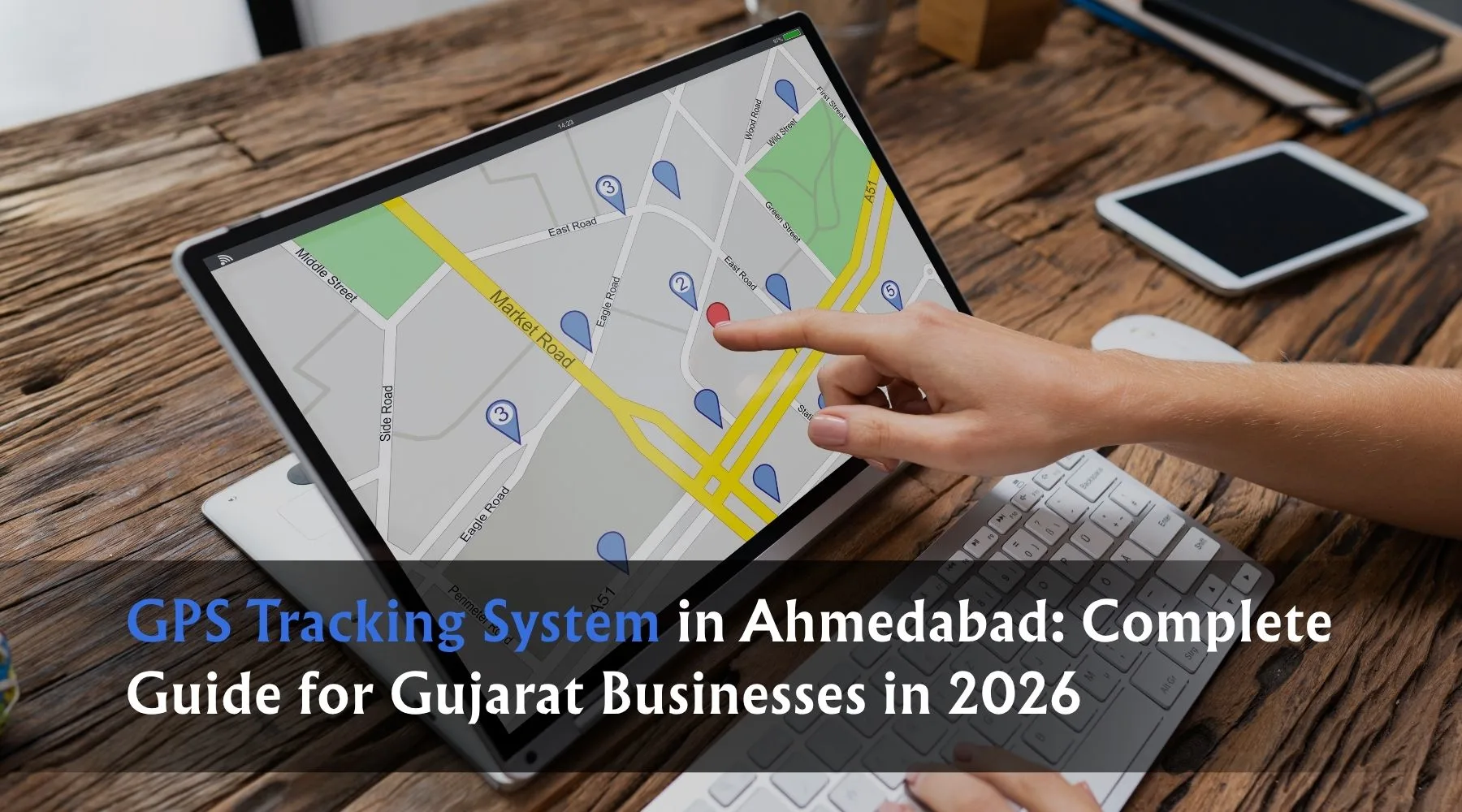
A GPS tracking system uses satellite signals to monitor the real-time location of vehicles, assets, or employees — giving business owners in Ahmedabad instant visibility into where their fleet is, what their field teams are doing, and how efficiently their operations are running. For Gujarat businesses managing commercial vehicles, delivery fleets, construction equipment, or field sales teams, GPS tracking is the operational backbone that reduces fuel costs, improves accountability, and ensures AIS-140 compliance under government regulations.
If you run a business in Ahmedabad — whether it’s a logistics company operating out of Vatva GIDC, a pharma distributor covering Sarkhej-Gandhinagar Highway, a construction firm managing equipment across Sanand or Dholera, or a mid-sized company with a field sales team covering Ahmedabad, Gandhinagar, Surat, and Vadodara — there’s a question that probably crosses your mind more than you’d like.
Where exactly are my vehicles and my people right now?
And if you’re honest about the answer, it’s probably somewhere between “roughly where they said they’d be” and “I’ll find out when there’s a problem.”
Ahmedabad is one of India’s most dynamic business cities. The Gujarat government’s industrial push, the Dholera SIR development, the expanding GIFT City corridor, the growth of textile and chemical manufacturing in Naroda and Odhav — all of this means more vehicles on the roads, more field teams managing more territory, and more operational complexity that traditional management methods simply weren’t designed to handle.
GPS tracking is the technology that brings this complexity under control. And for businesses in Ahmedabad and across Gujarat in 2026, it has become less of an optional upgrade and more of a foundational operational requirement.
This guide explains exactly what GPS tracking covers, which Ahmedabad business sectors need it most, what AIS-140 compliance means for Gujarat vehicle owners, and how to choose the right system for your specific operation.
What Does a GPS Tracking System in Ahmedabad Actually Include?
The term “GPS tracking” covers a range of capabilities. Here is what a complete, modern GPS tracking system for an Ahmedabad business looks like:
Real-Time Vehicle Location Monitoring
Every vehicle in your fleet — trucks moving goods between Ahmedabad and Mumbai on NH48, delivery vans covering Navrangpura and Bodakdev, service vehicles operating across Sarkhej and Prahladnagar — is visible on a live map, updated every 10 to 30 seconds. Location, speed, direction, and current activity are all visible from a single dashboard accessible on any device.
For a fleet manager sitting in Ahmedabad while vehicles are spread across Gujarat or running intercity routes, this real-time visibility replaces dozens of driver phone calls with a live picture that’s always accurate and always available.
Route History and Trip Playback
Every journey is recorded — from ignition on to ignition off. You can replay the exact route any vehicle took, see every stop and its duration, review speed at any point in the journey, and verify whether the actual route matched the planned one. For Ahmedabad businesses dealing with expense claims that don’t match map distances, this feature alone typically pays for the entire system.
Geo-Fencing and Zone Alerts
Define virtual boundaries on a map — around your depot in Vatva, a client’s warehouse in Changodar, a construction site in Sanand, the APMC market area in Jamalpur — and receive instant alerts whenever a vehicle enters or exits those zones. After-hours movement alerts catch unauthorised vehicle usage the moment it happens. Restricted area alerts flag vehicles visiting locations they have no business being at.
Driver Behaviour Monitoring
How your drivers behave on Ahmedabad’s increasingly complex road network — the SG Highway during peak hours, the SP Ring Road, the Sardar Patel Ring Road, the increasingly congested stretches around Iscon Cross Road and Shivranjani — directly affects fuel consumption, vehicle wear, and accident risk.
GPS tracking records harsh braking events, rapid acceleration, over-speeding, and prolonged idling — per driver, per trip, per day. Weekly driver behaviour scores give managers the specific data needed for targeted coaching rather than generic reminders.
Fuel Monitoring and Drain Detection
For commercial vehicles operating in and around Ahmedabad — trucks, tippers, tankers, construction equipment — fuel monitoring via tank-level sensors provides real-time visibility into every fill event and every consumption pattern. Sudden tank level drops while a vehicle is stationary trigger an immediate drain alert. Fill event data is automatically cross-referenced with receipts to detect short-filling at petrol pumps.
In Gujarat’s industrial areas — particularly for vehicles operating at remote GIDC sites in Sanand, Bavla, or Changodar where overnight parking creates theft opportunity — this monitoring capability is particularly valuable.
Field Employee Tracking
For businesses in Ahmedabad managing field sales teams, service technicians, pharmaceutical representatives, or delivery agents across the city and surrounding districts, GPS-integrated field employee tracking verifies attendance from client locations (not from home), tracks task completion in real time, and provides proof of visit documentation that eliminates the guesswork from daily field management.
A pharma company with 30 medical representatives covering hospitals across Ahmedabad, Gandhinagar, Anand, and Nadiad needs to know — with certainty, not estimation — that those visits are happening where and when they’re supposed to.
Why Ahmedabad’s Business Environment Makes GPS Tracking Especially Valuable
Every city has its operational context. Ahmedabad’s is particularly well-suited to the value GPS tracking delivers.
Gujarat’s Manufacturing and Industrial Scale
Gujarat accounts for roughly 18 percent of India’s total exports. Ahmedabad and its surrounding industrial corridors — Changodar, Sanand, Vatva, Naroda, Odhav — are home to thousands of manufacturing units across chemicals, pharmaceuticals, textiles, engineering, and food processing. Every one of these industries runs fleets. Most of them run field teams. All of them have the same pressure to reduce operational costs while maintaining delivery reliability.
GPS tracking deployed across Gujarat’s industrial supply chains has helped businesses cut fuel costs, reduce vehicle downtime, and tighten accountability in ways that calendar-based management simply cannot achieve.
The NH48 and National Highway Corridor Pressure
Ahmedabad sits at the intersection of major national highway corridors — NH48 to Mumbai, NH27 to Rajkot and further west, NH147 toward Gandhinagar. For logistics companies running intercity routes from Ahmedabad, the combination of long-distance exposure, overnight stops, and high-value cargo makes GPS tracking and fuel monitoring not just operationally useful but essential for loss prevention.
The overnight highway stop near Ankleshwar or Surat that results in a fuel drain. The vehicle that deviates to Vadodara on a route that should have stayed on NH48. The driver who claims Ahmedabad-to-Surat distance that doesn’t match the GPS record. These are patterns that GPS tracking catches in Ahmedabad businesses every single week.
The GIFT City and New Business District Growth
Ahmedabad’s expanding corporate geography — GIFT City in Gandhinagar, the SBD around SG Highway, the commercial corridors developing along the Metro route — means more businesses managing field staff across a wider geographic spread than ever before. Field employee tracking that covers Ahmedabad, Gandhinagar, and satellite towns like Kalol and Mehsana in a single dashboard is the operational requirement this growth creates.
The AIS-140 Compliance Requirement in Gujarat
This is the regulatory angle that Ahmedabad and Gujarat business owners cannot afford to ignore.
AIS-140 GPS Tracker in Ahmedabad: What Gujarat Vehicle Owners Need to Know
What is AIS-140? AIS-140 is the Automotive Industry Standard governing the Vehicle Location Tracking (VLT) system specification for vehicles in India. It is a government-mandated standard under the Ministry of Road Transport and Highways, requiring commercial vehicles — buses, taxis, goods vehicles above certain capacities — to be fitted with certified GPS tracking devices that meet specific technical requirements for accuracy, data transmission, panic button functionality, and data sharing with government platforms.
Who needs AIS-140 compliance in Gujarat?
- Commercial buses operating on Gujarat’s state and national routes
- Taxis and app-based cab aggregators operating in Ahmedabad
- Goods vehicles above specified weight categories
- Vehicles operating under government contracts in Gujarat
- School buses operating in Ahmedabad (state-specific requirements)
- Mining and heavy equipment vehicles operating in Gujarat’s mining zones
What are the consequences of non-compliance? Non-compliant vehicles can face fines, permit restrictions, and operational suspensions during transport authority checks. For businesses operating government contracts in Gujarat, AIS-140 compliance is a mandatory requirement for contract renewal.
GPCB-Approved AIS-140 Devices: The Gujarat-Specific Requirement
Gujarat Pollution Control Board (GPCB) has specific requirements for tracking devices used in vehicles operating within Gujarat’s industrial and environmental monitoring frameworks. GPCB-approved AIS-140 devices meet these additional Gujarat-specific requirements — ensuring vehicles operating in industrial estates like Ankleshwar, Hazira, and Vatva remain fully compliant with both central and state-level regulations.
Sahaj GPS provides GPCB-approved AIS-140 compliant devices specifically for Gujarat operations — designed to meet the state’s regulatory requirements alongside the central government’s VLT specifications. For Ahmedabad businesses navigating Gujarat’s compliance landscape, having a tracking provider based in the city — with direct knowledge of local regulatory requirements — is a meaningful operational advantage.
Industries in Ahmedabad That Benefit Most From GPS Tracking
Logistics and Transport Companies
Ahmedabad’s position as Gujarat’s commercial capital makes it a major logistics hub — with freight flows connecting to Mumbai, Delhi, Rajkot, Surat, and international port access via Kandla and Mundra. Logistics companies operating out of Ahmedabad run GPS tracking for route adherence, fuel monitoring, driver behaviour, and delivery confirmation. The savings on a 50-truck fleet typically run into lakhs per month.
Pharmaceutical and Chemical Distribution
Gujarat’s pharma cluster — concentrated around Ahmedabad and Vadodara — generates enormous field force activity. Medical representatives, distribution executives, and service engineers cover territories across Gujarat daily. Field employee tracking with geo-verified attendance and proof of visit is a compliance and management requirement for any serious pharma distributor operating out of Ahmedabad.
Construction and Infrastructure
With Dholera SIR, GIFT City expansion, and ongoing metro and infrastructure projects creating sustained construction activity around Ahmedabad, equipment tracking and fuel monitoring for construction fleets — excavators, dumpers, concrete mixers, compactors — is a high-priority operational need. Remote site fuel theft and equipment misuse are two of the most significant cost drivers in Ahmedabad’s construction sector, and GPS-integrated fuel sensors address both.
FMCG and Consumer Distribution
Ahmedabad’s dense urban geography — from the old city areas of Kalupur and Maninagar to the new commercial zones of Thaltej, Prahlad Nagar, and Science City Road — creates complex, multi-stop FMCG distribution challenges. Route optimisation, delivery confirmation, and real-time field supervisor visibility across 50 to 200 delivery agents are precisely the challenges GPS fleet tracking and field employee systems solve.
School Bus Operations
Ahmedabad’s expanding suburban geography — families living in Bopal, Shela, South Bopal, Makarba, and new residential zones — and the city’s emphasis on school safety make GPS-based school bus tracking with parent notification increasingly standard for reputable Ahmedabad schools. Live tracking, geo-fenced stop alerts, speed monitoring, and SOS buttons for driver and bus attendant are the core requirements.
How to Choose the Right GPS Tracking System for Your Ahmedabad Business
Not all GPS tracking providers are equal. Here is what Ahmedabad business owners should evaluate before selecting a system:
Local support and service availability When a device malfunctions or needs reconfiguration, local support matters. A provider based in Ahmedabad — with a service team that can visit your fleet location, not just respond via email — resolves issues in hours rather than days.
AIS-140 and GPCB compliance For commercial vehicles in Gujarat, confirm that the tracking device is AIS-140 certified and, where required, GPCB-approved. Ask specifically for the certification documentation, not just a verbal confirmation.
Scalability Your fleet today may be 10 vehicles. In two years it may be 50. Confirm that the platform scales without requiring a complete hardware replacement or a new software contract.
Fuel sensor integration If fuel management is a priority — and for most Ahmedabad commercial fleets it should be — confirm that the system supports tank-level sensor integration, not just estimated fuel consumption from OBD data. Sensor-based monitoring is significantly more accurate and catch actual drain events rather than estimating consumption patterns.
Offline data retention For vehicles operating in Gujarat’s industrial sites, rural areas, and highway corridors where connectivity is inconsistent, confirm that the GPS device stores data locally and syncs when connectivity resumes. Data gaps in remote areas create accountability gaps that defeat the purpose of tracking.
Integration with existing systems If you run an ERP, a CRM, or a dispatch management system, check whether the GPS platform offers API integration. Connected data across systems eliminates manual re-entry and creates a more complete operational picture.
What Ahmedabad Businesses Experience in the First 60 Days of GPS Tracking
The pattern is remarkably consistent across business sizes and industries in Ahmedabad.
Week 1 to 2: The first surprise. Fleet managers see actual route histories and compare them against claimed routes. Idle time reports reveal hours of wasted engine time that were invisible in monthly averages. For businesses with fuel sensors, the first drain event alert arrives — often within the first week, confirming a problem that had been suspected but never provable.
Week 3 to 4: Behaviour shifts. Drivers adjust their patterns quickly once they know tracking is active. Idle time drops. Route deviations become less frequent. Expense claims begin to more accurately reflect GPS distance records.
Month 2: The data compounds into decisions. Route planning is adjusted based on actual traffic and timing patterns. Maintenance reminders fire on actual usage data. Driver behaviour scores identify who needs coaching and who deserves recognition. Fuel consumption per kilometre begins declining across the fleet.
Month 3 and beyond: ROI becomes clearly measurable. Most Ahmedabad businesses see total monthly savings — from fuel, maintenance, and operational efficiency — that significantly exceed the cost of the tracking system.
Sahaj GPS in Ahmedabad: Local Expertise, 15 Years of Proven Results
Sahaj GPS operates from SG Highway, Thaltej, Ahmedabad — which means the team that supports your Gujarat fleet is based in the same city, familiar with Ahmedabad’s roads and operational environment, and available for direct, in-person support when you need it.
With over 15 years delivering GPS tracking solutions across India, and specific expertise in AIS-140 compliant and GPCB-approved devices for Gujarat operations, Sahaj GPS brings a combination of technology depth and local knowledge that out-of-city providers simply cannot match.
The platform covers everything Ahmedabad businesses need: live vehicle tracking, fuel monitoring, driver behaviour scoring, geo-fencing, field employee tracking, school bus management, and automated fleet reporting — all in a single unified system, supported by a local team that knows Gujarat’s compliance requirements and operational realities.
Explore GPS Tracking Solutions for Ahmedabad Businesses →
Contact the Ahmedabad Team Directly →
GPS Tracking in Ahmedabad: At a Glance
| Feature | What It Does | Best For in Ahmedabad |
| Real-time vehicle tracking | Live location of all vehicles on one map | Logistics, delivery, construction fleets |
| Fuel sensor monitoring | Actual tank level, drain alerts, fill verification | Highway fleets, construction equipment, GIDC operations |
| Driver behaviour scoring | Harsh events, speeding, idle time per driver | Any fleet with multiple drivers |
| Geo-fencing | Zone entry/exit alerts, after-hours movement | Depot security, site monitoring |
| AIS-140 compliance | Government-mandated VLT for commercial vehicles | Buses, taxis, goods vehicles in Gujarat |
| GPCB-approved devices | Gujarat-specific regulatory compliance | Industrial vehicles in Gujarat GIDC zones |
| Field employee tracking | GPS-verified attendance, task management, proof of visit | Pharma reps, FMCG distributors, service teams |
| School bus tracking | Live tracking, parent alerts, SOS button | Schools in Ahmedabad and surrounding areas |
Frequently Asked Questions
Q1. Is GPS tracking mandatory for commercial vehicles in Ahmedabad?
Yes — AIS-140 compliant GPS tracking is mandatory for most commercial vehicles under Ministry of Road Transport guidelines, including buses, taxis, and goods vehicles above specified categories. Gujarat has additional GPCB-specific requirements for vehicles operating in industrial zones. Sahaj GPS provides AIS-140 certified and GPCB-approved devices that meet both central and state compliance requirements.
Q2. How much does a GPS tracking system cost for an Ahmedabad fleet?
Device and installation costs vary by hardware type and vehicle category. Monthly software and connectivity charges typically range from ₹300 to ₹800 per vehicle depending on the feature set required. For most Ahmedabad fleets of 10 or more vehicles, the total monitoring cost is recovered within the first month through fuel savings and operational improvements alone.
Q3. Can GPS tracking work for both vehicles and field employees in Ahmedabad?
Yes — Sahaj GPS offers a unified platform that tracks both commercial vehicles and field employees from the same dashboard. Vehicle tracking uses GPS devices installed in the vehicle, while field employee tracking uses a mobile app with GPS verification. Both streams of data are visible in one platform, giving Ahmedabad businesses a complete operational picture.
Q4. Does GPS tracking work in Ahmedabad’s industrial areas like Vatva and Naroda where connectivity can be inconsistent?
Yes — Sahaj GPS devices store location and event data locally when mobile connectivity is unavailable and automatically sync when the connection is restored. No data gaps are created by connectivity variations in industrial or semi-urban areas around Ahmedabad.
Q5. How quickly can GPS tracking be installed and activated for an Ahmedabad fleet?
For most Ahmedabad fleets, device installation and platform activation can be completed within one to two days. Sahaj GPS’s Ahmedabad-based team handles installation across the city and surrounding areas. Most businesses have their first full day of live tracking data within 48 hours of confirming the order.