
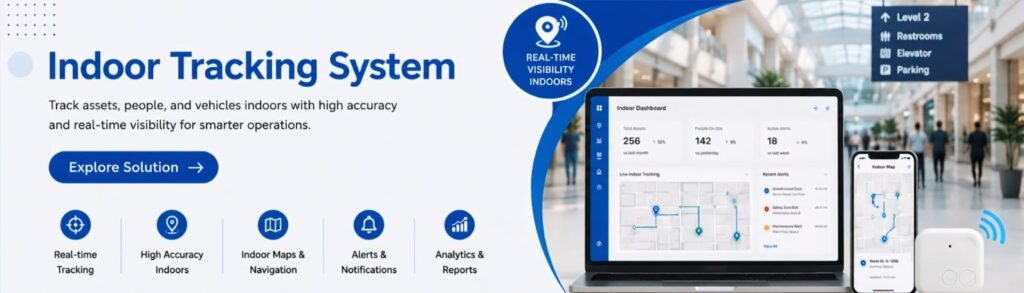
Indoor tracking systems allow businesses to monitor the location and movement of assets inside facilities in real time. By using technologies such as RFID, BLE, Wi-Fi, and UWB, organisations can reduce equipment loss, improve inventory accuracy, optimise asset utilisation, and make faster operational decisions based on live data.
Have you ever noticed how much time employees spend looking for equipment instead of actually using it? In busy warehouses, hospitals, manufacturing plants, and corporate facilities, valuable tools and assets are constantly moved from one place to another. When their exact location isn’t known, even a small delay can affect productivity, increase operational costs, and interrupt daily workflows.
This is one of the biggest reasons businesses are moving toward indoor tracking systems. Rather than relying on manual registers or periodic inventory checks, companies can monitor assets continuously, giving teams instant access to accurate location information whenever it’s needed.
What Is an Indoor Tracking System?
An indoor tracking system is a location-based technology that monitors assets inside enclosed environments where traditional GPS signals are unreliable. It helps organisations identify where equipment is located, how frequently it is used, and when it moves between different areas of a facility.
Depending on business requirements, indoor tracking solutions may use technologies such as RFID tags, Bluetooth Low Energy (BLE), Wi-Fi positioning, Ultra-Wideband (UWB), or IoT sensors. These technologies work together to provide accurate location data while improving visibility across warehouses, hospitals, factories, offices, retail stores, and other indoor environments.
Why Indoor Asset Tracking Is Becoming More Important
As organisations expand, the number of physical assets also increases. Managing equipment manually becomes increasingly difficult, especially when multiple departments share the same resources. Employees often spend unnecessary time searching for tools, inventory records become outdated, and businesses sometimes purchase duplicate equipment simply because existing assets cannot be located.
Indoor tracking systems eliminate much of this uncertainty by providing continuous visibility into asset movement. Instead of searching for equipment, employees can locate it instantly, improving both productivity and operational efficiency.
Real-Time Visibility Improves Daily Operations
One of the greatest advantages of indoor tracking is complete visibility into asset locations at any time. Managers and employees can instantly identify where equipment is located, review movement history, and understand whether an asset is currently available or in use.
This immediate access to information reduces delays across departments and allows teams to complete their work without wasting valuable time searching for equipment. In environments where every minute matters, better visibility directly supports faster operations.
Reducing Asset Loss and Unnecessary Purchases
Assets are not always lost because they are stolen. In many cases, they are simply misplaced, transferred between departments without proper documentation, or left unused in unexpected locations.
Indoor tracking systems maintain continuous records of asset movement, making misplaced equipment much easier to locate. Businesses also receive alerts whenever valuable assets move outside authorised zones, improving security while reducing replacement costs.
Accurate visibility into existing assets also helps organisations avoid purchasing equipment they already own but cannot easily locate.
Better Inventory Management
Inventory management becomes much more reliable when stock movement is tracked automatically. Instead of relying on periodic stock counts, businesses receive live information about inventory availability, storage locations, and asset movement.
This reduces human error while helping organisations maintain accurate inventory records, improve stock planning, and avoid both shortages and unnecessary overstocking.
Improved Asset Utilisation
Many organisations are surprised to discover that some of their equipment is rarely used while other assets remain in constant demand. Without reliable usage information, making informed purchasing decisions becomes difficult.
Indoor tracking systems provide detailed utilisation data that helps managers identify underused assets, balance equipment allocation across departments, and maximise the value of existing resources before investing in additional purchases.
Maintenance Tracking Helps Extend Asset Life
Every business depends on equipment that performs reliably. However, when maintenance schedules are managed manually, servicing is often delayed or overlooked, increasing the chances of unexpected breakdowns and expensive repairs.
An indoor tracking system maintains detailed records of asset usage and movement, making it easier to schedule preventive maintenance at the right time. Managers can monitor usage patterns, review service history, and ensure equipment receives timely attention. This proactive approach extends asset life, reduces downtime, and keeps daily operations running smoothly.
Business Analytics Support Better Decisions
Location data becomes far more valuable when it is transformed into meaningful business insights. Indoor tracking systems collect information continuously, allowing organisations to understand how assets are being used across different departments and facilities.
Managers can identify heavily used equipment, underutilised assets, movement trends, and storage patterns. These insights support better planning, improve resource allocation, and help businesses make informed investment decisions based on actual operational data rather than assumptions.
Increased Productivity Across the Workforce
Employees often lose valuable working hours searching for equipment, checking inventory manually, or coordinating with different departments to locate required assets. These small delays accumulate over time and reduce overall productivity.
With an indoor tracking system, equipment locations are available instantly through a central dashboard. Employees spend less time searching and more time completing their assigned work, allowing departments to operate more efficiently while improving overall workflow.
Better Safety and Regulatory Compliance
Many industries operate under strict safety and compliance requirements, particularly healthcare, manufacturing, pharmaceuticals, and logistics. Keeping accurate records of equipment usage and maintenance is essential for meeting these standards.
Indoor tracking systems automatically record asset movement, maintenance activities, and operational history, making audits and inspections much easier. Businesses can also monitor equipment located in restricted areas, helping improve workplace safety and maintain better operational control.
Choosing the Right Indoor Tracking Solution
Every organisation has different operational requirements, so selecting the right indoor tracking solution depends on several factors. Businesses should evaluate the size of their facility, the level of tracking accuracy required, the type of assets being monitored, and compatibility with existing business systems.
Scalability is equally important. A flexible solution should allow businesses to expand tracking capabilities as operations grow without requiring major infrastructure changes. Ease of implementation, reporting features, and ongoing technical support should also be considered before making a decision.
Final Thoughts
Managing assets efficiently has become an essential part of improving operational performance. As businesses continue to grow, manual asset management often creates delays, increases operational costs, and reduces overall productivity.
An indoor tracking system gives organisations complete visibility into their assets while improving inventory management, maintenance planning, workplace efficiency, and operational control. By using accurate real-time data, businesses can reduce losses, optimise resources, and build a more productive working environment.
Frequently Asked Questions
What is an indoor tracking system?
An indoor tracking system is a technology solution that monitors the location and movement of assets, inventory, or equipment inside buildings using technologies such as RFID, BLE, Wi-Fi, or UWB.
How does indoor tracking improve asset management?
It provides real-time asset visibility, reduces search time, improves inventory accuracy, supports maintenance planning, and helps businesses utilise their resources more efficiently.
Which industries benefit from indoor tracking systems?
Industries including healthcare, warehousing, manufacturing, logistics, retail, hospitality, education, and corporate facilities use indoor tracking systems to improve operational efficiency.
Can indoor tracking systems reduce operational costs?
Yes. By reducing asset loss, improving equipment utilisation, lowering manual labour, preventing duplicate purchases, and supporting preventive maintenance, businesses can achieve significant long-term cost savings.
Is indoor tracking suitable for businesses of all sizes?
Yes. Indoor tracking solutions are scalable and can be implemented by both small businesses and large enterprises depending on their operational requirements.